More PET bottles are getting a second life in S-E Asia as capacity, demand grow
Coca-Cola’s sustainability director lifts the lid on its activities to get the region’s PET recycling capacity up to speed

Wong Pei Ting
BEVERAGE giant Coca-Cola has spent more than five years looking into building capacity for the collection and recycling of polyethylene terephthalate (PET) bottles in South-east Asia. But, even now, the region continues to be a pet peeve for the group.
Unlike other plastics, PET is not single-use, and can be remade into new bottles. In this part of the world, however, a lot of PET waste is picked up and collected by people who are not officially in charge of sorting out such bottles.
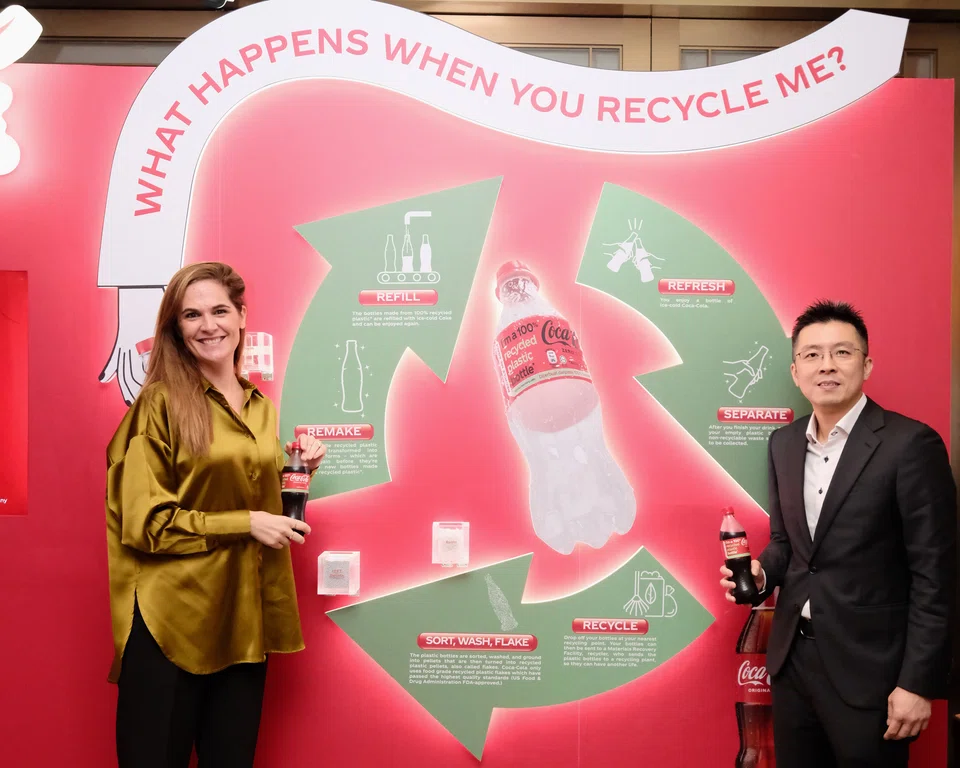
The word for the resultant state of affairs is “chaotic”, Kirsten van Zandwijk, the director of sustainability and partnerships for Asean and South Pacific at The Coca-Cola Company, told The Business Times.
As PET bottles get mixed up with other waste, the recyclable material often ends up in landfills and many remote parts, where it becomes irretrievable instead.
It does not help that some governments do not yet have well-designed legislation to manage waste effectively.
This creates another problem. Without a steady feedstock of sorted bottles here, it has been a challenge to build PET recycling capacity that can generate enough recycled bottles to support the region’s demand for soft drinks.
Making it real
After fighting some of these battles in the region, Coca-Cola was finally able to claim some victories, including bringing 100 per cent recycled plastic bottles to the Singapore market for the first time from last October.
This adds to the growing list of more than 40 countries where it offers at least one brand in these 100 per cent recycled plastic bottles. Other South-east Asian countries where it has already rolled out such products include Myanmar, Indonesia, Vietnam and Thailand.
The results are part of a wider push by The Coca-Cola Company to make 100 per cent of its primary consumer packaging recyclable globally by 2025, and use at least 50 per cent recycled content in its packaging by 2030 globally.
Moving forward, van Zandwijk revealed that the company will be making strategic investments to boost recycling capacity, unlock new supplies of recycled plastic and scale new technologies through joint ventures and long-term supplier agreements.
The urgency to get these going, especially in South-east Asia, comes as demand for recycled PET plastic for food-grade applications currently exceeds supply, she said.
Much of it stems from the company needing to do much more to hit its 2030 target. As at 2022, only 15 per cent of the PET bottles it uses to package its drinks are made with recycled PET.
“We have seen our system partners and suppliers announce significant investments in recent years to boost global recycled PET infrastructure,” she added.
“We expect many more investments to come online in the coming years, which will change the recycled PET landscape, particularly in Asia.”
Already, in Indonesia, the number of facilities that can generate food-grade resin from recycled PET has grown from one to three since Coca-Cola started intensifying its sustainable packaging activities in the country from 2018.
Three more are in the pipeline, so at least six of such facilities would be up and running in Indonesia in three years’ time, Triyono Prijosoesilo, the public affairs and communication director at Coca-Cola Indonesia, told BT.
Creating circular loops
How the company was able to get to this point was quite the journey, though.
When the company launched its World Without Waste programme in 2018, it was making commitments “without having all the answers in place locally”, van Zandwijk said.
It was only when it started drawing out country-based plans to make that happen that it quickly realised the massive scale of the work that is required in Asia: in many places, the infrastructure to do so was lacking, even non-existent.
Across Indonesia, for instance, there was only one company that could produce food-grade recycled resin.
In any case, these recycling facilities would require used PET bottles for the idea of circularity to take off, and securing this supply pipeline was another challenge.
The company could have imported PET waste, but soon discovered that it was not a viable option, for Indonesia at least. “There’s a lot of pushback from the government in terms of, ‘Why are you importing plastic waste?’,” Prijosoesilo said.
The focus then turned to strengthening its collection capabilities in Indonesia, which would require partnering with waste collectors across the country to collect as many PET bottles as possible, regardless of the brand, he noted.
Different strokes
The work did not end at partnership. It has sometimes resulted in Coca-Cola building some of these recycling capabilities themselves to speed things up a little.
This happened for Indonesia, where it plunged into a joint venture with Dynapack Asia under Coca-Cola Europacific Partners to build a recycling facility with a food-grade recycled plastic output.
Opened in February last year, the 556.2 billion Indonesian rupiah (S$47 million) facility – Amandina Bumi Nusantara – can produce up to 25,000 tonnes of recycled PET a year.
It takes different approaches in different markets, though, depending on what “makes sense”. Therefore, it did not have to do such direct investments in Malaysia, where some recycling facilities were present and suffering from poor demand for their services, Prijosoesilo noted.
As for Singapore, bottles collected under its existing programme with SembWaste, which is one of Singapore’s three public waste collectors, will be processed in the neighbouring Malaysian state of Johor.
But, after all that is said, van Zandwijk stressed that this entire effort is “not philanthropy”, and cost efficiency is very much top of mind.
“Our big objective is to create circularity solutions with the mainstream audience in mind. Coca-Cola is a product for everyone. It’s not a luxury product whatsoever,” she said.