

Singapore companies grapple with reporting carbon emissions from value chain: study
This comes as ‘Scope 3’ disclosures will soon be mandatory for listed companies

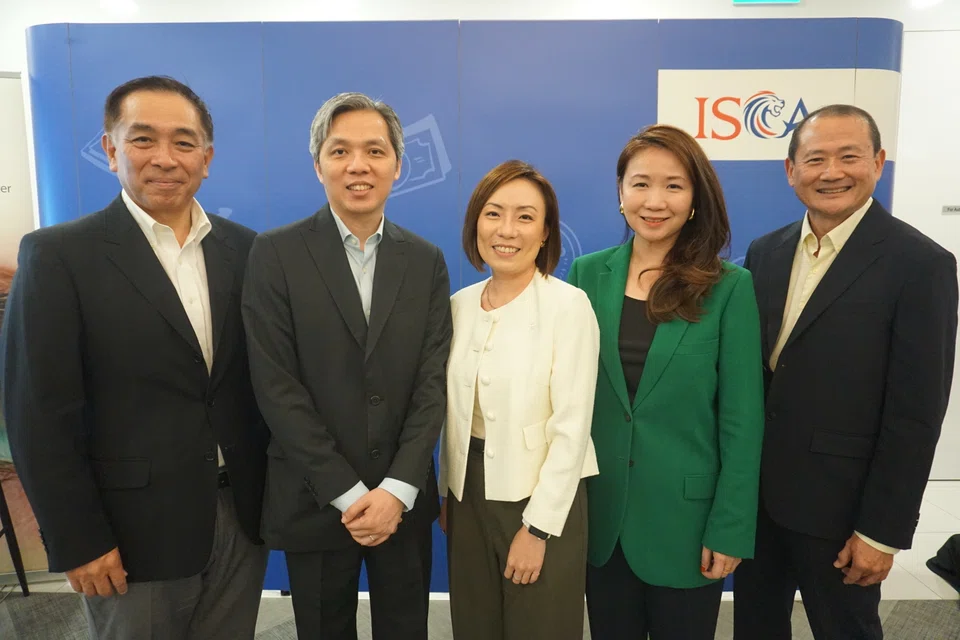
MOST Singapore companies are not fully measuring the carbon emissions associated with their value chains, and many business leaders lack a good understanding of this metric, known as “Scope 3” emissions, a study has found.
This is affecting these companies’ readiness for sustainability reporting, said the study by the Institute of Singapore Chartered Accountants (Isca) and energy-management company Schneider Electric on Tuesday (Jul 2).
Singapore is making it compulsory for listed companies to disclose their Scope 3 emissions from their 2026 financial year; large non-listed companies are potentially set to follow no earlier than FY2029. This means, for example, that a Singapore-listed construction company would have to report emissions from the manufacture and transport of cement, and from product disposal when a building is torn down. Scope 3 also covers emissions from employees’ commute and business travel.
Of the over 500 senior business leaders interviewed for the study, only 6 per cent said their organisation fully measured and analysed Scope 3 emissions.
And only 39 per cent of the leaders felt that they had a strong grasp of Scope 3 emissions – even though such emissions typically make up over 70 per cent of a company’s carbon footprint.
Yoon Young Kim, cluster president of Schneider Electric Singapore and Brunei, said: “Scope 3 presents the next frontier of emissions management, and still (is) unchartered territory for many organisations in Singapore.”
A lack of understanding of emissions leads to “a lower level of planning, target setting and ultimately action”, he added.
Measurement uncertainty
Many companies are more familiar with measuring their carbon footprint under two other categories – Scope 1 emissions, which arise directly from the company’s activities, and Scope 2, which covers indirect emissions from power usage. Slightly over half the business leaders surveyed said their companies measured Scope 1; 30 per cent measured Scope 2 emissions. With Scope 3, companies face “measurement uncertainty”, said Fang Eu-Lin, sustainability and climate change practice leader at PwC Singapore.
In the best-case scenario, a company would be able to get direct emissions data from its suppliers. But such instances are “few and far between”, said Fang, who spoke at a panel after the launch of the study. Many companies instead have to use mathematical formulae to calculate Scope 3 emissions, based on business-activity data.
Scope 3 emissions are also less understood beyond the top rungs of management. While 58 per cent of board members and 51 per cent of C-level executives said they had strong knowledge of Scope 3, only 27 per cent of senior managers reported the same, the study found.
Another panellist, Singtel’s vice-president for group sustainability Andrew Buay, flagged this as a concern and called for Scope 3 emissions to be understood among individuals beyond the leadership.
“You can’t run away from the rest of the organisation – the middle and more junior levels – fully understanding Scope 3. That’s where execution happens, measurement happens and decisions get taken, in terms of implementation – and that finally helps to reduce Scope 3 emissions,” he noted.
Low confidence in targets
The study also suggested a low level of confidence about achieving Scope 3 targets. Only 27 per cent of executives believed their companies’ Scope 3 targets to be highly achievable, compared to 40 per cent for Scope 1, and 31 per cent for Scope 2 targets. Leaders from smaller businesses were also less likely to set targets for Scope 3. Only 31 per cent had done so – compared with 54 per cent for larger companies.
Kelyn Tan, head of corporate sustainability at UOB, suggested that small and medium-sized enterprises (SMEs) can get started with “engagement targets” for Scope 3, under which they begin conversations with supply chain stakeholders and customers on emissions.
“For example, employees’ commute. We all know it’s very difficult to track this. So (it’s) about the education of our internal employees, encouraging them to think about how they can commute to work more sustainably. From there... work on employee surveys, (and) know how to calculate all this emissions data,” she said.
Despite the challenges of Scope 3, Singapore businesses are making efforts to learn more about the topic. The study showed that three-quarters of business leaders (76 per cent) reported having completed feasibility studies to understand their organisation’s readiness to measure, report, and manage its Scope 3 emissions.
Kang Wai Geat, divisional director for professional standards at Isca, said that accountants will have a key role to play in reporting such metrics. “Sustainability is a megatrend that is reshaping the accountancy profession. Increasingly, organisations are turning to the accountancy profession for sustainability reporting and assurance,” he added.
“To take full advantage of the opportunity to help organisations advance their emissions’ agenda, accountants must upskill and reskill to keep up with the latest developments in sustainability.”
TRENDING NOW

Grab CEO’s wife Chloe Tong on life with Anthony Tan and finding her purpose
Number of listed companies an ‘outdated metric’ of Singapore market’s success: SGX chairman
UOB found ‘grossly negligent’ over Stamford Land rights issue advice, to pay S$1.9 million
Oil climbs after Trump denies he is willing to ease sanctions on Iran

