

Nature-based solutions critical to S-E Asia’s adaptation to global warming
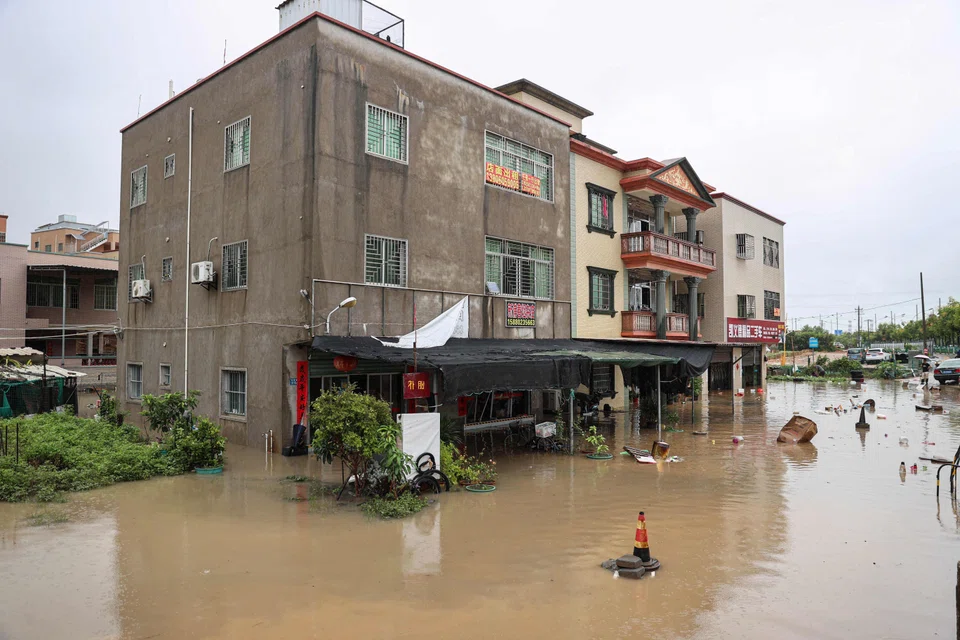
FLOODS, droughts and chronic heat are the most pressing areas in which South-east Asian countries must prioritise adaptation investments, sustainability professionals told The Business Times.
While companies need to address their physical risk exposure, greater onus is on governments to implement system-wide policy changes that integrate climate resilience into urban planning and economic development, the observers said. The effectiveness of nature-based solutions, in particular, should not be underestimated.
Those comments came in the wake of the Paris Agreement’s first “Global Stocktake” synthesis report, which showed that adaptation efforts are not keeping pace with increasing climate impacts and risks. The report will play a key role in the upcoming United Nations Climate Conference in Dubai, which begins in late November, as negotiators contemplate the future of their climate commitments.
Adaptation measures
Lubo Varbanov, managing director and head of public sector solutions for Asia-Pacific at Swiss Re, said historical estimates show that Asia has suffered the highest flood-related economic losses. Between 2011 and 2020, economic losses from flood events averaged almost US$30 billion annually.
Neha Bhatia, partner for environmental, social and governance (ESG) and sustainable finance at consultancy ERM, also pointed out that there have been studies that estimate rising sea levels might slash between 45 per cent and 50 per cent of South-east Asia’s total gross domestic product over the next 50 years in the worst-case scenario.
Beyond coastal defences such as levees and sea walls, as well as flood retention areas, the preservation of coral reefs and mangrove swamps along coastlines are also among the most effective climate adaptation measures, a number of observers said.
Noting that nature-based solutions are not only cost-effective, but also help to drive carbon sequestration and support biodiversity well-being, Alain Mahieu and Amy Steel, climate risk experts at Engie Impact, said that policymakers should focus first on preserving and restoring the ecosystems.
With a better understanding and valuation of the Earth’s natural ecosystems, businesses will also be better able to incorporate these resources into their decision-making, such as ensuring that there are sufficient climate resilience considerations through the environmental impact assessments of new development projects, they added.
Frameworks such as the Taskforce on Nature-related Financial Disclosures help to evaluate nature and biodiversity and contextualise the financial impact that businesses will feel should these resources not be managed.
Hence, beyond governments, private entities also have a vested interest in investing in the conservation of these ecosystems as it protects their assets, said Christopher Au, director of Willis Tower Watson’s Asia-Pacific climate and resilience hub.
“(We’ve) been getting these ecosystem services for free. So it’s basically payment for ecosystem services, but through the lens of disaster risk,” he added.
Echoing similar sentiments, Varbanov said that one action all companies can take is to consider nature as an insurable asset or service and understand the dependencies in the value chain, which means that it should be protected and insured like any other item of value.
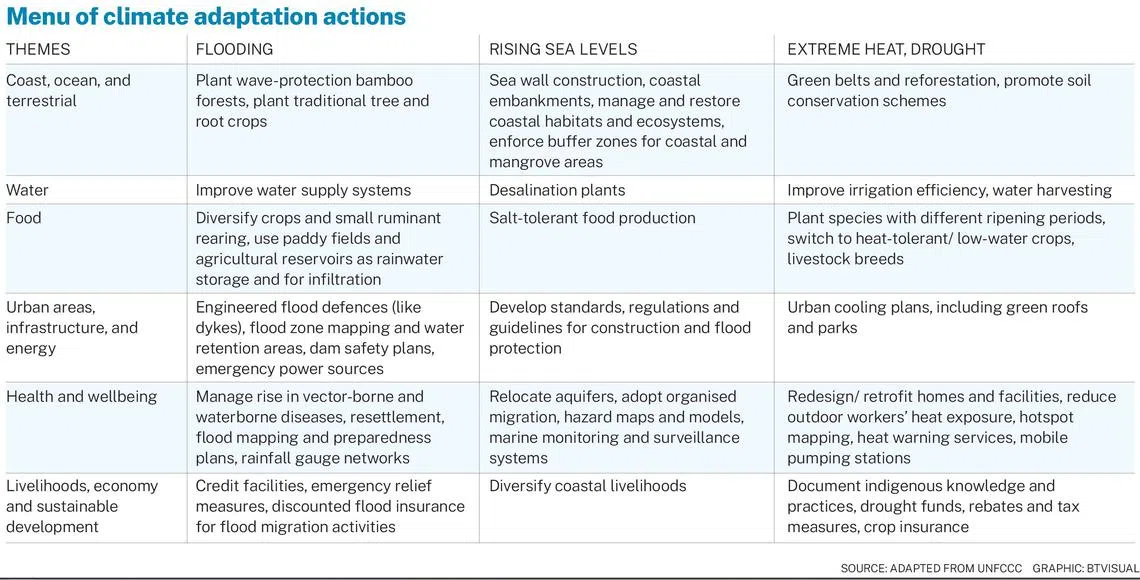
Besides guarding against flood risk, Bhatia also pointed out that South-east Asia is extremely prone to chronic heat and humidity.
In the context of a region that is urbanising rapidly, the combined impact of rising temperatures, humidity levels and flash floods could also mean that the spread of diseases will be more intense. Hence, there is also a need to invest in healthcare systems that are able to not only put in place preventative measures, but also control the spread of disease.
Adapting existing infrastructure to be more earthquake-resilient and employing appropriate construction methods in earthquake-prone areas are also important, said Tobias Grimm, head of climate advisory and natural catastrophe data at Munich Re.
While there are some risk areas that are more urgent, observers also noted that adaptation measures have to take on a system-wide approach, unlike mitigation. Hence, it is not possible to just focus resources into one or two areas and neglect the others.
Given limited fiscal space and competition for adaptation needs, Olivia Jensen, deputy director for Lloyd’s Register Foundation Institute for the Public Understanding of Risk at the National University of Singapore, said the priority for policymakers in South-east Asia should be to implement “no-regrets” measures.
For example, she said that single-use grey infrastructure projects such as flood walls should be lower down the priority list. Climate-resilient developments should not only be able to absorb and retain rainwater to reduce flooding, but also act as an additional water resource to better withstand periods of drought.
Investments in these measures would generate benefits in all possible climate futures, and also maximise co-benefits for other development objectives.
Policy measures
Implementing these adaptation measures requires governments to undertake system-wide changes where climate resilience is integrated at every aspect of policymaking.
One critical area is in urban planning, where governments should start thinking about the impacts of sea-level rises and heat stress on zoning, public transport design, and the distribution of hospitals, for example, said Willis Tower Watson’s Au.
This also means that, in areas that have extremely high exposure to hazards, new developments should be prevented from being built, and existing developments should not be rebuilt, said Grimm.
Building codes and insurance regulations also need to start adopting a greater focus on climate resilience and risk transparency. This could mean regulations mandating the use of certain construction methods that embed flood risk resilience, or insurance cover for vulnerable regions, said Bhatia.
Governments can consider transferring risk to the private sector through insurance, said Varbanov.
“Advance allocation of budgets towards risk mitigation and insurance negates the need to raise funds afterwards to manage the impacts of an event, which can take time and further negatively impact affected communities,” he added.
Observers also noted a need for more public-private partnerships to drive improvements in risk-sharing and the allocation of investments.
The public sector has to see itself as a facilitator that develops a baseline of core infrastructure projects, policies and frameworks, which allows the private sector to enter at a lower risk, said Bhatia.
Sharad Somani, partner and head of KPMG ESG at KPMG in Singapore, suggested that tax incentives and grants could be provided for critical showcase projects, on top of adaptation research, investment and implementation of facility collaborations.
However, there remain challenges in ramping up adaptation measures. One reason is simply because it is harder to see the benefits of climate adaptation, compared with mitigation where there are visible reductions to carbon emission levels.
In addition, the complex and interrelated nature of climate-related risks complicates the task of prioritising adaptation initiatives. Multiple stakeholders may have different views of the trade-offs involved in adaptation plans, said Mahieu and Steel.
To identify the best solutions, policymakers need to understand how the complex array of hazards will impact the particular communities, economies and ecosystems, and determine criteria for assigning higher importance to specific areas, they added.
Unlike developed markets in certain parts of the United States, where regular forest fires have led to insurers not willing to insure properties in these fire-prone areas, Au said that South-east Asia still has a chance of not locking itself into this cycle.
The region still has the opportunity to improve the balance between economic development in the short-term and ensuring long-term resilience to climate change, said Mahieu and Steel.
Governments in South-east Asia need to “start thinking holistically around climate risk and opportunities, and start embedding it into every single policy and plan that they have,” said Bhatia.
“If you fail to recognise that, the cost of not getting it right is way too much... There is just no future without investments in adaptation,” she added.
TRENDING NOW

Despite the de-dollarisation debate, demand for dollar liquidity in Asia is growing

He built the Vingroup empire. Now South-east Asia’s richest man is handing some key roles to his sons
Malaysian developer Eco World tops bids for Sin Ming area housing plot with S$1,612 psf ppr offer

As China trust-tax deadline looms, wealthy clients explore options across Asia

