

Olam Food Ingredients well-placed to cushion tariff impact on food prices, says CSO
Its wide sourcing footprint allows it to offer alternatives to food manufacturers, from countries that are not hit as hard by tariffs

[NEW YORK] The food ingredients arm of agribusiness giant Olam is well-positioned to mitigate the impact of rising food prices caused by US tariffs on end-consumers, said its chief sustainability officer Roel van Poppel.
“We believe that our global sourcing footprint and combination of multiple origins and destination production facilities help us at least to mitigate that potential disruption,” he told The Business Times in an interview, on the sidelines of Climate Week in New York City.
He noted that as the Olam Food Ingredients (ofi) value chain spans more than 60 countries, it can find alternatives for the food manufacturers that it supplies, reconfiguring supply chains to involve source countries that face lower tariff rates.
However, the impact is harder to avoid for ingredients where major producers face high duties, or for food manufacturers that prefer not to diversify their sources.
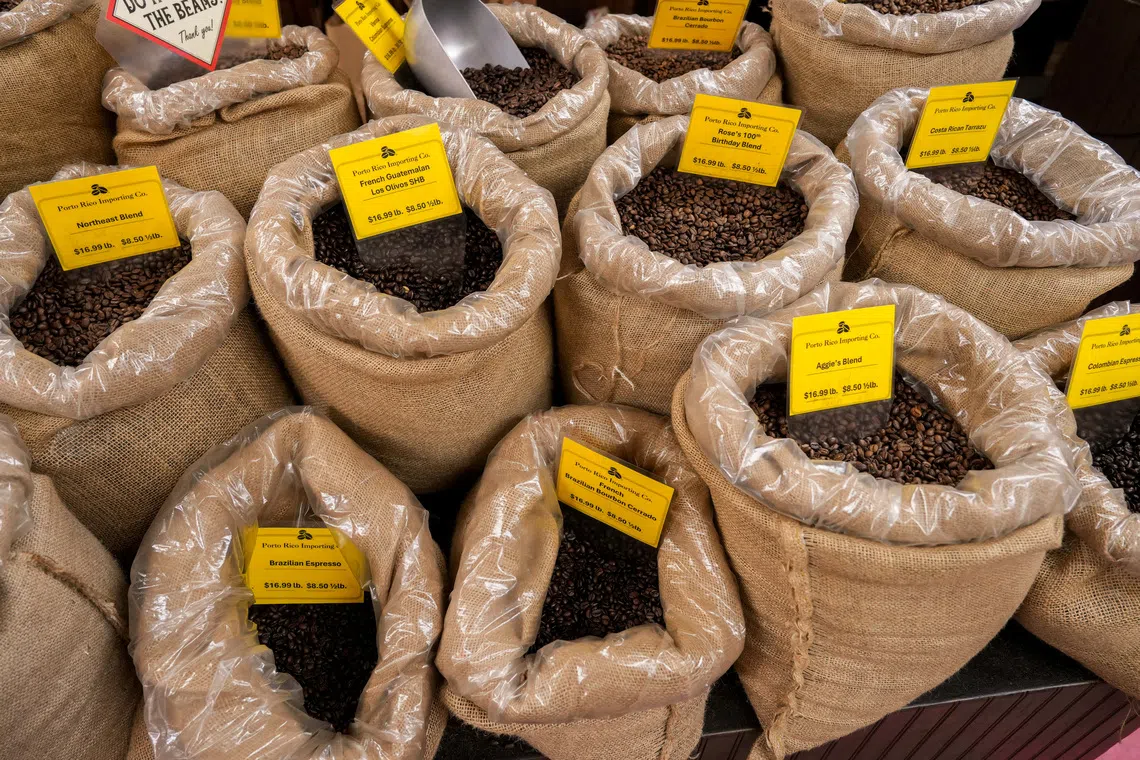
For example, Brazil and Vietnam are the world’s two largest exporters of coffee beans – and both face high tariffs from the United States, at 50 per cent and 20 per cent, respectively.
Ofi is active in the supply and distribution of five major food ingredients – cocoa, coffee, spices, nuts and dairy – with the US as one of its major buyers.
“Certain tariffs really negatively impact certain countries that are origins of key products,” said van Poppel.
“We’re monitoring the commentary around those tariffs, and we’re also looking at what the real implications are, but we know that food projects will be subject to tariffs,” he added, referring to activities such as sourcing or processing food.
“So we are worried about how we can continue to make coffee affordable for customers anywhere in the world.”
He added: “We would not applaud any major barriers, like a tariff, to add a cost that is not justifiable. And at the end of the day, it doesn’t come at the benefit of those who need it most, which in our case is the smallholder farmer.”
Farmers’ resilience
Nonetheless, even while ofi makes short-term adjustments to supply chains in response to economic headwinds, the company remains undeterred when it comes to its long-term sustainability goals, said van Poppel.
It has identified four areas where it faces material risks and set targets for them. These are farmer prosperity, safeguarding human rights in its communities, climate action, and regenerating the living world.
Among its 2030 goals, ofi aims to provide enhanced livelihood support to one million farmer households within its supply chain, and enable 200,000 of them to earn a living income.
The company runs more than 130 multi-stakeholder programmes across its supply chain, working with customers, local governments, non-profits and farmer communities towards specific impact targets.
Van Poppel noted that these are multi-year programmes which will not yield concrete results within just two or three months. They include training to improve crop yield and quality, as well as “regenerative agriculture”, which refers to farming practices that restore and enhance soil health, biodiversity, water cycles and ecosystem resilience.
“(In our sustainability strategy), we always start with farmer livelihood and farm resilience. Because if that’s not in place, then the risk of serious infringements on the other side is increasing,” he said.
“If a farmer cannot provide for his family, doesn’t have a livelihood, cannot earn a living income, the risk of human rights issues is higher. The risk of a farmer encroaching into forests is higher. The risk of a farmer overdosing pesticides to maximise short-term yield is higher.”
He added: “No matter what’s happening in the world outside, we need to stay very close to that first mile, because that’s where the biggest risks exist, that’s where the biggest impact is to be created.”
While political moods and governments can change, ofi’s sustainability strategy involves making sure that the supply of food ingredients remains a resilient business, he said.
Level playing field
Yet, even as end-consumers indicate that they increasingly want sustainable and traceable food, there are signals that they may not be willing to pay the price, noted van Poppel.
This is where policymakers have to come in and provide a level playing field, by requiring food supplies to meet sustainability criteria, he said. One example might be that no deforestation should take place in food supply chains.
“If you’re looking at short-term prices, it is fair to say that more regenerative, more sustainable (food supplies) might not be cheaper. But in the longer term, it helps to create that resilience to keep products affordable for consumers, which is a difficult message to explain,” he added.
“I do think that regulation can help set that level playing field. It can help make sure that... companies that want to cut corners cannot do that, and it also rewards those companies that are taking sustainability seriously and really have that long-term view.”
TRENDING NOW

Singapore identifies 7 firms responsible for haze fires, notices issued urging action: Grace Fu

Could stablecoins be the future of money?

Singapore should prepare for prolonged haze until November, says Grace Fu

High Court rules against Julius Baer’s Singapore trust arm in US$50 million family trust dispute

