Order book shows methanol’s sure rise as a marine fuel
Onboard carbon capture and nuclear propulsion are also cost-competitive under some conditions, says DNV

Wong Pei Ting
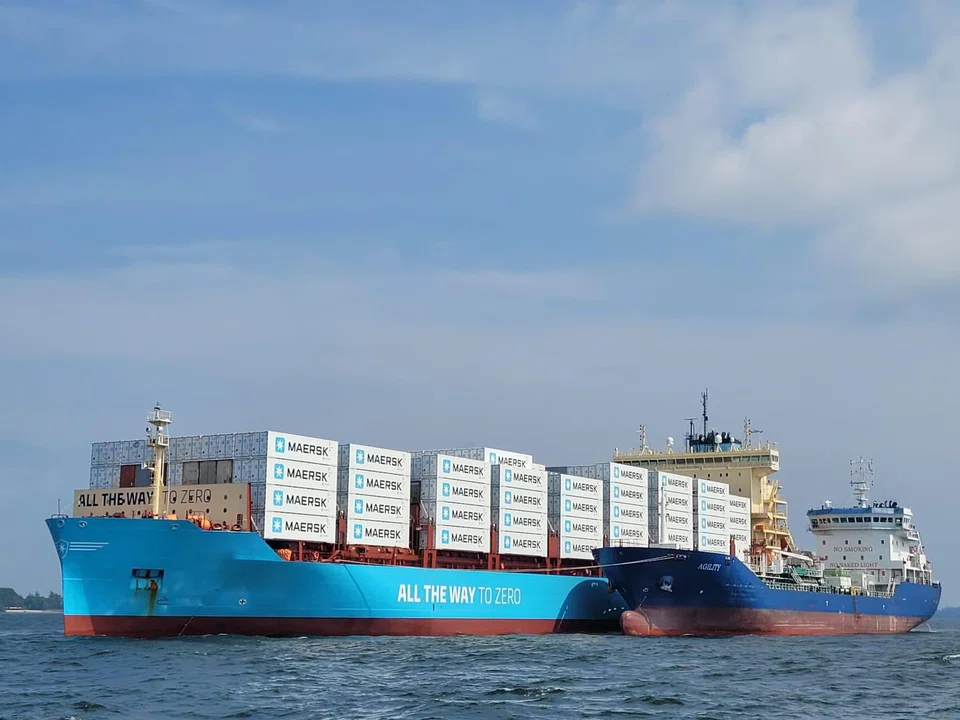
IT COULD be a matter of months before methanol lodges its place as the world’s third-most used marine fuel, after liquefied natural gas (LNG) and conventional fuel oils, according to a new report. This is even as Singapore is still ironing out details for methanol to be bunkered safely here.
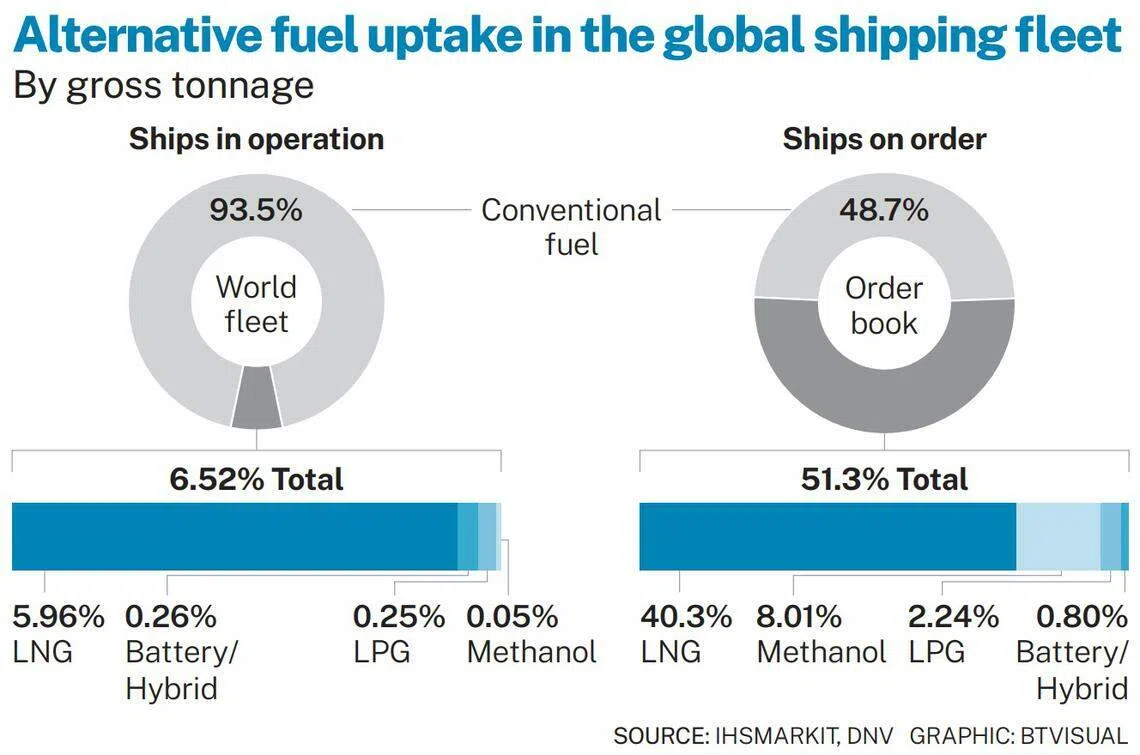
Norwegian ship certifier DNV’s latest energy-transition outlook noted that the order book for ships capable of using methanol as fuel is 20 times the gross tonnage of methanol-fuelled ships currently in operation.
This will push the uptake of methanol to 8 per cent, from 0.05 per cent currently, once the ships are delivered.
The report was released just as Singapore completed its first ship-to-ship methanol bunkering operation on Jul 27. Bunkering refers to the act of refuelling a marine vessel, which can be done from vessel to vessel or in a port.
When announcing the successful fuel transfer, the Maritime and Port Authority (MPA) had said it was working with the Standards Development Organisation at the Singapore Chemical Industry Council to issue a technical reference on the operational and safety requirements for methanol bunkering.
Methanol can cut carbon dioxide emissions by up to 95 per cent when produced from renewable electricity. In the event of a leak, however, the highly flammable fuel may form plume clouds that could lead to a fire or an explosion.
The maritime industry has been slow to transit to alternative fuels. Last year, 94.5 per cent of ships by gross tonnage operated on conventional fuels. This number shrunk by 1 percentage point this year.
According to DNV’s analysis, LNG use will rise to 40.3 per cent by the time methanol use ticks up to 8 per cent. LNG use is currently at 6 per cent. This means it won’t be long before more than half of ships by tonnage run on cleaner-burning fuels.
Much has been said about ammonia-fuelled ships coming into play. Ammonia is a suitable transport medium for green hydrogen, which is touted to have a big part to play in greening the power grid.
DNV noted, however, that while several demonstration projects for ammonia-fuelled ships are ongoing, there are no ammonia-fuelled ships in the official order book. Suitable energy converter technologies are still a few years away, it said.
The lack of prescriptive rules and regulations for handling ammonia – assessed to be far more toxic than methanol – also make it hard to plan for its implementation on board, it pointed out.
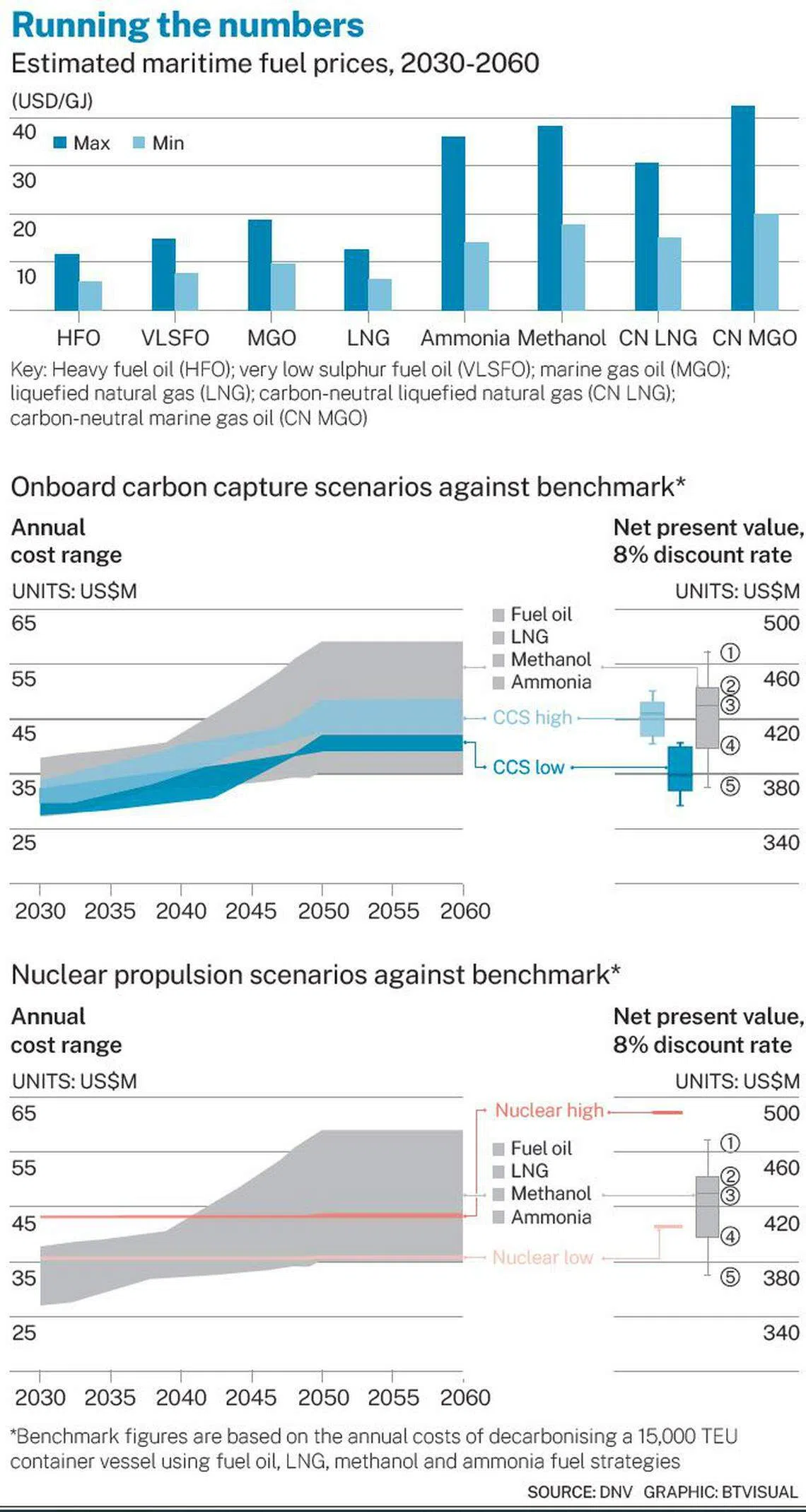
Carbon capture and storage (CCS) – capturing carbon from exhaust gases – and nuclear propulsion are other solutions to decarbonise the maritime industry. DNV explored the cost feasibility of these as well, seeing that there won’t be enough carbon-neutral fuels to go around come 2030, given increased demand from aviation, road transportation and other heavy industries.
Its findings suggested an economic case for onboard CCS in the case of a 15,000 20-foot-equivalent unit deep-sea container vessel – if carbon dioxide deposit costs are low, at US$40 per tonne, and fuel penalty is low, at 15 per cent. Fuel penalty refers to the additional energy used to capture carbon dioxide.
Under these assumptions, CCS would be cheaper than three-quarters of fuel oil, LNG, methanol and ammonia strategies. The latter options are expected to become more expensive towards 2050, when the greenhouse gas trajectory requires an increasing share of carbon-neutral versions of these fuels.
Even under a less-optimistic scenario – a 30 per cent fuel penalty, and a carbon dioxide deposit cost of US$80 a tonne – CCS costs would come in at the middle range, DNV found.
Nuclear propulsion can compete with other strategies if reactor costs are in the lower range of historical capital expenditure for land-based nuclear power plants, it added.
Nuclear’s very first hurdle would be to pass the claim as a green fuel, though.
At DNV’s Singapore Energy Transition Conference on Sep 4, Dr Sanjay Kuttan, chief technology officer of Global Centre for Maritime Decarbonisation, said a mindset change is needed before floating modular reactors can be counted towards green energy production.
Fellow panellist Andrew Hoare, global head of shipping and marine projects at Australia’s Fortescue Energy, said the debate risks pulling resources away from renewable energy towards nuclear energy.
Remarking that ship nuclearisation is still “some way off” and “so untested”, he said: “I would not want to see the pink debate eclipsing what we’re trying to do on the renewable side, because I think it could be very dangerous, or stop us acting today.”
MPA’s assistant chief executive for industry and transformation Kenneth Lim said a hurdle is in figuring out where to locate nuclear energy infrastructure: “Should I put it in Ang Mo Kio, or East Coast? If it is floating, should I put it in East Coast, or West Coast?”