Private credit for real estate boosting green building premium
Commercial banks are trying to reduce their exposure to commercial real estate


PREMIUMS are piling on for greener or climate-adapted buildings, as private credit funds swoop in to refinance floundering commercial real estate (CRE).
Industry players said the private credit industry is focused on risks from climate change, such as flooding and rising temperatures, and seeking out best-in-class buildings that are energy efficient or have lower emissions.
The CRE market has been in a bad place for some months, particularly in the United States and Europe, as offices emptied out by the pandemic refused to fill up again.
Commercial banks are trying to reduce their CRE exposure, and many owners are being pushed to refinance.
These conditions are creating opportunities for private credit funds with a focus on real estate, many of which believe the sector is nearing the bottom of a cycle.
“(We have recently seen) the sharpest and fastest correction in capital values on record. This creates a very interesting opportunity,” said Martin Barnewell, an investment director specialising in commercial real estate debt at fund manager abrdn.
He believes, however, that property values have stabilised.
“We are towards the bottom of the valuation cycle,” Barnewell said, adding that the fund always likes “lending after a decline”.
The important thing in such an environment is to be “disciplined and selective”. Abrdn only puts credit behind buildings in good locations, with best-in-class transport links, in-demand amenities and best-in-class sustainability credentials.

The company also looks at physical risks, such as floods, to avoid the danger of being stuck with stranded assets.
Vinamra Srivastava, the chief sustainability and sustainable investments officer at real estate investment manager CapitaLand Investment (CLI), echoed this perspective.
He said his team also looks at the sustainability policies and practices adopted by the borrower, “including its past track record and future ESG plans and targets”.
Their comments line up with findings from a Knight Frank Research survey of more than 600 private bankers, wealth advisers, intermediaries and family offices.
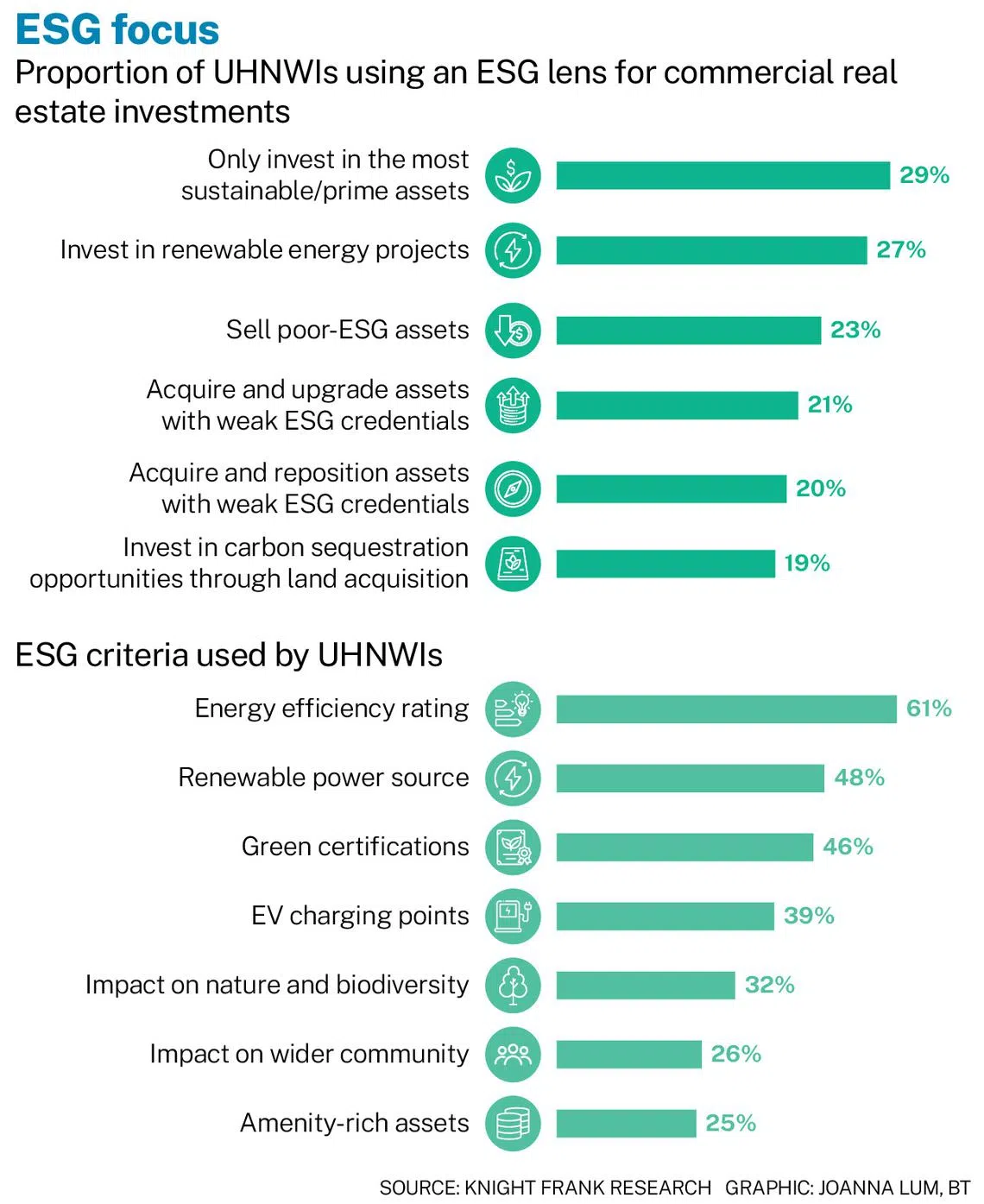
“Green credit is an investment trend that fits the bill for both institutional and ultra-high-net-worth individuals. Everyone wants to invest sustainably,” said Christine Li, Asia-Pacific head of research at Knight Frank. “If you have a green initiative, then there’s no lack of funding.”
The result of this preference is a “massive bifurcation” in buildings, particularly in markets where vacancy rates are on the high side.
Hong Kong is a classic case, Li added. “Landlords are really looking for ESG credentials to attract demand from occupiers.”
Many tenants that have made net-zero ESG commitments are also growing more aggressive in their building selection, and some have a 2030 deadline to meet.
“From the real estate perspective, that is just one or two leasing terms,” Li said.
Choosy tenants and choosy financiers are combining to create a green premium for buildings, she added, “both in the rental sense as well as the price sense”.

A study of the London, Sydney and Melbourne markets, for instance, found a green rental premium of between 5 and 12 per cent. The sales premium was almost 19 per cent.
Singapore – and many other parts of Asia, for that matter – is still in the early stages of the green building revolution.
Vacancy rates are relatively low in Singapore, which means tenants cannot afford to be picky. There is also a smaller supply of green buildings, and a bigger gap in the implementation of ESG principles.
“The difference in investment attitudes between the European Union and Asia generally reflect the regulatory differences between the regions,” said Julie Townsend, ESG lead for Europe and Asia-Pacific at manager PGIM Real Estate.
EU regulators are focused on disclosures by managers, Townsend said, such as the adverse impacts or effects of investment decisions. In Asia, regulators are more concerned with risk management. In Hong Kong, regulators have narrowed the focus to just climate-related risks.
CLI’s Srivastava believes Asia is “rapidly catching up”, though.

“As the Asia private credit market matures, we are witnessing widespread involvement of European and North American institutional investors, and increasing participation by global private equity sponsors and private lenders,” he said.
“This global participation is prompting debt funds to quickly familiarise themselves with ESG considerations.”