

Recent oil spill could raise Singapore maritime sector costs as industry ponders risk mitigation moves
Risk reduction measures could take the form of deploying more tugboats around bunker barges

COSTS for the shipping and maritime sector in Singapore could go up following the recent oil spill, as the industry assesses if further risk mitigation measures are needed to prevent another similar disaster.
These are some of the medium and longer-term economic impacts of the oil spill on the shipping and maritime sector, analysts and observers told The Business Times.
There could also be implications on the wider economy in the future, but they said that the immediate economic hit on Singapore is limited, as the authorities responded to the oil spill quickly, leaving little room for reputational damage. Government agencies also gave an assurance that port operations and fish farms remain largely unaffected, at least in the near-term.
Stephanie Groen, partner for coastal and marine in Asia at sustainability consultancy ERM, said that these risk reduction measures could involve having more thorough emergency response plans, lengthening the time vessels take for the berthing process, or deploying more tugboats around bunker barges. Bunkering could also be limited to only certain locations, which would create logistical challenges for the fuelling and refuelling of vessels.
All these point to higher compliance and operational costs for companies in the shipping and maritime sector, especially if the Singapore government enacts tighter regulations on such risk reduction measures, she added. Insurance premiums could also rise.
Such safety measures are even more crucial as the industry is looking towards using hydrogen and ammonia-powered ships as part of its decarbonisation plans. In the event of a collision, hydrogen and ammonia are potentially more deadly and toxic than fossil fuels.
“Regardless of what fuel a vessel is using, or is retrofitting to use in the future, it doesn’t reduce the risk of a collision... So what can be done to mitigate or to reduce the risk of a collision with a bunker fuel barge? Is there an opportunity to reduce those risks whether it is carrying crude oil, liquefied natural gas, or ammonia or other stuff in the future? The risk will remain the same,” said Groen.
Professor Lynn Loo, chief executive officer of the Global Centre for Maritime Decarbonisation, said that existing emergency response plans for oil and chemical spills are insufficient if an ammonia-powered vessel is involved in a collision as the chemical in its aqueous form is corrosive and toxic to human and animal life.
These emergency response plans, however, can serve as a valuable foundation for developing ammonia spill handling procedures in the future as the sector decarbonises.
Unfortunately, accidents such as oil spills could diminish support and resources needed for the sector to weather the necessary green transition, said Stephen Beng, head of ESG (environmental, social and governance) strategy at Phillip Capital Management.
“Significant financial losses from accidents come with a cost to the industry’s reputation and (its) social licence to operate,” he added.
This could mean the sector having to face more stringent sustainability targets when seeking financing from banks.
Andy Yap, partner for Singapore’s finance industry at ERM, said that banks may want to start considering incorporating oil spills as part of the list of key performance indicators (KPI) and targets tied to sustainability-linked loans.
Currently, only workplace accidents relating to workers’ health and safety have been included as social KPIs in sustainability-linked loans, which is a type of debt instrument that allows the borrower to enjoy lower interest rates if they meet a predetermined set of targets.
On Jun 14, a Netherlands-flagged dredger Vox Maxima collided with Singapore-flagged bunker vessel Marine Honour at Pasir Panjang Terminal, causing a rupture in one of the vessel’s oil cargo tanks and releasing about 400 tonnes of low-sulphur fuel into the sea.
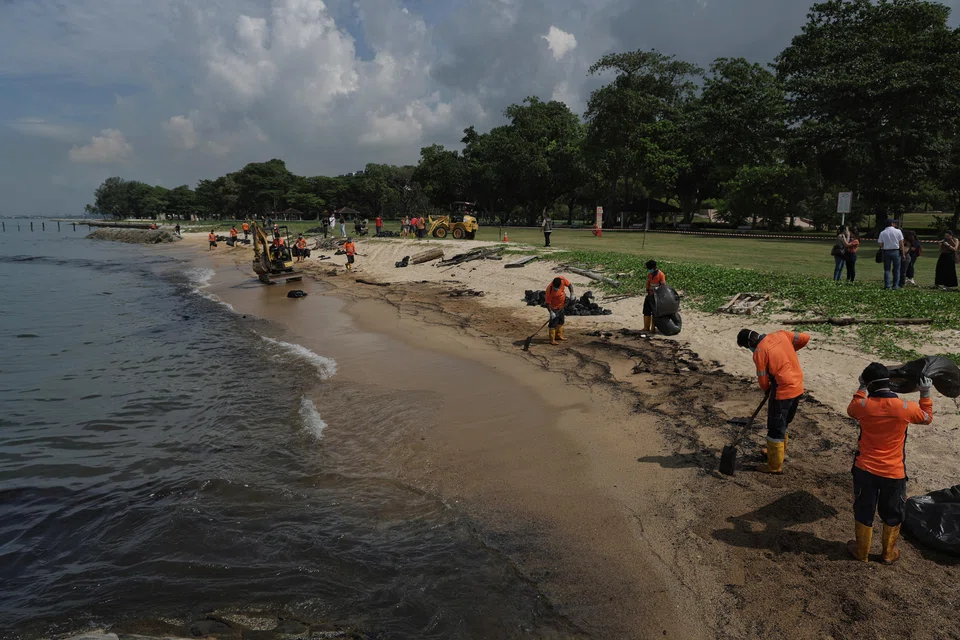
Over the last week, beaches around Singapore have been closed amid cleanup efforts, as the oil had washed up along Singapore’s southern coastline and was sighted as far east as the Changi area.
Aquaculture and maritime habitat impacted
Besides the maritime and shipping sector, the local aquaculture may also be affected. While the Singapore Food Agency has said that local fish are safe for consumption, whether consumers have the confidence to buy them is another question.
Fandy Suradji, partner for remediation at ERM, said that consumers may think twice when buying fish sourced from Singapore, which could lead to potential losses in revenue for the local aquaculture industry.
Already, Malaysian newspapers have reported that fishermen have not been able to sell their catch in the market, while some 200 of them have not been able to go out to sea for days.
There may also be long-term impact on habitat degradation and the reproduction abilities of the various species of the affected areas, said Kamal Seth, director for climate and sustainability at WWF-Singapore.
“If the oil particles are broken down, they are sinking to the floor, how will it affect the corals, how will it affect the species around the coastal areas? That still needs monitoring and evaluation,” he added.
Based on past oil spill incidents, generations of wildlife were affected and it can take decades for ecosystems to recover.
The other unknown is the long-term impact on Singapore’s mangroves, which are huge carbon capture ecosystems surpassing those of primary and secondary rainforests in South-east Asia, Seth pointed out.
Beyond the sectors affected directly by the oil spill, Seth said that the Singapore government needs to look at future projects on the southern coast from the lens of this disaster. This includes plans to designate a second marine park at Lazarus Island, as well as the Long IsIand project, which involves reclaiming three new tracts of land at a higher level as a form of coastal defence against rising sea levels.
Ultimately, companies that rely on the ocean to do business need to be much more aware of their dependencies on nature, and integrate planetary boundaries into their business plans and practices, said analysts.
“They’re using the area, they are always in touch with nature and with the ecosystem. They need to take that a lot more into account in what they are doing right now, going forward,” Groen said.
The negative externalities of shipping and many other industries that contribute to the blue economy need to be mitigated, or be borne by the polluters – be it through a carbon tax or pollution fines, said Beng.
“Sustainability is about planetary sustainability, not just business sustainability, because we need a healthy planet to continue providing the ecosystem services we rely on to feed both our people and profits in every way,” he added.






