

Renewable energy imports are a more efficient and faster way to get to net zero
These will probably be the most efficient of the low-carbon energy options that Singapore plans to utilise in the decarbonisation of its power sector

SINGAPORE’S plan to import renewable energy may be insufficiently ambitious, a recent study found. Increasing the share of imported energy in the renewable mix will not be easy, however, and may not even be desirable.
The lack of a regional power grid in South-east Asia poses practical challenges, while economic and energy security must also be considered.
Energy think tank Ember Climate suggested that Singapore needs to import 8.1 gigawatts (GW) of renewable energy by 2035 in order for its power sector emissions pathway to be aligned with the International Energy Agency’s (IEA) net zero scenario.
The city-state’s plan, the Energy 2050 Committee Report indicated, is to import 4 GW by 2035 – a target that will be achieved based on various signed cross-border electricity contracts.
Ember Climate also estimated that Singapore will need to invest between US$51 billion and US$100 billion to develop solar and wind power plants in neighbouring South-east Asian countries by 2035.
“By setting more ambitious renewable import policies, Singapore has an opportunity to secure its energy future by reducing reliance on gas, and reach its climate targets sooner,” Ember Climate’s report said.
Professor Subodh Mhaisalkar, executive director of the Energy Research Institute at the Nanyang Technological University, said such investment sums are within the reach of the country.
After all, Singapore spent over S$72 billion between 2020 and 2022 to address challenges brought about by the Covid-19 pandemic, Prof Mhaisalkar said.
The climate crisis, if unaddressed, will bring about equally challenging conditions. “From a cost perspective, investing in renewables will provide significant climate and health returns; and the technologies are mature,” he added.
Renewable energy imports will probably be the most efficient of the low-carbon energy options that Singapore plans to utilise in the decarbonisation of its power sector, Prof Mhaisalkar said.
He estimated that imports from solar, wind and hydro-powered facilities in the region have an energy efficiency of at least 85 per cent.
In contrast, hydrogen – which has been identified by the government as having the potential to supply up to half of Singapore’s power needs by 2050 – only has a net energy efficiency of less than 30 per cent.
In addition, as the major shift to hydrogen in the power mix is expected to occur only after 2035, imports would still be the most cost-effective method in the next 10 years for Singapore to stay on course with its decarbonisation goals, said Mats de Ronde, a member of the Sustainable Energy Association of Singapore (SEAS).
The actual pace of Singapore’s energy transition will depend on the rate at which hydrogen is introduced to the country, said de Ronde, who is also team lead for energy markets and strategy at advisory company DNV.
“Should hydrogen begin to replace a portion of the natural gas prior to 2035, an alternative pathway to achieve the targets becomes viable,” he added.
Growing imports
The Energy Market Authority has set a target for the power sector – which contributes about 40 per cent of Singapore’s total emissions – to achieve net zero emissions by 2050.
It aims to reach this target by growing domestic solar capacity; importing clean energy; and developing other low-carbon alternatives, particularly hydrogen.
Renewable energy imports are expected to make up around 30 per cent of Singapore’s project energy supply by 2035.
The country has already secured this necessary capacity through four cross-border electricity contracts with its neighbours.
In June 2022, Singapore received its first clean energy import of 100 megawatts (MW) of renewable hydropower from Laos.
More imports will come through tie-ups with Indonesia, for 2 GW of electricity; Cambodia, for 1 GW of electricity; and Vietnam, for 1.2 GW of electricity.
Ember Climate believes Singapore can – and should – go further, given it has the “financial muscle to fuel Asia’s energy transition”.
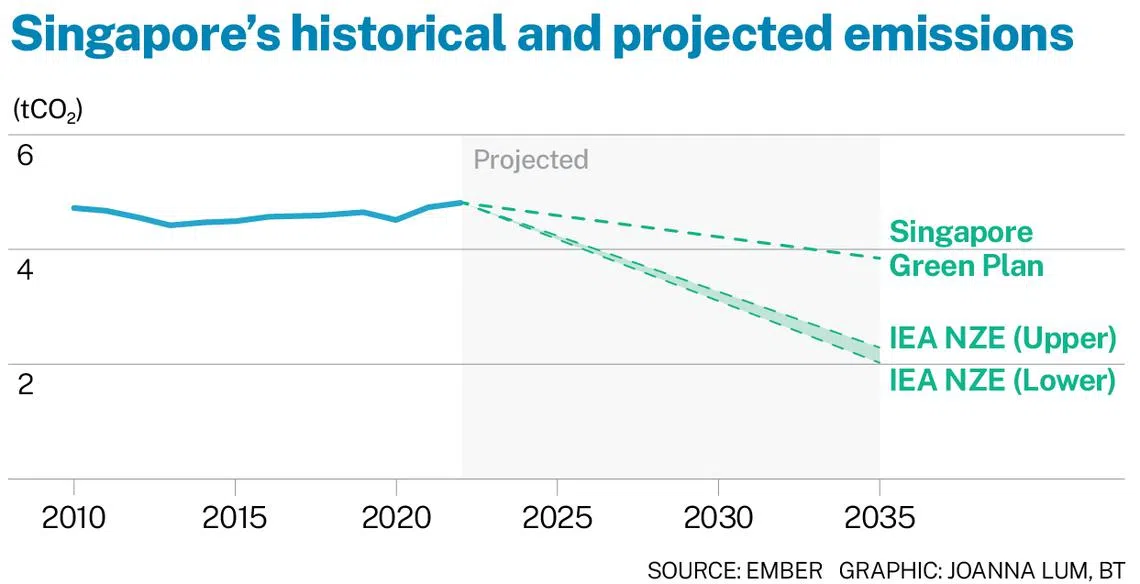
It calculated that by doubling renewable energy imports, Singapore’s per-capita emissions for its power sector would be cut by between 52 and 58 per cent by 2035. This is more than double the 20 per cent estimated decline under existing government plans.
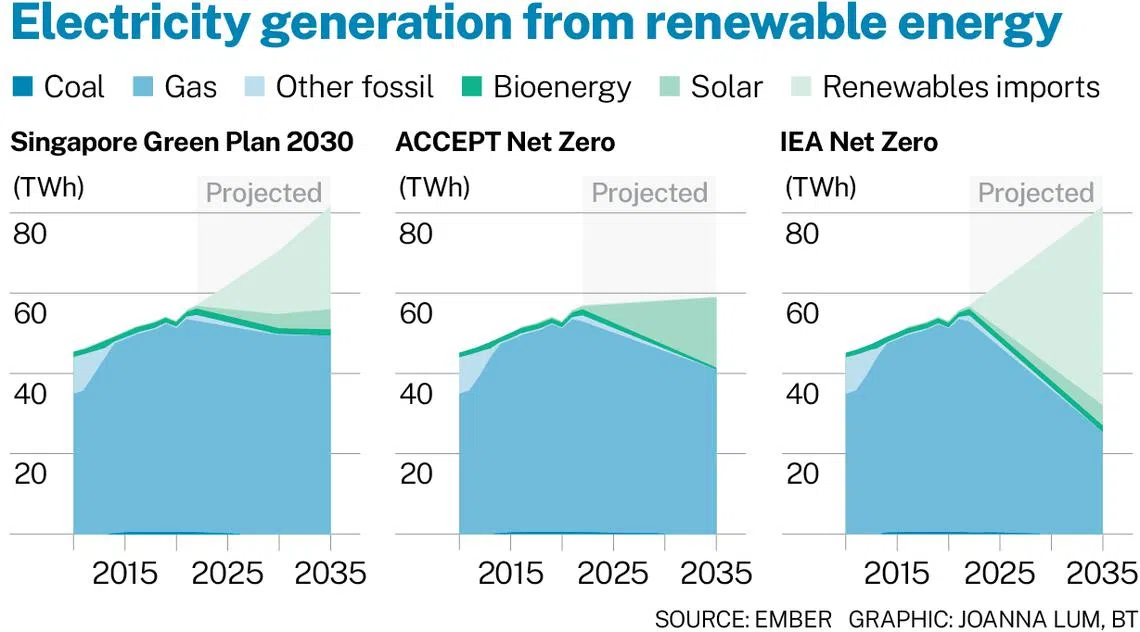
For Singapore’s power sector to align with the IEA’s net zero scenario, Ember Climate said, the share of unabated fossil fuel in the country’s power mix should decline to less than a third of electricity generation by 2035.
The share of renewable energy imports, meanwhile, should go up to 61 per cent – double the current target set by the government.
Checking feasibility
But not everyone believes such aggressive targets are feasible or desirable.
Dr Victor Nian, chief executive officer of the Centre for Strategic Energy and Resources, said that it would be “close to impossible to stockpile electricity in the same way we stockpile fossil fuels as an economic and energy security measure”.
The necessary infrastructure to share and trade power is also underdeveloped.
“In the absence of a regional trading framework and the evolving geopolitical dynamics, we need to be realistic in import project developments,” added Dr Nian.
Ember Climate’s report, too, said establishing grid interconnection in South-east Asia will be necessary for Singapore to grow its renewable energy imports.
De Ronde of SEAS said the lack of commitment and certainty from governments is a major roadblock in setting up a regional power grid. Setting up a task force with sufficient authority to see the project through is an urgent step.
While Singapore has started building renewables abroad and connecting them to its own grid, it will be more beneficial in the long run to directly connect the networks of the countries and start trading with each other, instead of just importing energy, he added.
TRENDING NOW
World’s largest offshore wind platform by Seatrium consortium on track to be completed by 2028

Is stamp collecting enjoying an analogue revival or are its best days over?

GovTech retrenches another 38 staff in second round of layoffs
MBS adjusted property Ebitda falls 20.6% in Q3 with fewer high-roller visits, weaker hold

