Singapore bets on ‘giant batteries’ as it guns for clean energy imports

As the development of the Asean Power Grid ramps up, interest in energy storage systems is ‘accelerating’

Summarise
Sharanya Pillai
Published Mon, Oct 13, 2025 · 07:00 AM
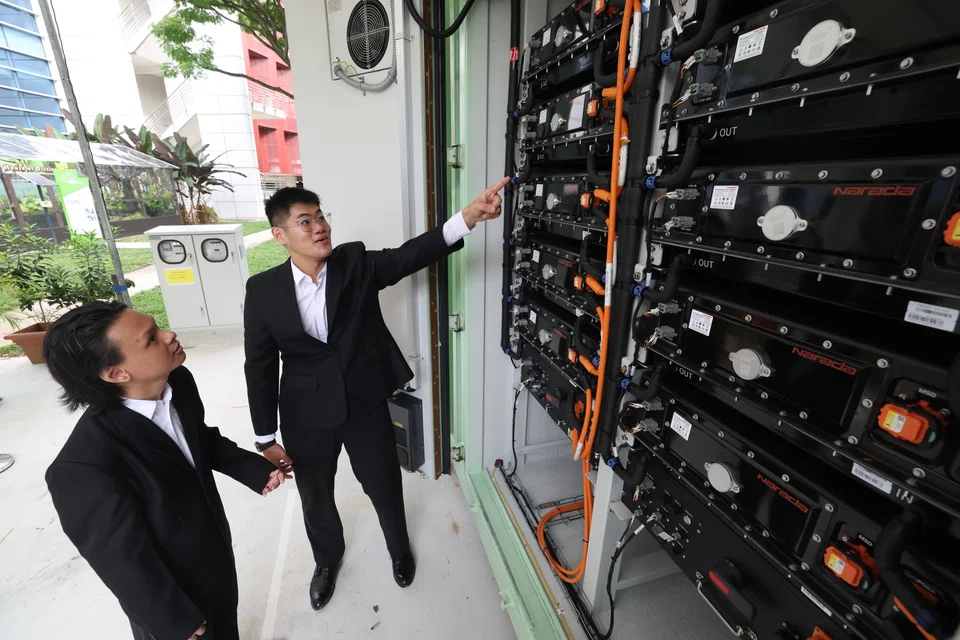
    • Green Tenaga's ESS installed at ITE College East. The Institute of Technical Education has teamed up with Green Tenaga and Narada Asia Pacific to co-develop specialised training programmes in energy storage.
    • Green Tenaga's ESS installed at ITE College East. The Institute of Technical Education has teamed up with Green Tenaga and Narada Asia Pacific to co-develop specialised training programmes in energy storage. PHOTO: CMG

    [SINGAPORE] Energy storage systems (ESS) and batteries will be vital as Singapore and its neighbours work towards building the Asean Power Grid, creating fresh investment opportunities for the sector, the Republic’s energy regulator and industry players told The Business Times.

    The Asean Power Grid refers to the region’s effort to build interconnections for the trade of energy, especially clean sources such as solar and wind power.

    Singapore aims to import around six gigawatts (GW) of low-carbon electricity by 2035, which will meet around one-third of its energy demand then. The city-state currently generates 95 per cent of its electricity from imported natural gas.


    It has thus far awarded conditional licences and approvals for 7.35 GW worth of clean power import projects from Indonesia, Vietnam, Cambodia and Australia.

    Such clean energy trade is vital for the region to meet net-zero goals. But there is also a threat to grid stability as solar and wind power are intermittent, meaning that their output can vary drastically according to weather conditions.

    The solution thus lies in ESS, which “act like giant batteries that can store and discharge energy when required”, said Violet Chen, director of the energy capabilities development department at the Energy Market Authority (EMA).

    “As we work towards enhancing regional energy connectivity through the Asean Power Grid, large-scale ESS deployment will be essential to manage the variability and intermittency of imported renewable energy.”

    “Large-scale ESS deployment will be essential to manage the variability and intermittency of imported renewable energy,” says Violet Chen of the Energy Market Authority. PHOTO: EMA

    Such systems will “be critical to efforts in scaling up cross-border electricity trading by providing fast backup in the event of any unplanned interconnector outages or supply disruptions, ensuring stability of power supply”, she added.

    This is because ESS “can quickly send power into the grid to regulate second-to-second fluctuations, managing sudden imbalances in electricity supply and demand”, Chen noted.

    ESS deployment in Singapore has been growing. For instance, renewables player Sembcorp Industries in 2023 opened a two-hectare ESS facility on Jurong Island with more than 800 large-scale battery units. The facility can meet the electricity needs of 24,000 four-room HDB households for one day, with a single discharge.

    Kavita Gandhi, executive director at the Sustainable Energy Association of Singapore (Seas), believes that the development of the Asean Power Grid is “a very big business opportunity” for member companies, with plenty of potential to scale up ESS.

    In a recent survey by Seas of 105 energy professionals in South-east Asia, 65.7 per cent of respondents cited ESS and batteries as the area of clean energy likely to see the highest investor interest in the next 12 months.

    “Despite the global headwinds, companies are still looking at hard infrastructure, whether it’s grids, storage or solar. These are the areas where... things will continually be done,” she said.

    Interest in ESS is “accelerating across South-east Asia”, noted Gilles Pascual, Asean power and utilities leader at EY-Parthenon.

    From “kilo” to “giga”

    The growing demand in Asean means that ESS projects are now of a much larger scale, noted Peter Ng, an industry veteran and consultant to Narada Asia Pacific, a unit of Chinese battery manufacturer Zhejiang Narada Power Source.

    In 2024, the Philippines’ Citicore Renewable Energy procured 1.5 gigawatt-hours’ worth of ESS from China’s Sungrow Power Supply. Last month, Citicore unveiled the country’s first “baseload” solar plant – which can deliver energy even at night, thanks to ESS.

    “Gone are the days when we said a few hundred kilowatt-hours is a big deal; now we are in the age of gigawatts,” said Ng, who was previously managing director of Narada Asia Pacific.

    “We are no longer talking about (ESS) centralised only in Singapore or restricted by the local physical size or geographical concerns; we are talking about regional support,” he added.

    Pascual of EY-Parthenon pointed out that many investors now view ESS “as a bankable asset class, backed by long-term power purchase agreements, ancillary revenues and growing access to green finance”.

    Philip Lee is vice-president of Green Tenaga, which designs and deploys ESS. The company is exploring opportunities in Malaysia and the Philippines, he notes. PHOTO: CMG

    Singapore-based Green Tenaga, which designs and deploys ESS, is receiving many invitations for pilot projects and collaboration with academic institutions in the region, said its vice-president Philip Lee.

    The two-year-old company – which is owned by Singamas Container Holdings, under shipping giant Pacific International Lines – is now exploring opportunities in Malaysia and the Philippines.

    A potential project it could pursue abroad is solar microgrids coupled with ESS to provide stable power for townships or industrial developments.

    Asked if Green Tenaga may participate in energy import projects, Lee noted that these projects are complex for a smaller company to participate in. Nevertheless, Green Tenaga is building up its brand name and hopes to be “viewed as a potential candidate”, he said.

    Challenges

    While the growth prospects are there, the ESS sector still faces challenges. Even as battery costs have come down over the years, overall startup costs are still high.

    “It’s not easy for newcomers to come in just like that. You really need deep pockets to last the two, three years before you’re able to see good returns in terms of your investment,” noted Lee.

    The scarcity of concessional financing is another challenge, particularly in emerging economies, said Pascual of EY-Parthenon.

    “At the same time, supply-chain reliance on imported lithium-ion batteries exposes developers to cost volatility and geopolitical risk,” he noted.

    Talent is another constraint. It is vital to nurture localised pools of engineers who can maintain ESS assets for 10 to 15 years, said Lee.

    “If each time there’s a need to troubleshoot minor issues (or) to perform maintenance, we have to fly someone down from Singapore or other regions into the country itself, then that will affect the financial viability,” he added.

    Powering up

    Nevertheless, industry players are working to close the talent gap. On Friday (Oct 10), Green Tenaga and Narada signed a partnership with Singapore’s Institute of Technical Education to co-develop specialised training programmes in energy storage.

    There is also more research being conducted into other types of batteries, beyond lithium-ion ones. Last year, EMA awarded S$7.8 million in grants to two projects: one by VFlowTech to study the potential of locating ESS underground, and another by Posh Electric to explore sodium-ion batteries.

    “Sodium-ion is actually a potentially cheaper alternative than lithium-ion battery, and it’s also in a nascent phase of development. We wanted to have this project to see whether it can work in our local market,” said Chen.

    Another area of research is in how ESS can be made more space-efficient, given Singapore’s land constraints. “Ultimately, we want a technology that’s cost-efficient as well, because we are always managing the trilemma of (energy) security, sustainability and cost competitiveness,” she added.

    Technology will be critical to bring down ESS costs, noted Sharad Somani, head of infrastructure advisory at KPMG in Singapore.

    “For (ESS) to achieve commercial viability and reach grid parity with solar and wind generation, technological innovation is essential, mirroring the breakthroughs seen in solar over the past decade.”

    ESS adoption may eventually underpin the success of the Asean Power Grid. “The true value of a regional grid lies in its ability to integrate and mainstream the diverse renewable energy sources across South-east Asia,” said Somani.