

Singapore carbon tax hike spurs demand for credits, but companies face supply crunch
Government is again looking into allowing roll-over of unused credits, and trying to ink carbon credit transfer deals with more countries

[SINGAPORE] Demand for carbon credits is projected to rise among Singapore corporates, say market watchers, as carbon tax-liable companies look to purchase credits to offset up to 5 per cent of their taxable emissions.
This comes as Singapore’s carbon tax increased to S$45 per tonne of carbon dioxide equivalent (tCO2e) from Jan 1, almost double the previous rate of S$25 a tonne.
However, there are concerns that there may not be enough supply of credits that meet Singapore’s eligibility criteria under its International Carbon Credit (ICC) framework.
Eligible carbon credits under the framework need to satisfy several integrity criteria; they also need to be aligned with Article 6 of the Paris Agreement – which governs the international and bilateral trading of carbon credits between countries, including the sourcing of credits from countries with which Singapore has signed carbon credit transfer agreements.
Cheaper to buy credits
The tax hike to S$45 “meaningfully changes the economics for companies”, said Choo Oi-Yee, chief executive officer of carbon exchange Climate Impact X (CIX).
“This makes the use of carbon credits a more practical, cost-effective lever to help navigate compliance requirements and the transition,” she added.
There is no benchmark price for credits meeting the ICC standards, due to a lack of liquidity in spot trading as most transactions are currently done over the counter.
However, the Singapore government will be spending S$76.4 million to purchase 2.175 million carbon credits from four projects in its first tender for the international transfer of carbon credits to offset its national emissions. This translates to about S$35 a tCO2e on average.
Separately, credits that meet the criteria of the aviation sector’s carbon offsetting scheme generally traded in the low US$20s for most of 2025, noted energy and commodity price-reporting agency Argus media.
This price point made it comparable to Singapore’s tax rate of S$25 a tonne before Jan 1, 2026. As at January, these credits had since fallen to about US$18.
At this price point, there are clear opportunities for tax-liable companies to reap potential tax savings, which could lead to an increase in demand for credits, said Rueban Manokara, global lead for WWF’s carbon finance and market taskforce.
Out of seven Singapore companies The Business Times approached, four said they intend to purchase carbon credits for facilities that are tax-liable; some are looking to offset the full 5 per cent.
They include power-generation companies Senoko Energy, YTL Power Seraya, chemicals company PCS, as well as asset manager Keppel, which operates the Merlimau Cogen power plant.
These companies did not provide details on the type of carbon credits they intend to purchase, except that they will fulfil the requirements set out in the ICC framework.
A Senoko Energy spokesperson said that the carbon tax hike will increase generation costs by around S$8 per megawatt-hour for power-generation companies using the combined-cycle gas-turbine technology.
A spokesperson for YTL Seraya, whose power plant emits about 4 million tonnes annually, said the company will be taxed another S$80 million from the rate hike.
A spokesperson for PCS said the cost impact from the tax hike would be “substantial”; Keppel declined to disclose the amount of carbon taxes paid due to commercial sensitivities.
While the tax hike is significant, Mark Addy, partner for energy and natural resources, telecommunications, media and technology as well as tax at KPMG, said that companies have had time to prepare and factor in the higher cost into their financial and operational planning because it was announced well in advance.
Geraldine Chin, chairman and managing director of ExxonMobil Asia-Pacific, said that it has committed a significant amount of time and resources into making its refining and petrochemical manufacturing complexes more energy-efficient.
“As technologies and policies evolve, we will continue to pursue initiatives that can help lower our overall emissions intensity,” she added.
A spokesperson for Aster, a new joint venture that bought over Shell’s refinery and refining assets, said that the company “supports Singapore’s long-term decarbonisation direction, and is confident that the government will continue to implement carbon policies in a calibrated and pragmatic manner that balances climate ambition with economic competitiveness”.
Energy company Sembcorp did not respond to BT’s queries.
Supply constraints
While Singapore’s carbon tax policy may be giving demand for credits a much needed uplift, a bigger issue to resolve is the lack of supply.
A PCS spokesperson confirmed this constraint, noting a previous purchase for 2024 emissions “did not materialise due to lack of eligible carbon credits from our supplier”. The company is now monitoring the situation.
CIX’s Choo said the exchange is increasingly advising its customers to structure transactions in a way that mitigates delivery risk, such as by using forward purchasing or portfolio diversification strategies to lock in supply early.
“This approach helps companies make more informed procurement decisions, as well as manage supply and price risk, while ensuring alignment with regulatory requirements and longer-term sustainability goals,” she added.
To deal with this, the Singapore government allowed tax-liable companies to roll over unused credits; they may also offset a total of 10 per cent of their emissions in 2025.
Manokara noted that the government is actively trying to resolve the supply crunch by securing carbon credit transfer agreements with more countries.
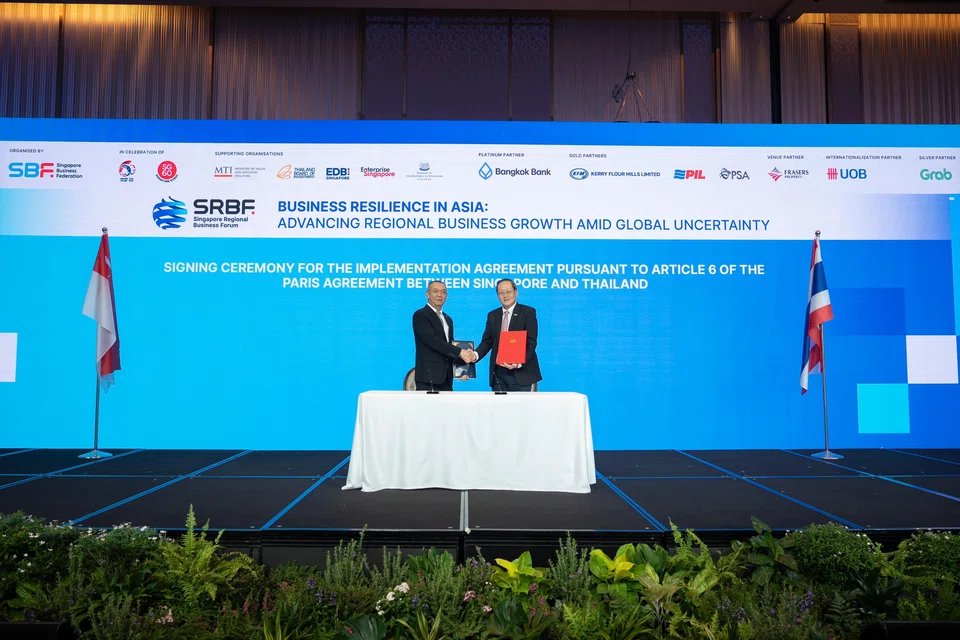
There were only two such agreements at the end of 2024, with Papua New Guinea and Ghana. The number now stands at 10, with the other eight countries being Bhutan, Peru, Chile, Rwanda, Paraguay, Thailand, Vietnam and Mongolia.
In response to BT’s queries, a Singapore government spokesperson said that it is monitoring the situation. It will also review whether to roll over emissions for 2025 to address business needs in the light of market conditions, and notify carbon tax-liable companies in advance.
It will also strengthen efforts to grow and diversify the supply of eligible credits, including inking agreements with more countries, accelerating the operationalisation of existing agreements, and reviewing carbon crediting methodologies.
The government also said that it recognises that supply remains constrained, due to systemic challenges in implementing Article 6 globally, including factors such as institutional readiness and project development timelines. However, it expects the international carbon market to mature over time.
Impact on decarbonisation
Senoko Energy’ and Keppel said that they have been focusing on plant efficiency improvements, which include upgrading the gas turbines of their combined cycled plants.
PCS is looking at deploying carbon-capture solutions as a longer-term solution, while it tries to minimise current emissions by optimising energy efficiency.
Nonetheless, the effectiveness of the tax hike is tempered by the government’s allowances for trade-exposed companies.
It introduced a transition framework in 2024 for some high-emitting companies that are trade-exposed, to give them more time to reduce their emissions and invest in cleaner technologies, and also help defray their costs and prevent them from moving to other countries without carbon taxes.
A spokesperson for the Ministry of Trade and Industry (MTI) said that it reviews and adjusts allowances based on how companies have fared in lowering their emissions, as well as international developments and advancements in decarbonisation technologies.
MTI also said it plans to release aggregated data on these allowances in 2027, in response to BT’s question on the amount of discount that has been given.
“The transition framework will be calibrated to spur companies to invest in decarbonisation. Transitory allowances will be provided only for a proportion of the companies’ emissions, and are based on internationally recognised efficiency benchmarks, where available, or the companies’ decarbonisation plans.
“The remaining emissions will be subject to the prevailing headline carbon tax rate,” added the spokesperson.
To drive meaningful climate action, KPMG’s Addy said that climate taxes will need to evolve to take into account industry-specific characteristics and challenges.
The current framework does not consider a facility’s emissions per unit of output, or a sector’s abatement potential, as it is based on the total emissions generated by a facility.
“A progressive carbon-tax system, taking these factors into consideration, and combined with a conditional rebate system based on industry-specific criteria may be a more effective and transparent way to reduce emissions,” he added.
Impact on carbon markets
The increase in demand for carbon credits among Singapore corporates will mean that the voluntary carbon market will be tapped to supply these credits.
However, even if all tax-liable companies in Singapore are purchasing credits to fully offset their emissions, it ultimately represents only a small transactional segment of the greater Asean region, and may not increase demand in the voluntary carbon market to a significant extent, said Thomas McMahon, chief executive officer of carbon exchange AirCarbon Exchange.
However, Choo said that voluntary buyers of carbon credits are increasingly using compliance-aligned standards as a benchmark to shape internal frameworks and carbon-pricing decisions.
“We see this clarity as constructive for the voluntary carbon market, providing confidence for buyers to stay active. Over time, stronger demand signals could attract new project developers, who may otherwise have been deterred by uncertainty, helping to expand supply across both markets,” she added.
TRENDING NOW

Once staunchly pro-China, Malaysian Chinese businesses are now distancing themselves from Beijing

Looking beyond looming CEO succession, should UOB potentially pursue a transformative merger?

Could stablecoins be the future of money?

Grab CEO’s wife Chloe Tong on life with Anthony Tan and finding her purpose

