

Singapore EV accelerator pitches carbon credits programme to ComfortDelGro, SMRT
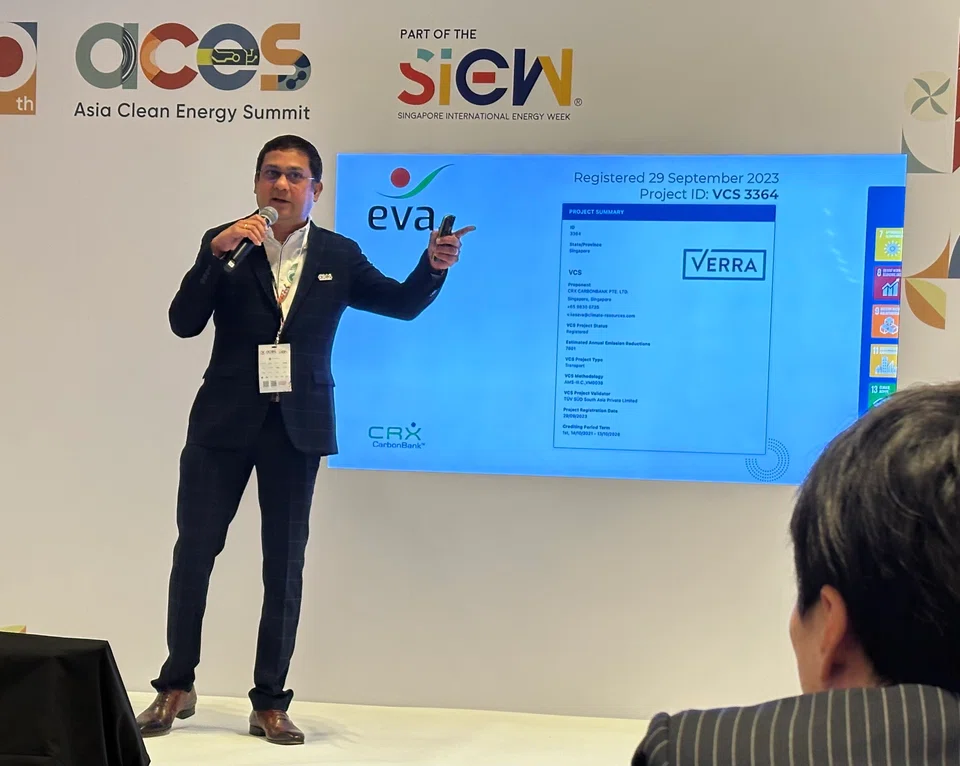
SINGAPORE-based carbon project developer CRX CarbonBank is working on striking deals with the country’s major transportation companies, including ComfortDelGro and SMRT, after successfully registering its project with Verra on Sep 29.
The green light from Verra, which is the world’s largest carbon credit certifier, means the project can start issuing credits whenever partner electric vehicles (EVs) utilise charging points involved with the project’s platform, dubbed EV Accelerator, or Eva.
CRX CarbonBank’s chief executive Vinod Kesava told The Business Times (BT) that the company is working through details of selling the carbon credits on a per kilowatt-hour basis to platform participants at a cost equivalent to 0.5 per cent to 1.5 per cent of the price of charging.
This comes after potential partners gave feedback that they would like to own carbon credits generated from the platform, and not just take a cut of the proceeds from the credits’ sale. The potential partners see the credits as possibly being used for compliance or to voluntarily offset their emissions, he said.
Singapore’s carbon tax is set to rise from S$5 per tonne of greenhouse gas emissions to S$25 a tonne next year, with a view of increasing even further to S$45 a tonne starting from 2026, and S$50 to US$80 a tonne by 2030. The government had said that companies can offset up to 5 per cent of their taxable emissions using eligible credits from next year.
BT has asked the Ministry of Sustainability and the Environment if it intends to include credits from the Eva project under its list of acceptable carbon credits, which is set to be released by the end of the year.
Alternatively, the carbon credits could also be sold on carbon exchanges such as AirCarbon Exchange, Kesava said. The credits will be Corsia eligible, meaning airlines would be able to buy them to offset flight emissions.
He said Eva credits come with Sustainable Development Verified Impact Standard accreditation, and expects the price points of each to be at least US$8 to US$10 in the early stages.
The initial plan was for CRX CarbonBank to own the credits and monetise them in the open market. Of the proceeds, 30 per cent is to be shared with the charging point owners and EV fleet owners and operators on the platform, for them to pass on the incentive to EV drivers.
The plans have evolved as CRX CarbonBank is “dedicated to continually enhancing the models that drive the Eva programme”, the CEO said at a recent summit.
A carbon credit represents one tonne of carbon dioxide removed from the atmosphere. Only 1.3 per cent of Singapore’s vehicle population was electric as at end-July. The government’s vision is to phase out internal combustion engine vehicles and have all vehicles run on cleaner energy by 2040, but adoption is slow as EVs are still more expensive than gas-powered cars.
Eva credits are generated by calculating the difference between baseline emissions – those that would have come from an internal combustion engine vehicle – and emissions from EV use, quantified using the amount of electricity transmitted from the grid to power it.
But only EVs that use its platform, which has a mechanism to prevent double counting, can yield credits. The mechanism is a custom protocol to ensure that all charge events are matched to a unique payment entity. In a case where both a fleet operator and a charging point operator are Eva participants, the carbon credits will be split between the two parties.
Kesava envisages the project to contribute 2.5 million tonnes of reductions by 2030, based on the take-up rates that the company has projected. In accordance with Verra’s rules, carbon credits generated under the programme from Oct 14, 2021 are eligible to qualify for issuance, since Eva was already up and running by then. Eva’s early partners include ride-hailing platform Gojek and Goldbell, which owns and operates car sharing platform BlueSG.
While the momentum in Singapore is just kicking up, Kesava has already set his sights on expanding the programme to other South-east Asian economies, as well as South Korea, Japan, Taiwan and Hong Kong.
It will be easier for the programme to start crediting from these countries since Eva was registered as a “grouped project activity” under Verra, he said. This means “we can keep adding on project activity instances under the umbrella of the entire programme”, he added.
The one-time registration under Verra thus opens the door to potentially generating “tens of millions” of carbon credits from now till 2050 in Singapore and other countries, Kesava said.
The CEO said getting to the point of registration was “not an effort to be trifled with”, given the rigorous validation and verification protocols in place, the vacillating state of carbon markets on how to count nature-based credits, and Eva credits’ origination costs of about US$5 million since 2020.
Many investors who had not dealt with carbon markets before are risk-averse, and refrain from funding origination costs prior to successful registration, but CRX CarbonBank’s efforts were boosted with Vitol Asia’s help, he pointed out. The energy and commodities company sponsored the overall design and origination process of Eva, while CRX CarbonBank invested and absorbed risks associated with the registration process, while developing the tech solution to capture precise charge event data.
Vitol will also be an off-taker of the credits “at least until the initial investment is recovered”, he shared.
With Eva’s addition, Singapore now has five Verra-registered carbon projects. The first to be registered here was developed by electricity retailer PacificLight. That project generates credits through the construction and operation of its 800 megawatt natural gas-based power plant on Jurong island. The baseline scenario used to justify the project is the generation of equivalent power from a coal-based power plant, which would have cost less to generate electricity.






