

Singapore tracking advanced nuclear technologies but has no plans to pilot
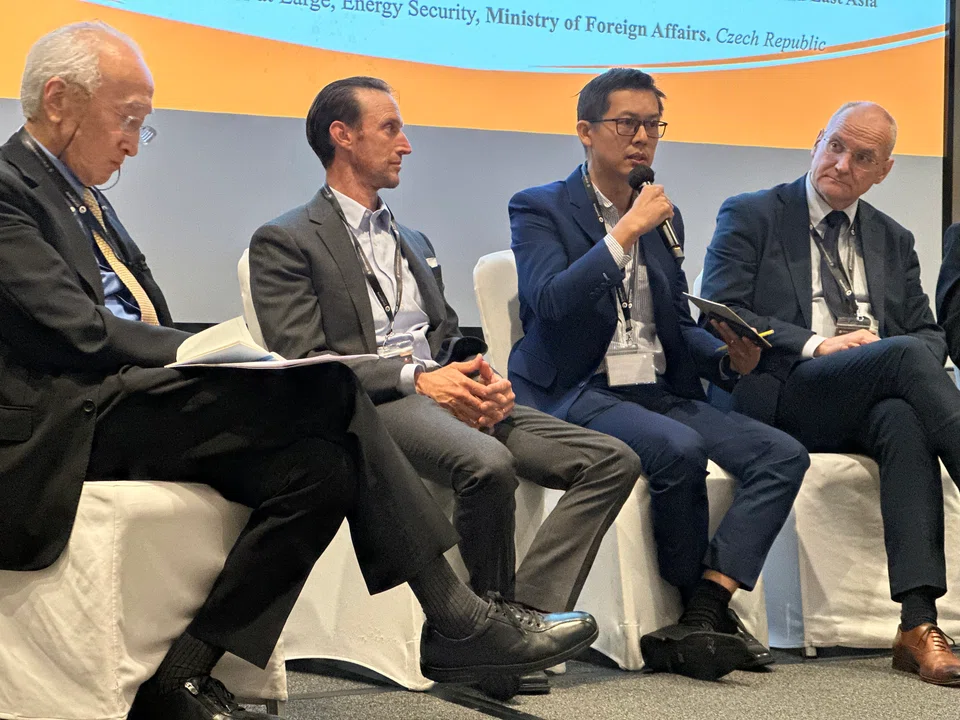
SINGAPORE is keeping close tabs on nuclear technologies that can be used to decarbonise the power grid as they mature, keeping alive the possibility of nuclear energy to support Singapore’s energy needs by 2050.
Despite that, there are no plans to pilot any of these technologies here as there are challenges with Singapore taking the first plunge given its status as a densely populated city-state, a senior executive with the Energy Market Authority (EMA) said on Thursday (Oct 19).
Chia Meng Hwee, deputy director of EMA’s energy technologies department, said in response to an audience question by The Business Times: “We’ve not made any decision. We’re still in the exploratory stage. Singapore is such a small country... In the world today, nobody puts a conventional plant right next to a city. If you were to do so, it is something that is very challenging.”
He was speaking at the Asia-Pacific Nuclear Energy conference, which gathered nuclear industry specialists, including Charles Oppenheimer. He is the grandson of nuclear physicist J Robert Oppenheimer, whose life and work was recently chronicled in a namesake blockbuster film.
Commercial deployment
Chia presented that the EMA has taken notice of at least eight advanced nuclear reactors which are expected to be commercially viable and deployed within this decade. They include the Xe-100, a gas-cooled reactor by private engineering company X-energy; GE Hitachi Nuclear Energy’s water-cooled reactor BWRX-300; and Moltex Energy’s stable salt reactor that uses recycled nuclear waste as fuel.
These are commonly referred to as “small modular reactors”, to distinguish them from the more well-known conventional reactors that have been associated with nuclear meltdowns in the likes of Fukushima or Chernobyl.
Many of the new models emphasise passive safety features that do not require any active systems, electrical power or human actions to initiate a shutdown if a problem crops up.
Chia thus said these reactors “serve as a solution that we can study carefully in the future”. The advanced designs promise to be significantly safer, and with the enhanced safety, the hope is that “they can afford a much-smaller emergency planning zone, possibly allowing them to be installed near or in cities”, he added.
Chia said that nuclear energy is attractive as it is not only “zero carbon”, but also that its associated fuel is “very energy dense”, allowing a lot of energy to be stored in a small area and, by extension, granting “immunity against supply-chain disruptions”.
Unlike natural gas, the price of nuclear fuels like uranium makes up a small percentage of total electricity costs, and this could provide insulation against price volatility, he pointed out.
So if what happened to liquefied natural gas prices last year happened to uranium fuel, “you may not see the same effect on the electricity price that we have seen in Singapore for the past two years or so”, he added.
The inclusion of nuclear energy as part of Singapore’s energy mix was first postulated in EMA’s Energy 2050 Committee report released last year. This was thought possible under the “emergent technology trailblazer” scenario, in which the world is fragmented, and technology advancement is delayed but eventually arrives, and nuclear could potentially supply about 10 per cent of the country’s energy needs by 2050.
Investment hurdles
Chia, however, highlighted the difficulty around governments crowding finance into nuclear projects, citing issues around project overruns and delays. Before investments pour in, he said that the industry has to prove viability.
“You can’t have a project that is under construction for 10 years and draw nothing from it,” he noted, referring to the need to generate power and revenue from such projects.
Meanwhile, Charles Oppenheimer talked up the importance of collaboration among countries, especially between the United States and China despite their frosty relationship, as he pointed out that China is the country building the most nuclear plants today.
“I recognise it’s not an obvious choice, or maybe even likely, but I think that it’s my duty and ours to advocate for even the hardest parts. Building energy is a better starting point for a discussion than talking about weapons, which is always a difficult place to start,” he said.
The Silicon Valley-based investor and entrepreneur, who founded The Oppenheimer Project to advocate the expansion of nuclear energy as a pathway to a more energy-abundant and peaceful world, later remarked: “In the 1950s, we built nuclear power plants in four years. We could do that today. We just have to choose to.”
Separately, the Centre for Strategic Energy and Resources, a Singapore-based independent think tank, and The Oppenheimer Project said they have reached an initial consensus to work together to raise funding. The money will go towards supporting capacity building and public outreach to advance understanding of nuclear energy-related issues, to enhance public and political acceptance in Asean and globally, they noted.
TRENDING NOW
High Court rules against Julius Baer’s Singapore trust arm in US$50 million family trust dispute
MSCI proposes standalone status for Indonesia; Jakarta stocks plunge 8%

Once staunchly pro-China, Malaysian Chinese businesses are now distancing themselves from Beijing
No chicken feed: How Malayan Flour Mills built an empire from flour to fowl

