

Singapore won’t fully benefit from expected lowering of green hydrogen production costs: experts
Challenges of transport, storage and handling must be overcome to make imported renewable fuel competitive
A NEW study estimates that sustainably produced hydrogen could reach price parity with its fossil-based counterpart before 2035, but experts said that this alone will not be enough to keep the renewable fuel affordable for Singaporeans.
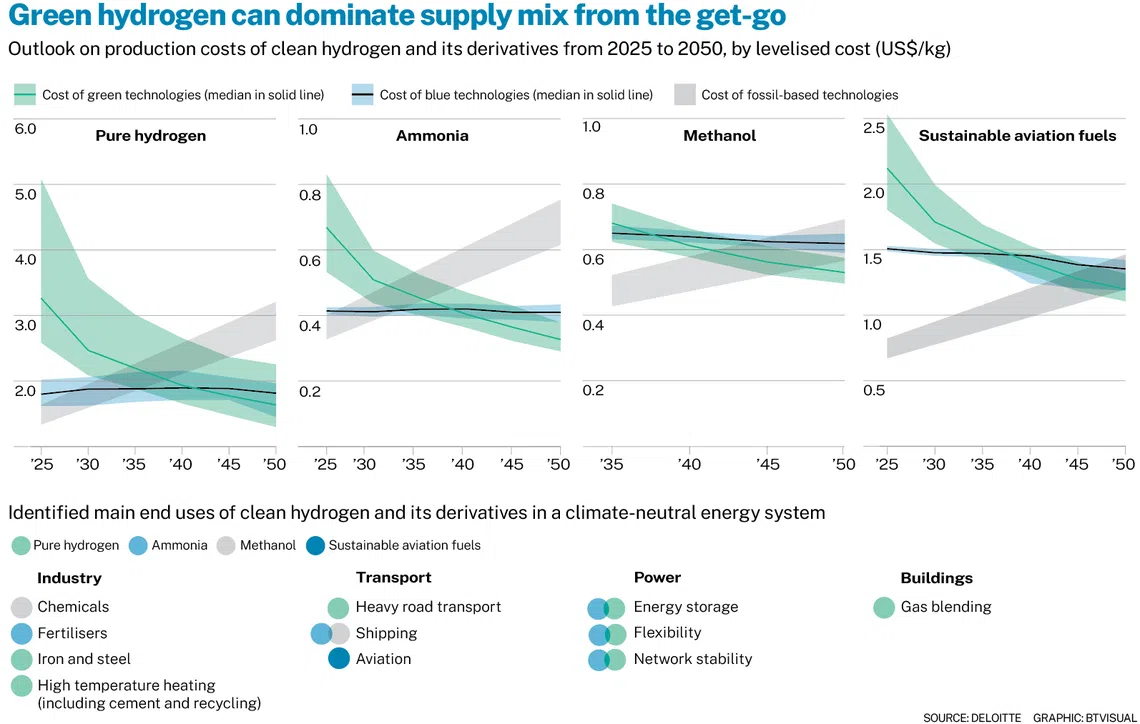
A report by Deloitte published on Thursday (Jun 8) said that the price of green hydrogen – or hydrogen produced with renewable power – could come down sufficiently to match that of hydrogen produced from fossil fuels by 2035. While almost all of the hydrogen produced today is from fossil fuels and is therefore not renewable, Deloitte expects green hydrogen to account for 85 per cent of the hydrogen market by 2050.
Singapore is unable to produce green hydrogen on its own at scale, and is therefore exploring hydrogen imports as part of its goal of achieving net zero emissions by 2050. Deloitte estimates that a fifth of global green hydrogen supply in 2050 will be traded around the world, with the highest export potential relative to domestic demand coming from North Africa and Australia.
Professor Chan Siew Hwa, who leads hydrogen and fuel cell research at Nanyang Technological University, explained that the need to import green hydrogen means that production cost should not be confused with the price that Singaporeans will pay for the fuel.
The “delivery-at-place” price must take into consideration costs associated with liquefying hydrogen gas for export and regasifying the liquid hydrogen before use, as well as storage, handling, shipping, unloading, transportation covering all the processes in between. A lower production cost will translate to a meaningful price decrease for end users in Singapore only if the source of the green hydrogen is close enough to pipe the fuel in instead of transporting it by ship, he said.
“No way US$1 per kilogram (kg) would be the case for Singapore,” Prof Chan said, citing a study of hydrogen imports and downstream applications for Singapore by KBR that was commissioned by Singapore’s National Climate Change Secretariat.
The KBR study assessed that the total cost to get liquefied hydrogen to Singapore, or landed cost, will be US$4.03/kg in 2050. It includes a projected US$1.87/kg production cost for hydrogen.
“As far as Singapore is concerned, we should look for hydrogen or its carrier close to us so that investment on using piping to deliver hydrogen will make more sense from investment perspective,” Prof Chan said.
Victor Nian, the chief executive officer of independent think-tank Centre for Strategic Energy and Resources, said production is “only a very small part” of the hydrogen value chain.
The most critical challenge in the hydrogen ecosystem today, he noted, lies with storage and transport, and picking the most efficient hydrogen carrier from an overall energy efficiency perspective from production to end-use.
“Unless there is evolutionary development in the transport, storage and downstream application technologies; and they are adopted willingly at a large scale, with justification on cost, it is hard to see the hydrogen story solely from the production side,” he said.
And while Deloitte believes ammonia would dominate global hydrogen trade, Nian said it is still “too early” for Singapore to place its bets on any particular hydrogen carrier, noting scattered interest in almost all types of hydrogen carriers across the world, including methylcyclohexane (MCH) and methanol. MCH and methanol are much easier to handle from a regulatory and safety perspective than ammonia, he pointed out.
With methanol – the carrier he is currently studying – Nian said there is potential for it to be cost competitive as well. For land transport, it has already been proven as a possible drop-in fuel – one that does not require adaptation of the engine or fuel system to adopt, he noted.
Deloitte acknowledged the challenges with transporting hydrogen as well, pointing out that pipeline transport is more competitive than truck, rail or ship for medium distances of up to 3,000 km. Anything beyond, or where cross-border pipeline projects may be infeasible, shipping and hydrogen derivatives will still be needed.
Repurposing former natural gas pipelines could reduce the cost of transporting hydrogen by 55 to 68 per cent, compared to building new pipelines, it added, stating this as the case for Europe within the limits of its existing infrastructure. “Where possible, pure hydrogen should be produced domestically or imported via pipelines from neighbouring regions,” Deloitte said.
It remains to be seen how likely it is that Singapore will have meaningful access to cheap, piped clean hydrogen. Deloitte estimates that domestic production will make up over 90 per cent of global hydrogen consumption, with those globally traded via pipeline making up just 2 per cent.
That 2 per cent mostly comprises trade flows between North Africa and Europe, which can partially repurpose their existing natural gas pipelines for hydrogen transport.
TRENDING NOW

Nvidia reinstates Jensen Huang as CEO; Trump says move poses no national security risk

Indonesia’s coal tycoon Low Tuck Kwong replaced as Bayan Resources president-director

Nvidia surges 33% after reinstating Jensen Huang, reviving AI trade; stocks soar in US and Europe

Consider lowering homeownership barriers for some non-resident foreigners

