SM Teo warns businesses about ‘just-in-case’ costs amid climate change, supply chain glitches
Separately, Temasek chief Dilhan Pillay urges Asean to tap opportunities in the green economy and India

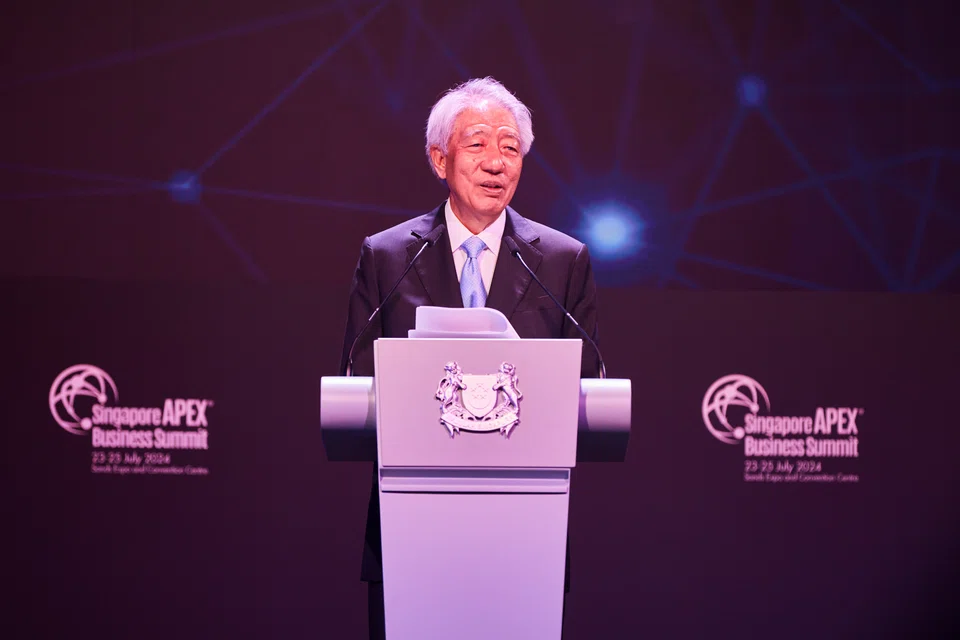
COMPANIES may have to contend with “just-in-case” costs while building resilience against global challenges, which range from climate change to supply-chain disruptions, said Senior Minister Teo Chee Hean on Wednesday (Jul 24).
Speaking to business leaders at the Singapore Apex Business Summit, he said: “‘Just-in-case’ means diversifying your entire business, including markets, products, the locations of your facilities, and even the people you hire.”
He added: “Expanding into new markets can mitigate localised economic downturns and sudden restrictions in market access. Establishing production facilities across different regions can help to reduce concentration risk and supply disruption.”
Companies will also need to prepare for climate-change risks and sustainable regulatory requirements, such as by pricing carbon into their business decisions.
“Short term costs may go up for your company, but in the long run, this is the more resilient strategy, and in a time of crisis, this may make the difference between survival and disaster. Assessing and striking the appropriate balance between ‘just-in-time’ and ‘just-in-case’ will be one of the new considerations in doing business,” he said.
“Just-in-time” refers to a traditional business strategy in which goods are sourced only as needed, without holding on to excess inventory.
Teo noted that even as the Covid-19 pandemic has ended, other disruptions persist, including the wars in Europe and the Middle East. A survey by the Singapore Business Federation found that 43 per cent of businesses in Singapore were affected by supply-chain disruptions in the past year.
At the same time, countries are decoupling and onshoring their supply chains for national-security reasons or to protect their own industries. “The very countries that were the flag bearers of free trade now take the opposite view, and are themselves putting up barriers,” said the minister.
Climate change is another big threat, with the rising frequency and severity of natural disasters disrupting economic activity.
“(In) Denmark, even cows and pigs are not spared from carbon tax. Businesses also need to consider how to maintain continuity when operations in various parts of the world are inevitably affected by some natural disaster or other,” said Teo.
Singapore’s efforts
Governments can play a role in keeping “just-in-case” costs for businesses in check, said Teo, outlining three ways that Singapore does so.
First is by encouraging regional and cross-regional agreements. Singapore is part of trade initiatives such as the Regional Comprehensive Economic Partnership and the Indo-Pacific Economic Framework for Prosperity. The city-state hopes to continue building stronger links between regions despite geopolitical challenges, said Teo.
Second, Singapore is striking partnerships in new growth engines. On the digital-economy front, the city-state is pursuing agreements that align cross-border data policies and establish common digital trade rules, for instance.
In sustainability, Singapore has inked agreements with the likes of Australia, the UK and Chile to create jobs in green sectors and encourage decarbonisation. It also has ongoing collaborations and talks to trade carbon credits with 19 countries, Teo noted.
Third, Singapore is supporting efforts to build critical regional infrastructure, such as an Asean power grid, which will improve power-supply resilience. Singapore has also granted conditional approval for 4.2 GW of low-carbon electricity imports and is already importing power via the Laos-Thailand-Malaysia-Singapore Power Integration Project.
“But these projects are still in their infancy in our region, and are sui generis, so we can expect to face hurdles from time to time, even as progress is made,” Teo said.
Business possibilities for Asean
In a separate panel at the summit, Temasek’s chief executive Dilhan Pillay echoed the point that a “just-in-case” business strategy would mean higher costs than “just in time”.
“You’re talking about having an insurance policy on top of what you’re normally doing. Part of that is inflationary. Part of that also disrupts intermediate trade... So we’ve to think about where Asean’s value lies in the context of a globalised world,” he said.
However, he noted that there are still opportunities that businesses can ride, such as in the region’s energy transition.
“The average age of coal-fired power plants in Asean is much lower than other markets. That presents an opportunity, not just in terms of transition from coal to green, but also to look at natural gas as an intermediate (energy source),” he said.
Pillay also identified the Indian market as another source of opportunities for Asean. The subcontinent is seen as a beneficiary of companies pursuing a “China-plus-one” strategy, that is, diversifying into an alternative market besides China.
“The emergence of the Indian consumer is a strong factor – whether it’s financial services, tech-enabled services, the green economy, two-wheelers – there’s a huge opportunity. The question for Asean is how to latch on to that growth, just as we did for China when China was taking off,” he said.
The Singapore Apex Business Summit, running from Jul 23 to 25 at the Sands Expo and Convention Centre, aims to connect and support the global business community in a fundamentally different operating climate, post-Covid.
TRENDING NOW
Grab CEO’s wife Chloe Tong on life with Anthony Tan and finding her purpose
HDB reviewing ‘jumbo’ flat scheme after Telok Blangah unit listed for sale at S$2.18m
He built the Vingroup empire. Now South-east Asia’s richest man is handing some key roles to his sons
Singapore judge raises doubts iron ore trader Radiant World is owed US$1 billion