SMEs need to strategise on sustainability to stay competitive: Grace Fu
The minister also addressed resistance towards sustainability efforts among some accountants

Sharanya Pillai
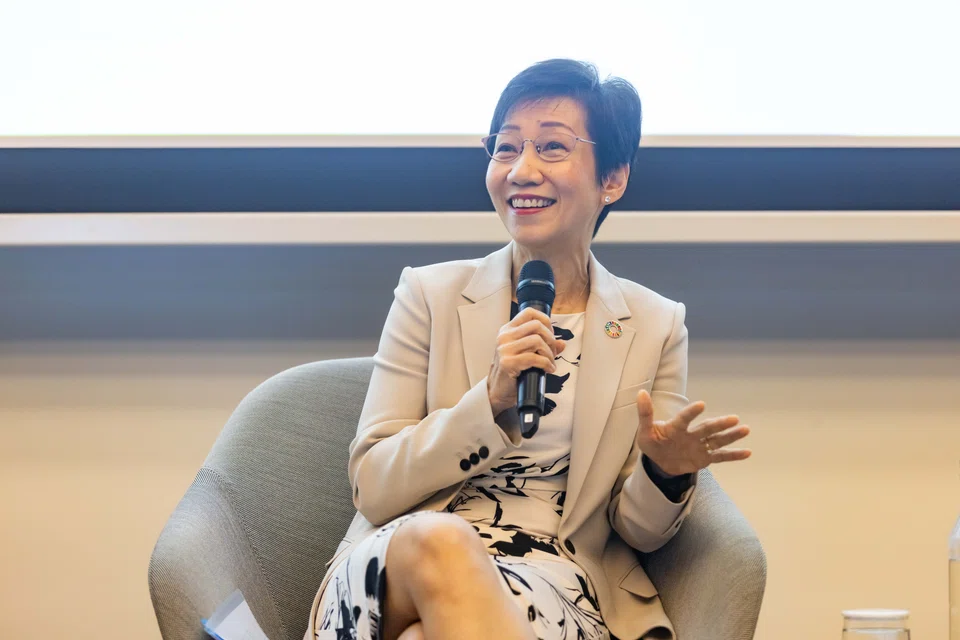
SINGAPORE’S small and medium-sized enterprises (SMEs) need to strategise on sustainability efforts to stay competitive internationally, said Minister for Sustainability and the Environment Grace Fu at an industry dialogue on Tuesday (Mar 12).
“If you are a supplier to large companies, if you have a regional or international ambition, then obviously you need to think about (sustainability) because the international global regulatory environment is heading there,” said Fu.
“You are either left behind, not being able to support your customers, or you can be really out there; be one of those first few that have experience… The more you warm up, the more you practise, (the more) you are ready when the big race is there,” she added.
Speaking to business and accounting professionals, Fu was addressing an audience question on why SMEs should be involved in sustainability when most emissions are generated by large companies.
The dialogue, held at the Singapore Exchange, was organised by the Singapore Business Federation and the Institute of Singapore Chartered Accountants.
Fu’s comments come as countries around the world explore sustainability regulations, some of which could hit SMEs in global supply chains.
In the European Union, for instance, a new carbon border tax will affect carbon-intensive products imported into the bloc, such as steel, cement and fertilisers.
Fu noted that SMEs that are domestically-facing should still care about being energy and carbon-efficient – primarily from a cost perspective.
This is especially since Singapore is set to step up its carbon tax rate, from the latest rate of S$25 per tonne to S$45 per tonne between 2026 and 2027. The tax is set to eventually range between S$50 and S$80 per tonne by 2030.
Fu urged SMEs to start on sustainability by changing their equipment to more efficient ones and tapping government schemes such as the Energy Efficiency Grant, as well as other subsidies and training programmes.
Separately, she noted that there is some resistance among accountants towards sustainability. The industry has had to adapt to new sustainability reporting requirements and evolving standards around the world.
“I was a little bit surprised when I heard from some friends that accountants are fighting this,” she said.
“Accountants are saying, ‘I’m not trained to do this… Why are you giving more work, I already have enough with accounting.’”
She instead urged accountants to focus on the potential upside for their careers.
“Hey folks, this is a chance for you to widen your scope, your value-add, and be the chief financial officer and sustainability officer,” she said.