

Solar generation 53% cheaper than fossil fuels in Peninsular Malaysia in 2023: report
The country could also benefit from integrating solar and battery energy storage systems

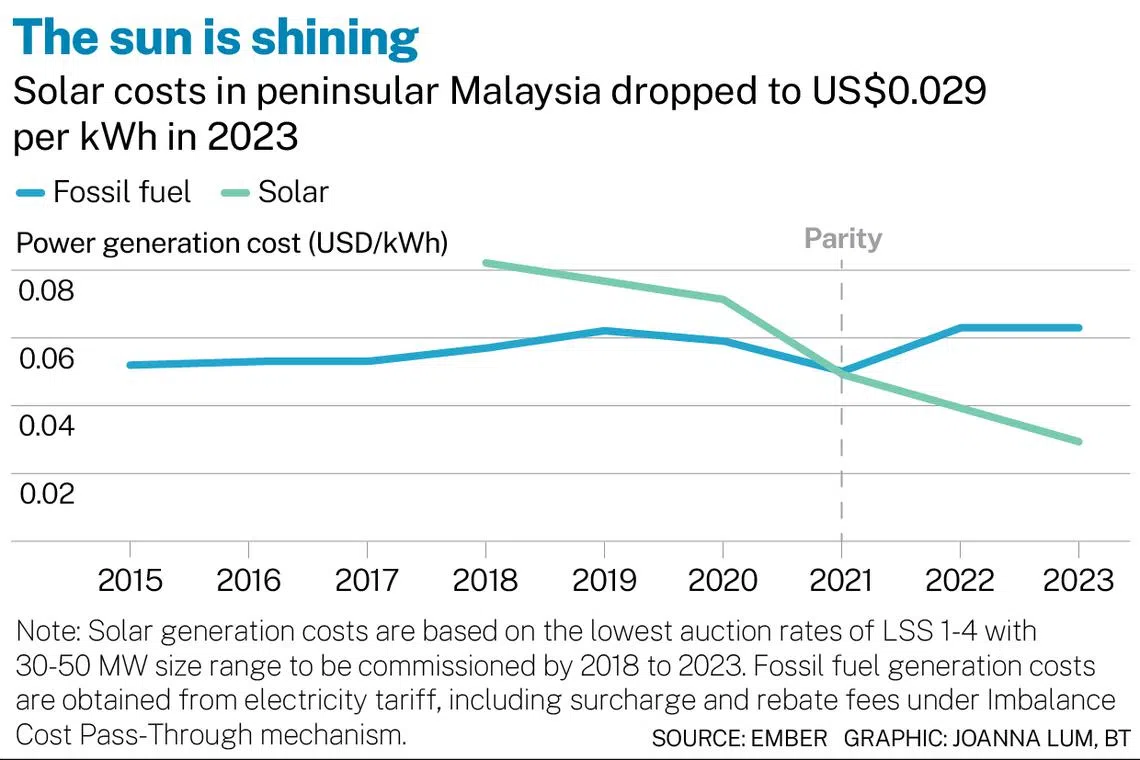
SOLAR power generation costs in Peninsular Malaysia were 53 per cent lower than that of fossil fuels last year, shows a new report, in a sign of the renewable energy source’s improving economics.
Costs for the renewable energy stood at US$0.029 per kilowatt-hour (kWh) in 2023, compared to US$0.063 per kWh for fossil fuels, based on the report released by Ember on Aug 7.
Malaysia “can achieve affordability and (energy) security benefits through rapid solar growth”, said the global energy think tank.
The country has three main electricity regions – Peninsular Malaysia, Sabah and Sarawak – with electricity supplied mainly by state-owned utility companies in each region. There is no existing grid interconnection between the regions, but the government has plans to link them up.
Ember estimates that about half of the country’s solar power potential, or 138 gigawatts (GW), is in Peninsular Malaysia. Sabah and Sarawak have the potential for 99 GW and 32 GW of solar power, respectively.
“Almost all of this solar resource is currently untapped,” said Ember.
Peninsular Malaysia had 1.7 GW of installed solar power capacity in 2021, or just 1.2 per cent of its solar potential. Sabah and Sarawak had installed capacities of 0.1 GW in 2021 and 0.1 megawatt (MW) in 2020, respectively.
Malaysia’s National Energy Transition Roadmap targets to have 70 per cent renewable capacity in its energy mix by 2050, with solar power expected to be the dominant source.
There is still some way to go in meeting this target. In 2023, coal and gas accounted for 43 and 37 per cent of total generation, respectively. The renewable share that year was 19.5 per cent, with 17 per cent from hydropower. Solar contributed just 1.7 per cent.
Ember estimated that by 2050, renewables will contribute about 52 per cent of Malaysia’s energy, while gas makes up the remaining 48 per cent.
The continued reliance on gas could make the country’s power sector “vulnerable to global fuel price volatility and domestic reserve depletion”, the think tank said.
“With decreasing technology costs, solar power is cheaper than fossil fuels for meeting the growing electricity demand in the long run. By decoupling the power sector from fossil fuels, Malaysia can make significant progress in sustaining and enhancing electricity affordability for all,” added Ember.
Battery investments
The think tank also called for policies that integrate solar and battery energy storage systems (BESS). It recommended that Malaysia conduct feasibility studies to analyse the economic and technical viability of BESS.
The country’s existing programmes, such as the Large Scale Solar and Corporate Green Power Programme, could also be enhanced by integrating BESS technologies and offering a different tariff scheme for BESS services, Ember said. This would extend flexible grid development to more market participants.
It noted that Sabah plans to install 120 MW of BESS capacity between 2023 and 2026, while improving its grid infrastructure and setting up interconnections with Sarawak.
Investing in solutions such as BESS is critical, even though high costs could be involved, said Dr Nora Yusma binti Mohamed Yusoff, director of the Institute of Energy Policy, in the report.
“By strategically planning, embracing technological advancements, and promoting public-private cooperation, Malaysia has the potential to harness its immense solar resources,” she said.
There also needs to be more energy interconnections across Asean, “prioritising regional collaboration over isolated national expansion”, said Professor Leong Yuen Yoong, director of sustainability studies at the UN Sustainable Development Solutions Networks’ Asia headquarters.
“By fostering a unified energy market, we can optimise resource allocation, reduce costs and bolster grid resilience,” added Prof Leong.






