

South-east Asia and Singapore score wins despite fresh tussle in UN climate talks


Wong Pei Ting &
Janice Lim
THE 28th United Nations climate change conference (COP28) in Dubai had got off to a good start on its first day, with the go-ahead given for a loss-and-damage fund – a finance facility developing countries have spent decades fighting for.
COP28 president Sultan Al Jaber, at his first press conference, expressed confidence that the progress made at this COP would be “unprecedented”.
But as the event wrapped up on Tuesday (Dec 12), that early glow of success had faded, only to be replaced with criticisms over the draft of the Global Stocktake report released the day before.
Fossil fuels were mentioned just thrice in the 21-page document, and the strongest language mustered was that its consumption and production should be reduced in a “just, orderly and equitable manner, to achieve net zero by, before, or around 2050”.
Fernanda Carvalho, global climate and energy policy lead at conservation organisation WWF, had one word to describe the lack of a commitment to the phasing out of fossil fuels: disastrous.
The stocktake, meant to be an assessment of the world’s progress on climate change and a signpost for the way forward, presents a buffet of energy options – including the continued use of coal, oil and gas. It is significantly less ambitious than the last version, Carvalho said.
The finalisation of the text is regarded as the main outcome of this year’s summit, and will spell out how quickly countries need to step up climate action when they submit their new climate plans – called Nationally Determined Contributions – by 2025. Negotiations on these were expected to drag beyond the scheduled end of the summit on Tuesday.
Observers said, however, that for Singapore and South-east Asia, COP28 has been significant, with market participants noting that enough has been done for the region to make progress on its own energy-transition plans.
One big step forward came from the Monetary Authority of Singapore (MAS), in the form of guidance on transition finance. A Singapore-Asia taxonomy for financial institutions was finalised on Dec 3, making it the first in the world to define “transition activities” comprehensively.
OCBC group chief sustainability officer Mike Ng said the provision of early coal phase-out in the taxonomy offers greater clarity for banks to “assess and align their committed net-zero targets and internal policies”.
“This could lead to financial institutions being more willing to support and channel capital towards early coal phase-out,” he said.
UOB chief sustainability officer Eric Lim agreed that the taxonomy would accelerate transition planning, and said that its effects would be felt in the real economy through the mushrooming of credible transition-finance initiatives.
The taxonomy provides “legitimacy for capital deployment” to transitioning sectors using time-bound sunset dates for relevant transitioning technologies, he said.
MAS followed this announcement with the Dec 4 launch of an international coalition – called the Transition Credits Coalition, or Traction – to develop a new class of carbon credits aimed at accelerating the closure of coal-fired power plants.
OCBC’s Ng said Traction could help “address the economic-viability concerns associated with the early phase-out of coal-fired power plants”. Figuring this out is important for the Asia-Pacific, given that coal accounts for almost 60 per cent of power generation in the region. MAS’ initiatives “will help get us there”, he added.
Another Singapore initiative is a blended-finance platform seeking to mobilise at least US$5 billion for green and transition investments in Asia.
MAS is supporting this by having discussions with multilateral development banks, development finance institutions and philanthropic organisations to mobilise a base of concessional capital for this platform.
DBS’ chief sustainability officer Helge Muenkel said Singapore and MAS “continue to punch above their weight” in driving policy, financing, collaboration and pilot programmes for Asia’s transition.
COP28 has generated positive momentum for Asia and Singapore, he said, noting the country’s outsized role in driving a just transition and supporting Asia’s managed coal phase-out.
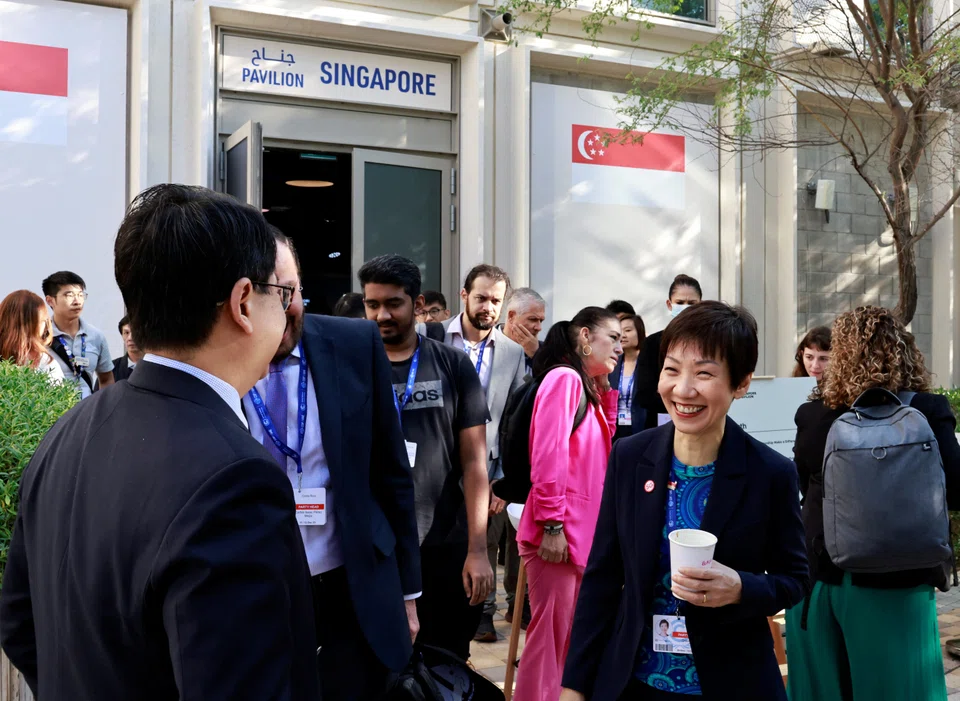
“Singapore’s proven track record as a convener further strengthens its position as a leader in this space. At COP28, the Singapore Pavilion was buzzy, action-filled, and attracted global heavyweights for content-rich discussions,” he added.
Another notable milestone for South-east Asia was the agreement between the Indonesian government, Asian Development Bank and utility provider PLN for the early retirement of a 660 megawatt Cirebon-1 coal plant in Java by end 2035. This demonstrates “real progress, and moves us a step closer to implementation”, Muenkel said.
Domestic and regional wins aside, he said the final wording of the Global Stocktake report remains crucial, and is worth tracking as a key indicator of COP28’s effectiveness in addressing climate change.
Muenkel noted that the draft frames fossil fuel reductions as optional, and goes only as far as to urge countries to “take actions that could include” reducing fossil fuels – when what it should require is that producers cut their fossil fuel output.






