South-east Asia’s ESG bond proceeds rebound with 73% jump in Q3 2025
Issuance of environmental, social and governance loans rise 33.3% to US$14.8 billion over the same period


[SINGAPORE] Proceeds raised from environmental, social and governance (ESG) debt instruments in South-east Asia rebounded sharply in the third quarter of 2025.
Funds jumped 73.1 per cent to US$9.1 billion in Q3 2025 from US$5.3 billion in the same quarter from the year before, indicated data provided by LSEG.
Issuance of ESG loans rose 33.3 per cent to US$14.8 billion from US$11.1 billion over the same period.
Sustainable finance observers told The Business Times that the rebound is not just a one-off. The decline in ESG-labelled debt over the first half of the year was a result of issuers adopting a wait-and-see approach amid geopolitical tensions and macroeconomic uncertainties, said Jeong Yoonmee, head of the sustainability office at OCBC’s global wholesale banking.
Despite the global pullback on climate action, the momentum for energy transition in this region remains strong, the observers added.
ESG bonds
ESG bond issuance in South-east Asia outperformed other regions.
Globally, bond proceeds in Q3 2025 fell 3.8 per cent to US$198.2 billion, from US$206 billion in the same quarter last year. Across Asia-Pacific (Apac) excluding Japan, the figure rose slightly by 5.5 per cent to US$51.2 billion from US$48.5 billion over the same period.
Given the size of ESG bond issuance, there can be significant quarter-on-quarter swings, said Martijn Hoogerwerf, head of sustainable solutions group for Apac at ING.
To begin with, issuers generally approach the market with an annual issuance plan, pointed out Max Thomas, head of sustainable capital markets for Apac at HSBC. Hence, taking a quarterly view could risk losing sight of the overarching trends.
SEE ALSO




The rebound in Q3 could be because many issuers have pushed their issuance plans into this quarter as a result of the geopolitical backdrop in the second quarter, as well as market noise around interest rates, he added.
The second quarter of 2025 was marked by new tariffs as well as retaliatory measures, largely initiated by the United States under President Donald Trump’s administration.
ESG bond issuance volumes at the end of October were already broadly equal to that in 2024, noted Thomas.
“This is in part due to a few issuers returning to market and progressing their issuance plans, but also taking advantage of the positive market backdrop to pre-fund for 2026,” he added.
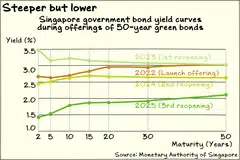
While green bonds have traditionally been issued in US dollars or in euros, the Singapore-dollar-denominated green bond market was exceptionally busy in Q3.
About 50 per cent of bonds issued in Singapore dollars had either the green, social or sustainability labels, compared with an average of 35 per cent last year.
In addition, even though there are headwinds around sustainability in the US, Thomas said that there is a more positive backdrop in Asia with more issuers issuing labelled bonds in local currencies.
Hoogerwerf echoed similar sentiments, that the sustainable finance markets in the region remain very robust. “Despite geopolitical tensions, many clients across sectors and countries continue to seek access to sustainable finance markets.”
While ESG may appear to have slipped down the corporate agenda globally, he said that he has observed a strong focus among issuers on implementing transition plans that were developed over the past three to five years.
“These strategies take time to materialise and are less about publicity or marketing, and more about execution,” he added.
Observers expect ESG bond issuances to remain positive in 2026.
Issuers that have already established sustainable finance frameworks are expected to continue issuing labelled bonds, as these reduce the effort required and leverage prior experience, noted Hoogerwerf. He added that investor appetite for such bonds remains strong, including from dedicated green bond funds.
One area to watch is transition bonds, which are used to finance activities that reduce the environmental impact or emissions of carbon-intensive sectors that would not qualify for green or social financing.
LSEG’s data indicated that there was one US$500 million transition bond issued in Apac excluding Japan in Q3. No transition bonds were issued in South-east Asia for the quarter.
“Whether we see credible transition bonds come to market in 2026 will be an important development,” said Hoogerwerf.
While Thomas expects issuance volume in 2026 to be in line with the last two years, he believes there will be an uptick in redemption volumes for green, social and sustainability bonds. These will provide issuers an opportunity to tap into the demand released by these redemptions or refinance with these labelled debt instruments.
Issuers have continued to invest in projects with positive social and environmental impact, which will further boost demand for green, social and sustainability bond fundings.
He added that international investors’ interest in green, social and sustainability bonds in South-east Asia will remain robust.
“However, it is important for South-east Asia issuers to disclose impact reports which are increasingly a hygiene expectation from global investors,” he said.
The top bookrunners for ESG bond deals in South-east Asia over the first nine months of 2025 were ING (US$2.2 billion), HSBC (US$1.5 billion) and UOB (US$995.4 million).
ESG loans
As with South-east Asia, ESG loan proceeds in Apac excluding Japan also increased significantly, rising 46.2 per cent to US$38.3 billion in Q3 2025 from US$26.2 billion in the same quarter last year.
Both outperformed the global ESG loans market, which saw proceeds going up by 12 per cent to US$155.2 billion from US$138.5 billion over the same period.
OCBC’s Jeong said there has been renewed activity in green financing with greater clarity on the geopolitical landscape.
The strong performance this quarter was largely driven by green loans, highlighting the region’s continued investment in environmentally responsible projects.
Besides sectors such as energy, utilities and real estate which have traditionally been the issuer of such loans, Jeong noted significant traction in emerging sectors such as data centres, telecommunications and chemicals.
“What’s especially encouraging is the growing diversity of sectors embedding sustainability into their operations... This shift reflects the region’s evolving economic landscape and an opportunity to address sustainability challenges in these high-growth industries,” she added.
Shilpa Gulrajani, head of sustainable finance at DBS institutional banking group, highlighted similar observations. She said that there is an uptick in green financing activity from infrastructure development and the digital economy, including data-centre operators and logistics players expanding capacity.
“Structural demand for digitalisation and telecommunications, media and technology services is driving rapid infrastructure expansion, which in turn is accelerating demand for cleaner power and transition-aligned financing. Projects like these are capex-intensive and require sustained access to capital throughout the development phase,” she said.
She also noted that demand for real-economy transition financing continues to rise – from energy-efficient retrofits to grid modernisation, low-carbon fuel pilots and supply chain decarbonisation solutions.
“These are pragmatic areas where Asean corporates are accelerating action, supported by a growing ecosystem of technology providers and data solutions,” she added.
Both OCBC and DBS expect the sustainable finance market in South-east Asia to continue to grow.
Jeong said that the structural drivers for sustainability remain strong. Companies continue to embed ESG into their long-term strategies, while Asean governments have maintained their support for green policies and infrastructure.
“We do expect continued interest in sustainable finance from corporates in South-east Asia as the region accelerates investments in clean energy and strengthens its position in global supply chains for technologies critical to the net-zero transition, including renewables and electric vehicles,” she added.
OCBC was the top arranger for ESG loans in South-east Asia in the first nine months of 2025, with US$3.2 billion raised. DBS came in second at US$3.1 billion. Bank of China was third, with US$1.9 billion raised.
Decoding Asia newsletter: your guide to navigating Asia in a new global order. Sign up here to get Decoding Asia newsletter. Delivered to your inbox. Free.
Copyright SPH Media. All rights reserved.