

South-east Asia’s green power investments hit new high of US$17 billion in 2025: IEA
But coal is growing more dominant, accounting for nearly half of power generation in 2024

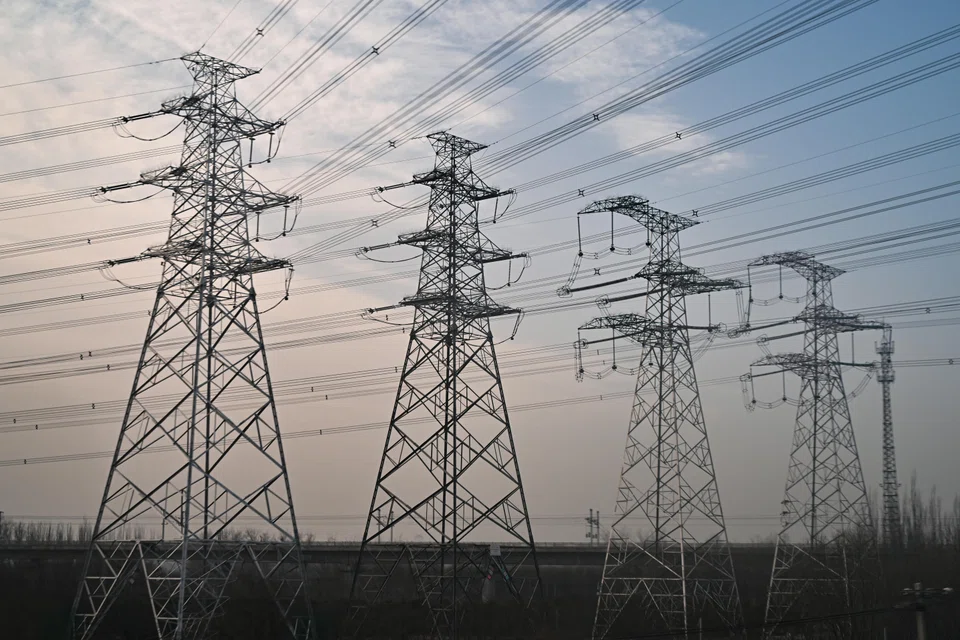
[SINGAPORE] South-east Asia invested US$17 billion in renewable energy last year, marking a new high since at least 2015, data from the International Energy Agency (IEA) showed.
The investments were spread across solar, hydropower, wind and geothermal technologies, it said in its annual outlook report released on Tuesday (Jun 16).
The Philippines is a key market, with recent auctions awarding 10.2 gigawatts (GW) of solar and wind power and storage capacity. An auction for a further 3.3 GW of offshore wind power is under way.
Businesses are also adding to demand for green power. Corporate power purchase schemes “have provided new avenues” to contract renewables in Malaysia and Vietnam, IEA noted.
Thailand is expected to launch a pilot for 2 GW in direct power purchase agreements for data centres this year.
The Middle East energy crisis has been a “major wake-up call” for the region’s energy security, said IEA executive director Fatih Birol in a webinar on Tuesday.
'%3e%3cpath%20d='M12.1475%2025.5262C13.7713%2025.4295%2014.94%2023.913%2014.94%2021.8832C14.94%2019.5359%2013.474%2018.093%2011.5917%2018.093C11.3745%2018.093%2010.9582%2018.093%2010.8393%2018.1413V25.2086L11.8891%2025.5745C11.8891%2025.5745%2012.207%2025.5262%2012.1475%2025.5262ZM11.4934%2017.6281C13.2567%2017.6281%2014.3843%2016.4292%2014.3843%2014.4501C14.3843%2012.372%2013.275%2011.2973%2011.4339%2011.2973H10.8393V17.6305H11.4934V17.6281ZM6.66078%2025.6482L7.39265%2025.5492C8.02617%2025.4502%208.26403%2025.3053%208.26403%2025.1097V11.6149C8.26403%2011.4193%208.1451%2011.3709%207.23484%2011.249L6.68137%2011.173L6.6219%2010.7588H11.9508C15.7153%2010.7588%2017.0624%2012.0797%2017.0624%2014.1578C17.0624%2015.9666%2015.7748%2017.1909%2013.4969%2017.6305V17.7041C16.111%2017.948%2017.6571%2019.5382%2017.6571%2021.7636C17.6571%2024.3318%2015.8937%2026.0417%2012.1109%2026.0417H6.60132L6.66078%2025.6482Z'%20fill='%232B2B2B'/%3e%3cpath%20d='M20.6287%2025.6505L21.5596%2025.5515C22.1725%2025.4779%2022.4104%2025.3076%2022.4104%2025.112V11.249H21.9346C20.073%2011.3479%2018.982%2013.0095%2018.408%2014.6227L18.1907%2015.5018H17.6555L18.1701%2010.7588H29.3837L29.6421%2015.4787H29.1664L28.9491%2014.6227C28.3728%2012.8645%2027.3047%2011.2743%2025.5002%2011.249H24.9856V25.1856C24.9856%2025.3812%2025.1251%2025.4548%2025.9965%2025.5515L26.7695%2025.6505L26.829%2026.0417H20.5693L20.6287%2025.6505Z'%20fill='%232B2B2B'/%3e%3c/g%3e%3cdefs%3e%3cclipPath%20id='clip0_5242_21648'%3e%3crect%20width='24'%20height='16.8'%20fill='white'%20transform='translate(6%2010)'/%3e%3c/clipPath%3e%3c/defs%3e%3c/svg%3e)
This has prompted some to “push the renewable button even stronger than before”, such as the Philippines and Vietnam with solar power.
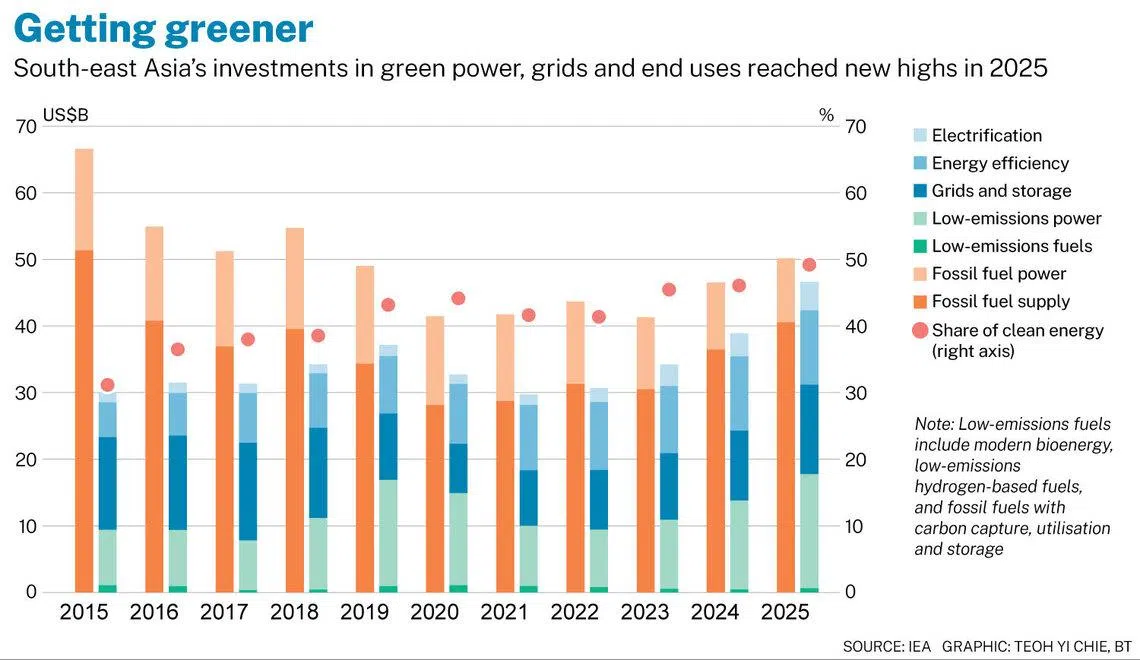
Total energy investments in South-east Asia exceeded US$100 billion in 2025, up from US$70 billion in 2023.
That said, the region still accounts for only 3 per cent of global energy investment, below its shares of global energy demand (5 per cent) and population (9 per cent).
SEE ALSO



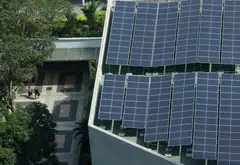
South-east Asia is also set to account for nearly 20 per cent growth in global energy demand through to 2035, second only to India.
In particular, grid spending is below 2015 levels and lags investments in power generation. Challenges include “long development timelines and complex permitting processes”, IEA said.
“Supply chain pressures continue to constrain delivery, with lead times for cables and large power transformers having doubled since 2021,” it added.
US$27 billion for cross-border power links
These challenges also apply to the Asean Power Grid, the ongoing effort to link the region’s power systems for trade in electricity.
Specifically, US$27 billion is needed between 2025 and 2040 to deliver the proposed pipeline of energy interconnection projects, comprising both overland and subsea cables.
This is more than 10 times the US$2 billion that the region invested in energy interconnectors from the 1970s to 2024, mostly for one-way power export.
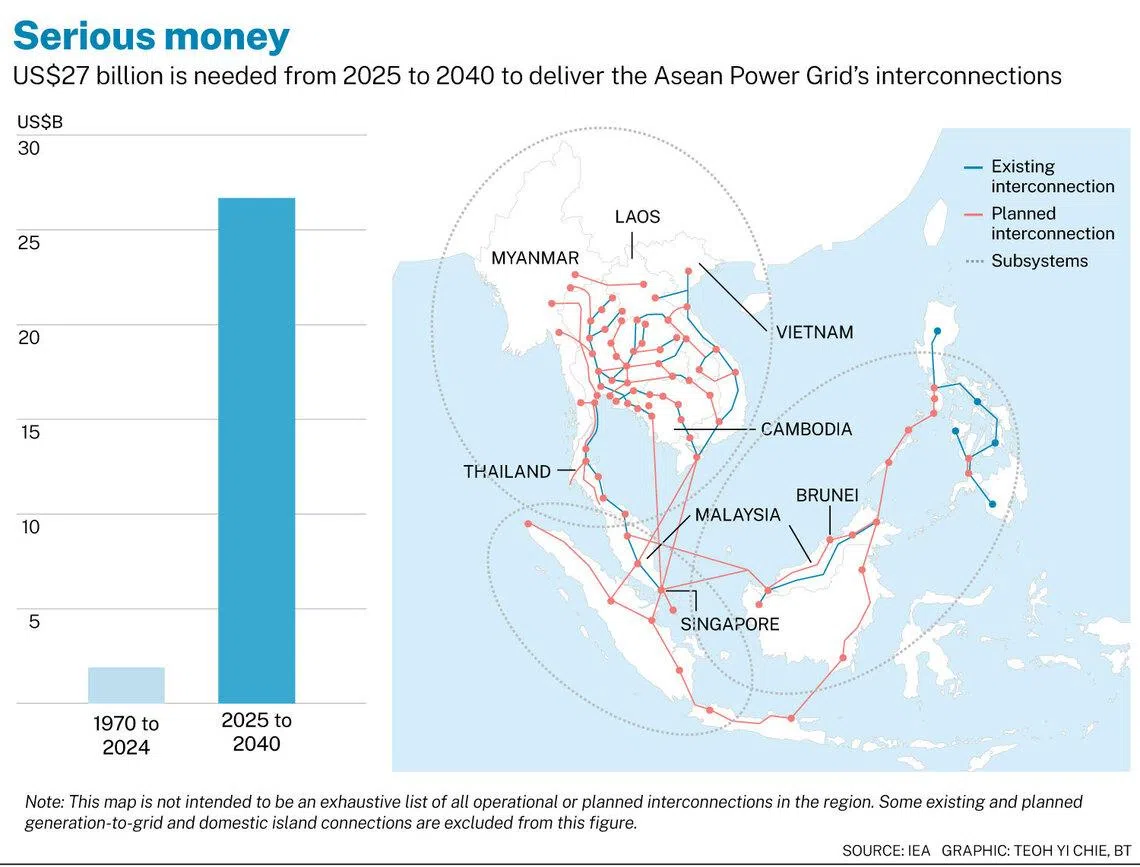
All investment in this period was in overhead lines, except for the 2 km subsea interconnector between Singapore and Malaysia.
The financing for cross-border power projects has thus far been “largely on the balance sheet of the respective utilities on either side of the border”, said Tim Gould, the IEA’s chief energy economist, in response to a question from The Business Times.
“That would need to change… There will undoubtedly continue to be a strong role for public sorts of finance, but that would be moving more towards a catalytic role, then to bring in some private funding as well,” he said.
The IEA’s report also noted that momentum for the Asean Power Grid (APG) “has never been stronger”.
Coal is still king
While there is more excitement over green power, IEA also noted that coal is increasingly dominant in South-east Asia.
The pollutive fossil fuel accounted for 47 per cent of the region’s power generation in 2024, up from 37 per cent in 2015. This translates to an annual growth rate of more than 8 per cent on average.
In 2024, coal accounted for 70 per cent of power generation in Indonesia and almost two-thirds in the Philippines. Its share was about half in Vietnam and 45 per cent in Malaysia.
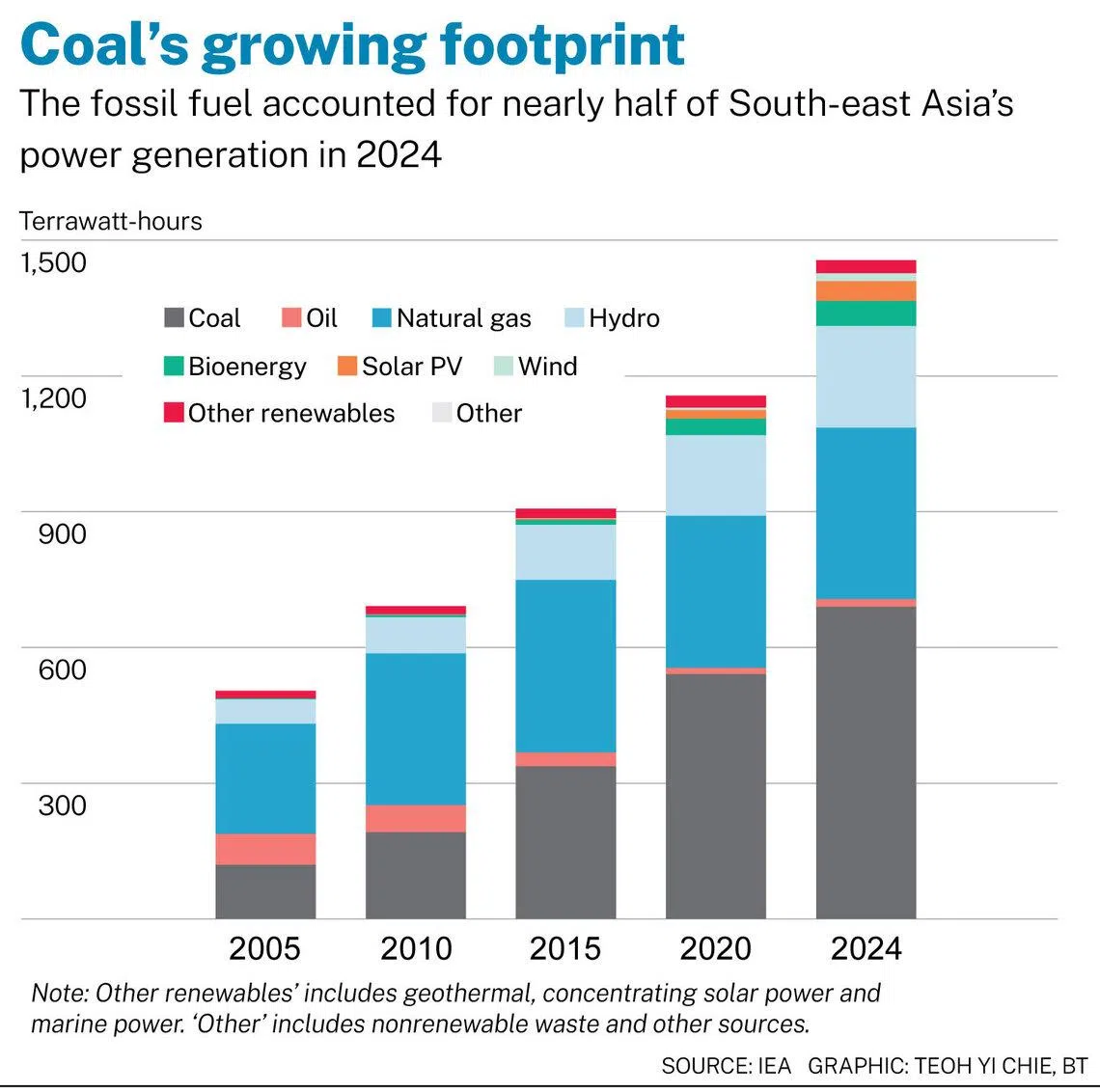
South-east Asia’s coal appetite comes as the generation of the region’s electricity surged 60 per cent between 2015 and 2024.
“Coal is widely available in South-east Asia and continues to play an important role in the energy system; it could see some upside from the renewed focus on energy security,” IEA said.
The region’s relatively young coal fleet provides flexibility and backup capacity, including during supply disruptions from the Middle East war, the agency noted.
“At the same time, coal use entails broader risks, including high levels of air pollution – which contributed to an estimated 330,000 premature deaths in 2024 – and emissions that are incompatible with achieving long-term climate targets,” it said.
Decoding Asia newsletter: your guide to navigating Asia in a new global order. Sign up here to get Decoding Asia newsletter. Delivered to your inbox. Free.
Copyright SPH Media. All rights reserved.
TRENDING NOW

Once staunchly pro-China, Malaysian Chinese businesses are now distancing themselves from Beijing

Looking beyond looming CEO succession, should UOB potentially pursue a transformative merger?

Could stablecoins be the future of money?

Grab CEO’s wife Chloe Tong on life with Anthony Tan and finding her purpose

