

Study finds ‘low or mitigable’ risks for testing ammonia bunkering in Singapore
SINGAPORE could be a step closer to starting pilot studies on the feasibility of ammonia as a green marine fuel, with a study finding the risks of assessing the highly toxic fuel to be “low or mitigable”.
The nine-month-long study commissioned by the Global Centre for Maritime Decarbonisation (GCMD), an entity formed with S$120 million of funding by the Maritime and Port Authority of Singapore (MPA), considered the risk of running the pilots in Singapore’s port waters and two sites on Jurong Island. Because ammonia as marine fuel is a highly nascent technology and Singapore is a major global bunkering hub, test-bedding is essential to the global adoption of ammonia.
The risks are not expected to exceed individual risk thresholds set by the Ministry of Manpower’s Major Hazards Department, according to the report, which was launched at Singapore Maritime Week – an annual industry gathering – on Thursday (Apr 27).
Conducted by DNV Maritime Advisory with the support of Surbana Jurong and the Singapore Maritime Academy, the study identified about 400 risks across four configurations of fuel transfers likely needed to support ammonia bunkering in Singapore.
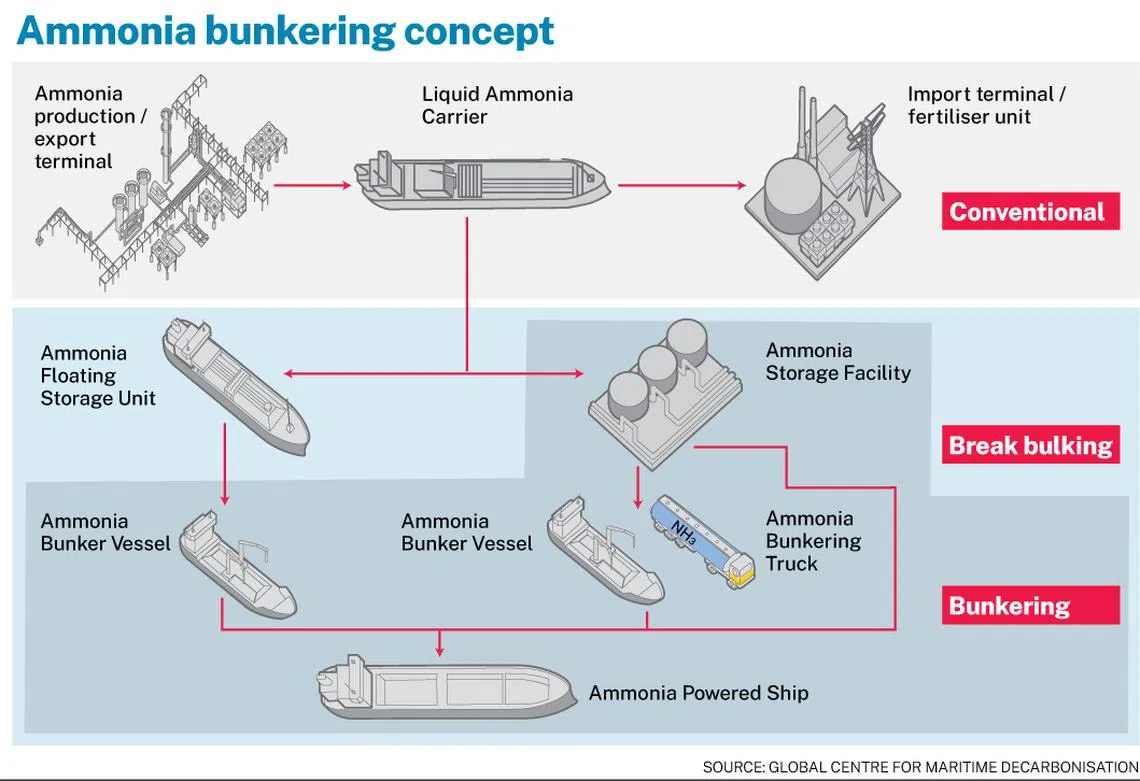
Configurations include the transfer of the compound from a liquid ammonia carrier to an ammonia bunker vessel at a break-bulk terminal in Singapore, before being transported to an ammonia-powered ship, as well as a shore-to-ship transfer.
‘Manageable’ risk
Most of the dangers were rated as “medium-risk and mitigable”, with none classified as posing a “high risk”.
For instance, if ammonia was accidentally leaked at a rate of up to 700 cubic metres an hour – about a third of an Olympic-sized swimming pool – from a small hole during break-bulk and bunkering operations at anchorage, people can find safety if they move 200 m to 400 m away from the incident site. This is if the operators detected the leak within 90 seconds and initiated shutdown.
With this information, operators can conservatively demarcate a radius of 400 m to keep any third parties from entering the bunkering zone, for example.
Injury and death would be contingent on a number of factors, such as ammonia’s flow rate, the number of fuel transfer operations, duration per transfer, and the length of piping and transfer arms, the study further analysed.
The consortium behind the study – which involved extensive consultations with 22 study partners and took in feedback from more than 130 industry consultation and alignment panel members – ultimately concluded that the identified risks are “manageable with mitigation measures”.
But ammonia’s safety might not be a given, as a separate study conducted by the Maritime Energy and Sustainable Development Centre of Excellence found toxicity to be of “utmost concern” during ammonia bunkering.
The research centre at the Nanyang Technological University came to the conclusion by comparing the threshold concentrations of ammonia to induce fire or harm to personnel.
Still, GCMD chief executive Lynn Loo said that the findings could pave the way for a pilot involving ship-to-ship transfer of ammonia in Singapore waters. “We are aiming for the first transfer of ammonia to take place by end-2023, subject to obtaining the green light from the relevant regulatory agencies.”
She also said that since ammonia-fuelled vessels are not yet available, GCMD will be conducting the pilot with proxy assets to gain “stakeholder competence and confidence”, so an actual bunkering exercise can begin when ammonia-fuelled vessels are on the water.
The Business Times (BT) has asked MPA for comment on Singapore’s readiness in conducting an ammonia bunkering pilot.
Estimated costs
Besides safety considerations, the study commissioned by GCMD also estimated the potential capital expenditure needed to develop the land-side infrastructure – loading arms, piping and project management costs, to name a few – to support an ammonia bunkering pilot.
The verdict is that it would take between S$1 million and S$10 million to build up the two Jurong Island sites – a jetty-based facility and a tank terminal. The wide range illustrates the high dependency on the current infrastructure already invested, the report stated.
The actual estimated costs are not disclosed as they are sensitive to the location of deployment, brownfield modifications, materials cost, procurement strategy, local taxes and other related parameters, it added.
Nevertheless, Surbana Jurong’s managing director for energy and industrial Tan Wooi Leong said that this already gives the authorities a “very practical, comprehensive view” of the costs associated with designing a port that supports safe ammonia transfer and storage.
Meanwhile, Knut Orbeck-Nilssen, chief executive officer of DNV Maritime, said that further pilots and studies are key to understanding, assessing and mitigating safety risks associated with using ammonia fuel onboard the global fleet.
The authors of the report expect ammonia to comprise 10 per cent of all marine fuels bunkered in Singapore in 2035, with the figure rising to 37 per cent in 2050 under a “realistic” scenario.
Given that Singapore’s demand for conventional marine fuels was consistently 20 per cent of the global marine fuel demand from 2012 to 2021, the country might have to meet a 50 million tonne demand for ammonia marine fuel by 2050, the report noted.
Supporting that goal will require many more bunker vessels, port infrastructure and storage capacity. Regulators should thus consider developing a regulatory framework “without delay” to allow the ecosystem to grow, the consortium pointed out.
Regulators also need to encourage private sector investment from fuel suppliers, bunker operators, storage facility operators and shipowners, it added.
That said, the study partners are wary of a situation where too many ammonia-related assets are left “stranded” for too long before fuel demand picks up.
They told BT that the pragmatic way is to take the next three to five years to clear all the “no-regret” requirements of establishing an ammonia bunkering ecosystem, while monitoring engine developments, order books with ammonia-fuelled engines, and their trade routes.
MAN B&W is already developing the world’s first ammonia-powered marine fuel engine, with a prototype due to be completed by the end of 2024, they added.






