

Blended finance, investments in business resilience are ways to fund climate adaptation
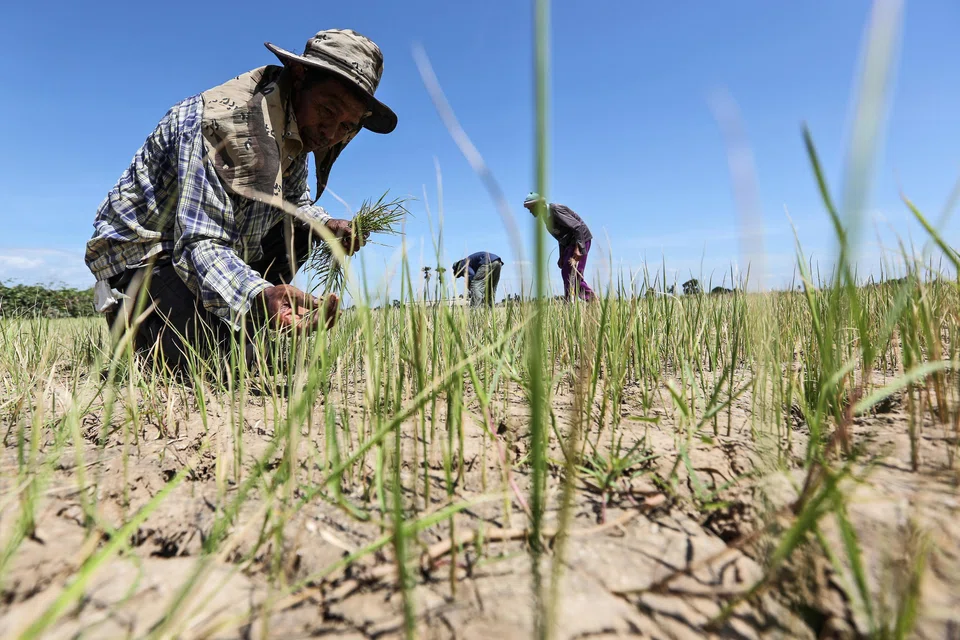
PUBLIC-PRIVATE partnerships through blended finance structures will play a key role amid louder calls to scale up and coordinate climate-adaptation action, observers told The Business Times.
Catalytic funding from the government would be an important starting point to lower the risks of adaptation-development projects, but the observers also said that it is paramount for the private sector to invest in such measures to build business resilience – especially for sectors such as agriculture, which is directly exposed to climate-change impacts.
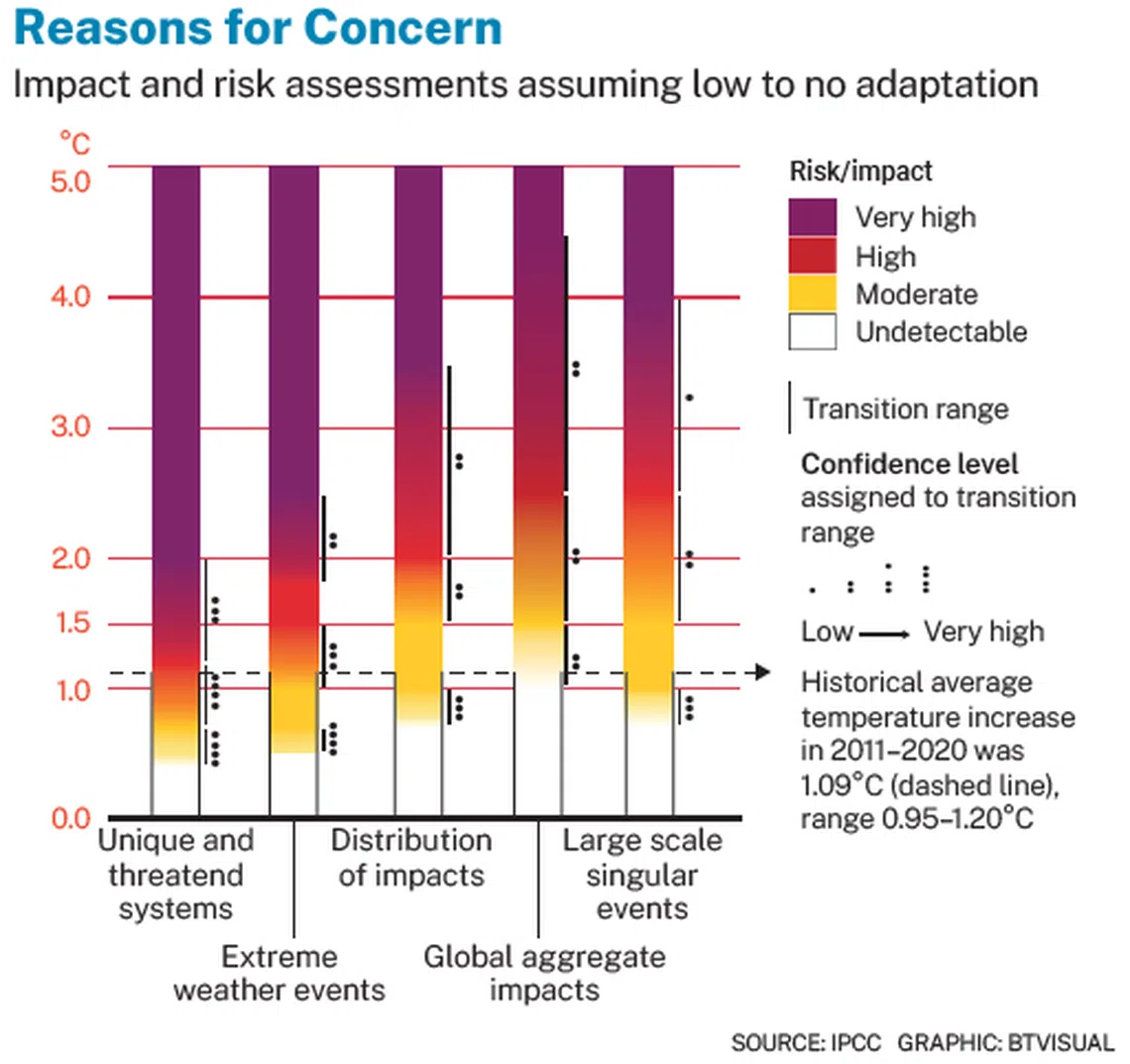
Those comments came in the wake of the Paris Agreement’s first Global Stocktake synthesis report, which showed that adaptation efforts are not keeping pace with increasing climate impacts and risks. The report will play a key role in the upcoming United Nations (UN) Climate Conference in Dubai, which begins in late November, as negotiators contemplate the future of their climate commitments.
The need for blended finance
Sharad Somani, partner and head of environmental, social and governance (ESG) at KPMG in Singapore, pointed out that adaptation measures are often seen as the poorer cousin of climate mitigation; they are under-invested, as the focus has been to contain climate impacts through the reduction of greenhouse-gas emissions.
That’s because most adaptation measures tend to be public infrastructure projects, such as coastal defences or drainage systems. And such projects tend not to lend themselves well to traditional commercial financing models, said Lubomir Varbanov, managing director and head of public-sector solutions for Asia-Pacific at Swiss Re.
This is because dividends often manifest as a loss avoided, rather than an additive cash flow on which investors can rely on, he added.
On top of these challenges are the facts that adaptation efforts are costly and most often needed in countries with limited resources, and they tend to be localised projects – where there are plenty of needs competing for limited funds, he also said.
The Global Stocktake report found that financial support for adaptation continues to fall far behind mitigation investments. However, the share of total climate-specific financial support has grown to 28 per cent between 2019 and 2020, compared to 20 per cent in the previous two-year period.
Citing forecasts from the UN Environment Programme, Somani pointed out that the annual cost of climate adaptation in poor countries alone could double or possibly even quadruple – from US$70 billion today to between US$140 billion and US$300 billion by 2030.
To direct such high levels of capital towards climate adaptation, observers said that blended finance – which combines private, public and catalytic funding – is an important mechanism.
Neha Bhatia, partner for ESG and sustainable finance at consultancy ERM, said that beyond developing a baseline framework or policy guidelines from which adaptation projects can take off, governments can provide the first layer of capital to absorb the initial risk before partnering multilateral development banks, or local development financial institutions, for the next layer of developmental capital.
“Only then, when you de-risk to this point... private players with innovative solutions can come in and build adaptation solutions on top of that, because they know that they have a stable policy environment, they know they have risk support, they know they have technical support,” she said.
Catalytic funding, in the form of grants, government incentives or impact investment, can also be the first layer of capital that enables the development of pilot solutions and proofs of concept, said Varbanov. He added that such collaborative models spread the costs and risks of change over several different actors.
Mobilising private finance
To get more private financing into climate adaptation, Somani said there is a need to address companies’ bias against such measures, which are often wrongly perceived as having low returns and impact.
The bias is evident given that the private sector’s contribution to adaptation measures stood at just 2 per cent of the global adaptation spend, according to data collated by non-profit outfit Climate Policy Initiative, he noted. As the impacts of climate change become more evident, businesses may actually end up forking out as much as 44 per cent of their profits to pay for damages caused by climate-related impacts, going by an economic study of nearly 15,000 public companies published in the journal Science last month.
One way to unlock more private-sector financing for climate adaptation is to have companies pay more attention to disaster risk, said Christopher Au, director of Willis Tower Watson’s Asia-Pacific Climate and Resilience Hub.
For example, a coastal manufacturing facility located in the Philippines, which experiences 20 typhoons annually on average, would see the value of investing in the conservation of mangrove swamps. These natural ecosystems have proven to be effective in preventing storm surges from reaching inland.
“This is a public good... But the mangrove being there is providing (the factory) financial benefits. It’s protecting your facilities. It’s allowing you to exist... You may not own the mangrove, but we think you should invest in its conservation because it’s protecting your facility,” said Au.
He also noted that there has been academic work showing that such nature-based solutions reduce losses from natural disasters by 25 per cent.
With reduced losses as a result of climate adaptation, companies could potentially experience more affordable and stable insurance premiums as well, though observers noted that premiums may not actually come down given that many other factors are being considered when pricing them.
While some told BT that there is a lack of data – regarding both adaptation activities and exposure to climate-related events – to help others understand how adaptation investments could affect broader risk assessments, Tobias Grimm said Munich Re has seen strong indications in its own data and analysis that climate change is a massive loss driver.
The head of climate advisory and natural catastrophe data at the reinsurer said: “Strengthening resilience and reducing vulnerability – at both individual and community levels – will help to soften the societal and economic shocks of natural disasters.”
While all companies across all sectors should invest in strengthening their business resilience against climate-related events, the agriculture industry is particularly exposed to direct impacts, observers pointed out.
With farmers facing more drastic weather cycles, major agribusinesses that depend on them as suppliers could consider extending loans to these farming cooperatives for them to invest in better irrigation systems or purchase seeds with higher yields, said Willis Tower Watson’s Au.
Financial institutions, though not directly hit by such events, have the most difficult and widespread exposure, said Alain Mahieu and Amy Steel, climate risk experts at Engie Impact.
“Portfolio managers face a daunting task (grappling) with widespread impact and inability to drive direct adaptation measures on the ground,” they said.
On the other hand, property developers are potentially big winners, especially those ahead of the curve on sustainable design and construction, said Olivia Jensen, deputy director for Lloyd’s Register Foundation Institute for the Public Understanding of Risk at the National University of Singapore.
“In the future, we can imagine floating residential districts off the coasts of Asia’s big cities, integrated with resilient infrastructure. In the more immediate future, onshore developments can incorporate flood protection with restoration of waterways and urban regeneration, raising property values,” she added.
Technology companies with solutions to improve water efficiency and reuse wastewater also stand to benefit in an increasingly water-insecure region.
Ultimately, regardless of the sector they are in, companies that take measures to strengthen their resilience against climate-related impacts would be able to stay ahead of the game, observers said.
Those that are able to come up with adaptation solutions, such as climate-adaptive clothing that is able to cool down body temperatures, or incorporate drought- or flood-resilient materials in construction, could also come out on top, said Bhatia of ERM.
Sometimes, adaptation actions do not have to come in the form of an infrastructure project, which is the conventional idea of what such measures entail.
Au noted that some companies are already increasing their resilience by identifying risks in their supply chains and addressing, diversifying or shortening them.
“The market will increasingly favour forward-looking companies that prioritise sustainability and are mitigating and adapting to climate change for a robust supply chain,” said KPMG’s Somani.
TRENDING NOW

Philippine power giant First Gen rebuffs foreign offers, plans up to US$2.6 billion in expansion

Once staunchly pro-China, Malaysian Chinese businesses are now distancing themselves from Beijing

Nearly half of Singapore workers put in at least six unpaid hours a week: survey
Vietnam’s data-centre investment rush faces reality check on power and site constraints

