

Inequitable for advanced economies to dictate pace of energy transition for Asean: Bank Negara director

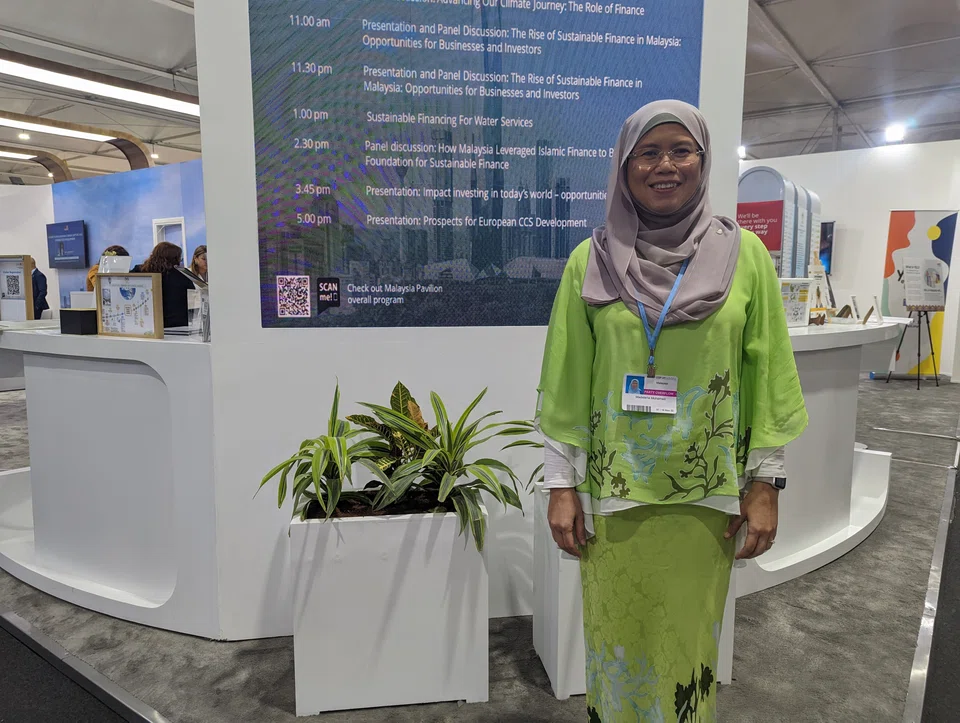
[SHARM EL-SHEIK, EGYPT] Advanced economies, particularly those in the European Union, are trying to impose their own decarbonisation pathways onto emerging markets in South-east Asia without working together with the less developed countries, said Madelena Mohamed, director of Bank Negara Malaysia’s sustainability unit.
One such example is the proposed carbon border adjustment mechanism, which seeks to propose tariffs on EU imports based on their emissions content — a measure that would hit small and medium-sized enterprises from emerging markets the hardest, Madelena told The Business Times on the sidelines of the 27th United Nations Climate Change Conference (COP27).
“Because they want to move, they want everybody to move at the same pace as theirs, so that nobody will actually be a drag to them,” she said. “Instead of working together, helping others to actually move. So, this is what we call climate equity. We don’t see that there is actually climate equity, because, you know, the advanced economies are dictating.”
Demands for high-income nations to do more to help developing countries combat climate change has always been a point of contention at the annual climate conference, with tensions intensified this year as negotiations on loss and damage funding — which refers to the destructive impacts of climate change that cannot be avoided by either mitigation or adaptation — was officially included in the agenda.
While Madelena did not specifically comment on loss and damage financing, she said that what is needed is capital investments and technology transfer.
“The advanced economies are talking about commitments and so forth,” she said. “I think for several COPs they have actually been talking about that. But I think, in reality, is that really happening? Is it really happening at the scale and at the pace It should be? Because we don’t think it is.”
But Sean Kidney, chief executive officer of the sustainable finance advocacy group Climate Bonds Initiative, said that companies need to sprint ahead in their energy transition, and not see it as a “gentle run” given that it has entered the race late.
He also said that the idea of ‘just transition’ — an approach advocated by top officials in the region to ensure that the negative consequences of energy transition on society are mitigated — should not be used as an excuse to slow down.
“We’ve got to enable and support companies, not get them to slow down. Now a lot of the just transition is ‘Hang on, take it easy, we’re gonna lose a lot of workers.’ That is the bad way. That is the problem. Rather, go full steam ahead. But make sure you’ve got someone behind you to pick up the people who have been left behind,” he said.
Kidney said that role should be mainly left to governments to make sure they get trained and find new work, such as in the case of Sweden.
“The reason we’re talking about special just-transition schemes is the failure of the state to support many places,” he added.
When asked about whether there is fairness in expecting emerging economies to move at the same pace as advanced economies, Kidney said: “I mean, there’s a lot of unfairness going on in the world, as if that’s ever changed anything”.
“By all means go red in the face and talk about unfairness. But let’s just get real about managing our world... Guilt hasn’t been motivating change in the last 20 years, don’t think it’s going to make any difference now,” he said.
What Asean economies need to do, in its decarbonisation journey, is to push for cheap capital, he added. “We’re not going to get handouts, we’re not going to get grants. We’re not going to get justice.”
However, Madelena argued that most of the financing for emerging markets in Asean do not come cheap, even those offered by multilateral development banks.
“They may, actually for instance, give you concessional rates, but it is actually in foreign currency. So then you have to take the foreign exchange risk. So at the end of the day, you know, all in, it is expensive,” she added.
Notwithstanding the hurdles, central banks in Asean are pressing on with their efforts to push forward decarbonisation in the region, Madalena said.
An Asean task force co-chaired by Madelena and comprising central banks in the region, has put together a report on the roles of central banks in the region in mitigating climate risks in November 2020, and they are in the midst of implementing these recommendations, though they are non-binding.
Some of these recommendations include setting up an Asean green map, building up capacity and awareness on climate change, as well as establishing an Asean taxonomy.
The first version of the Asean taxonomy, which provides definitions of what can be considered green for the purpose of obtaining sustainable finance, was published in Nov 2021. The Asean Taxonomy Board is currently in the midst of preparing the second version.
“I think whatever that is being worked on now, there’s a need for us to give time for that to happen, to take place,” Madalena said. “So the key thing is, you have the recommendations, but now it’s really to implement it.”






