

Issue 1: Singapore’s green bond framework, Asean’s green funding gap

Singapore
Setting the stage for green bonds
THE Singapore government has published a green bond framework for debt issued by the government. The framework is aligned with key international standards recommended by the International Capital Market Association and the Asean Capital Markets Forum, which should be welcomed by a market wary of unorthodox “green” standards.
The framework marks an important first step towards the Singapore government issuing up to S$35 billion of green bonds by 2030, a plan that was announced earlier in the year during the national budget.
Making use of the green label is not just jumping on a very trendy bandwagon. Sovereign issuance is important to help spur private issuance and establish pricing benchmarks, which are necessary to develop the sustainable finance market in Singapore. It is also likely to be cheaper for the government to raise money this way, given that labelled sovereign debt issues have been enjoying greeniums (see here and here).
Bonds issues under this framework may fund activities under eight categories:
- Renewable energy
- Energy efficiency
- Green buildings
- Clean transportation
- Sustainable water and wastewater management
- Pollution prevention, control and circular economy
- Climate change adaptation
- Biodiversity conservation and sustainable management of natural resources and land use
The past month may have seen a wave of fresh doubts about ESG investing, but this is probably what happens when stuff that is trying to pose as sustainable comes up against a market that is learning to be more discerning. The fact is that money still seems to be keen on activities that are genuinely sustainable and impactful.
The latest example is Singapore investment group Temasek committing S$5 billion of startup capital to a new investment company dedicated to decarbonisation solutions. Called GenZero, the new firm will focus on technology-based solutions, nature-based solutions and solutions that support the development of a carbon ecosystem.
Other Singapore reads
- Investors making their voices heard, votes count in AGMs
- Poor management of biodiversity also a risk to financial stability of economies: MAS
South-east Asia
The US$3t funding gap
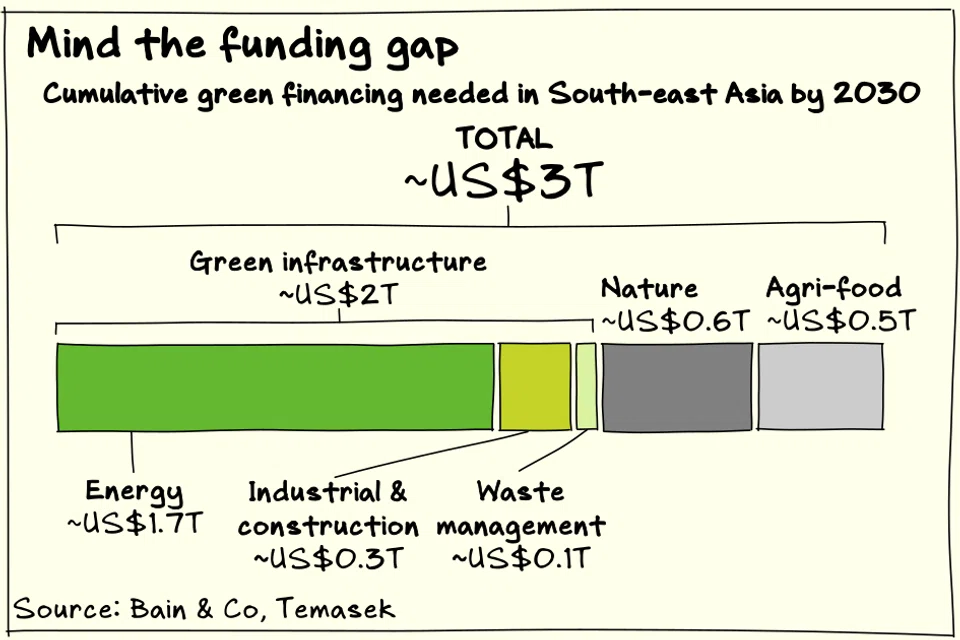
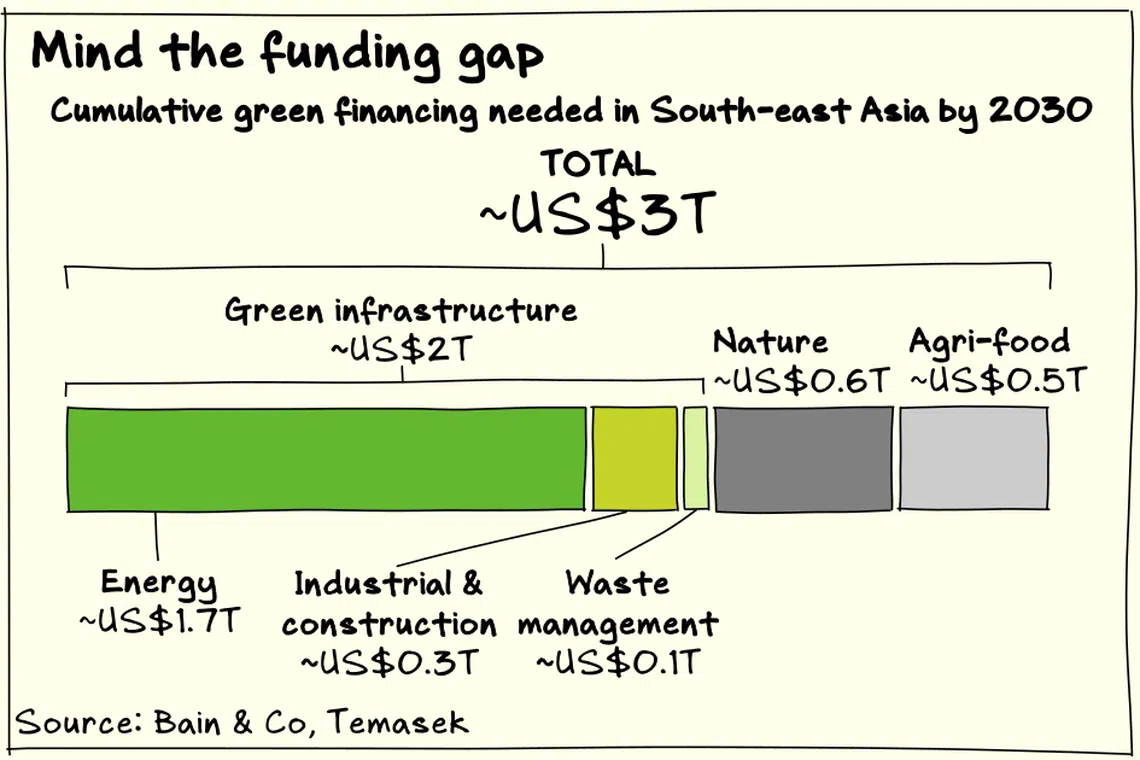
A new report by Temasek and Bain estimates South-east Asia needs about US$3 trillion of cumulative investments in climate change mitigation for the region to limit global warming to 1.5 deg C by 2030. Only about US$20 billion has been invested so far. Not surprisingly, the report found that no South-east Asian country is on track to achieve that level of global warming mitigation. Click here for the full report.
The size of the gap reflects investment opportunities, but it also represents the scale of change required to make South-east Asia sustainable. To put the US$3 trillion in context, it is roughly equal to the US$3.2 trillion total combined GDP of Asean in 2019.
Even if the region can achieve those investment levels, there will still be incredible challenges in ensuring a just transition with changes at that scale. Consider, for example, how coal, oil and natural gas are still the dominant sources of energy in the region. How will the region manage stranded assets and social displacements as it moves toward renewable energy?
Other South-east Asia reads
- What’s changed over 30 years of sustainable investing in Asia?
- Only 17% of sustainability leaders in Asia-Pacific’s finance sector are in C-suite: report
Other good reads
Where were you when DWS and Deutsche Bank were raided by German authorities amid investigations into greenwashing? The inevitable spotlight on the slippery, malleable and unavoidable concept of “ESG” investing has led to a lot of soul searching.
As a section in a newspaper or a library, it kind of makes sense to put environmental, social and governance stuff together; they’re aspects of business risks and opportunities that fall outside the traditional financial lens. As an investment concept, however, grouping them together can lead to weird outcomes.
Take the task of trying to create an ESG index, for example. Let’s say you assign weights to E, S and G components, then assign scores and work out a weighted average. Well, does that mean a company that’s terrible at the E stuff, but amazing at S and G, is comparable to a company that’s just above average for each of the three pillars? It’s heady stuff like these that give you the Aggregate Confusion Project.
Also check out the Asian Development Bank’s latest report on local-currency sustainable finance in Asean+3.
TRENDING NOW

Grab CEO’s wife Chloe Tong on life with Anthony Tan and finding her purpose

What role can Japan play in Asean’s future?

He built the Vingroup empire. Now South-east Asia’s richest man is handing some key roles to his sons

Asean’s challenge is to become resilient against global geopolitics: former Indonesia trade minister

