Issue 101: Singapore keeps cheap green borrowing streak alive; Indonesia’s mixed signals on coal

In this issue: Singapore’s new 30-year green bond yields less than price talk, while Indonesia can’t let go of captive coal plants just yet.
Singapore
Hitting another green bond out of the park
Singapore continues to draw strong demand for its long-dated green bonds, demonstrating how far a country’s creditworthiness can go to lower the costs of funding its green transition.
South-east Asia’s wealthiest country just sold S$2.5 billion of 30-year Green Singapore Government Securities (Infrastructure) – also called Green Singa bonds – at a yield of 3.3 per cent.
Preliminary indications during marketing were for a deal size between S$2.1 billion and S$2.5 billion at a 3.46 per cent yield, so the offering was aggressively priced. Singapore got to borrow the most that it was asking for at a cheaper rate than it had initially put on the table.
The deal benefitted from what appears to be strong demand at the 30-year part of the yield curve. The existing 30-year benchmark is the 1.875 per cent bond due 2051, and word on the street was that those bonds were terribly illiquid.
A lack of liquidity could be due to a number of reasons, but in this case, the view was that buyers far outnumbered sellers.
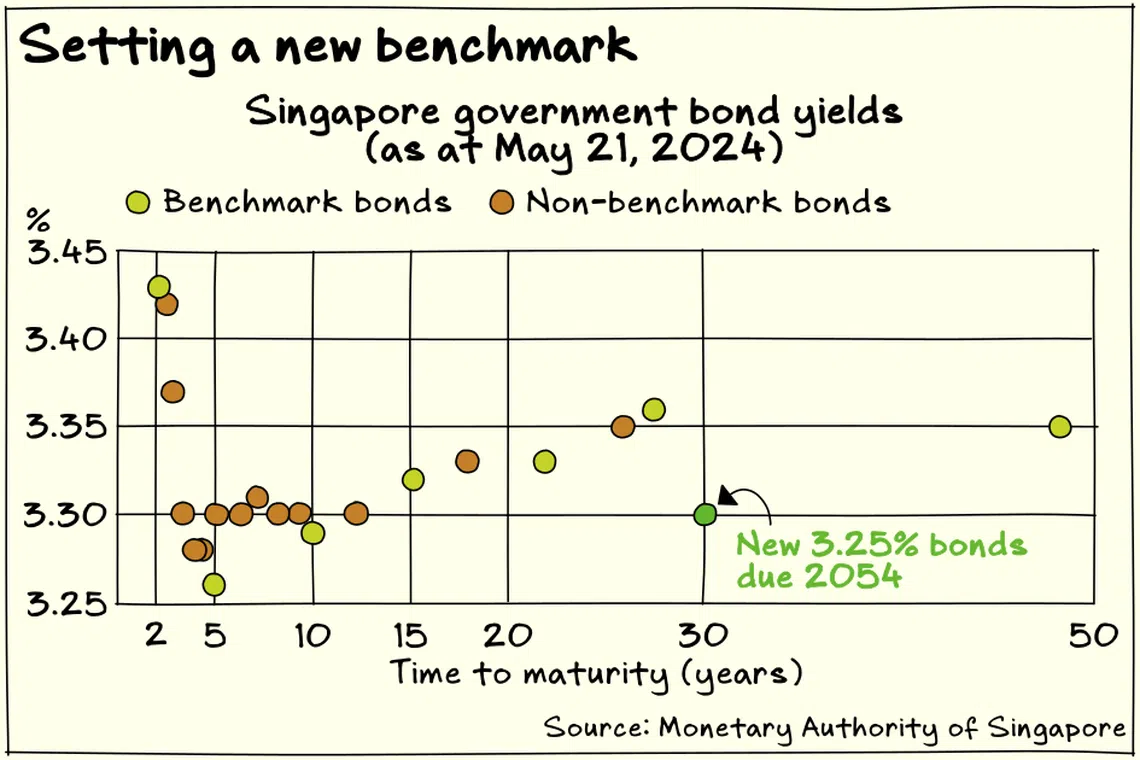
The new offering’s pricing seems to support that view. At 3.3 per cent, the new bonds are coming six basis points below the 2051 bonds’ 3.36 per cent yield, which raises the possibility that actual demand for 30-year paper is stronger than what the current benchmark is showing.
There’s reason to believe that the new deal’s pricing is a more accurate reflection of demand than the existing benchmark, which will be replaced by the new Green Singas as the 30-year reference price.
First, the 2051 bonds’ illiquidity may hinder their effectiveness in price discovery. Second, the 50-year benchmark – the 3 per cent Green Singas due 2072 – was quoted at a yield of 3.35 per cent on May 21. Shorter-dated bonds should typically bear a lower yield than longer ones, so the new deal removes an unusual inversion in the 30-to-50-year portion of the yield curve.
This is Singapore’s third offering of Green Singa bonds, and the sovereign issuer has managed to hit the most favourable part of price talk each time.
The 50-year Green Singa will be reopened in September, at which time Singapore will try to keep the streak alive. Regardless of where Singapore lands versus price talk in September, it’s unlikely that the country will be able to get a 3.04 per cent yield again, as it did in both previous offerings of the 50-year bond. The reopened yield will probably hew closer to the prevailing market price; the 50-year bonds now yield around 3.35 per cent.
Being able to raise cheap financing is handy when it comes to decarbonisation, which is a highly expensive endeavour even without having to borrow to pay for it.
Singapore is fortunate because the country has a strong balance sheet, which allows it not only to borrow large amounts of money, but also to stretch out the debt maturities into the decades, and do it all by paying relatively low interest rates.
In 2022 – the same year Singapore issued its inaugural Green Singas, a US$2.5 billion 50-year offering priced to yield 3.04 per cent – Indonesia sold US$1.5 billion of 10-year green sukuk at a yield of 4.7 per cent.
In the brutal commercial honesty of the capital markets, a country doesn’t get to pay less for its debt just because its needs might be greater.
That pricing reality – debt financing is costlier for poorer countries – illustrates one challenging aspect of sustainable finance.
Because the scale of decarbonisation is so large, capital markets are often seen as a key channel through which climate action can be scaled up. Borrowing at commercial rates is also expensive for many developing and emerging countries, however, and sometimes prohibitively so.
Concessionary capital, whether through outright philanthropy or blended finance, is one way those financing costs can be lowered. However, there is only so much a country can and should borrow before its balance sheet is no longer defensible.
That’s why there has been increasing discussion about debt relief, through which initiatives such as debt-for-climate or debt-for-nature swaps can potentially support transition in developing and emerging economies without overly burdening them with debt obligations.
Other Singapore reads
- MAS, PBOC further collaboration in green finance
- DBS takes part in S$286 million blended-finance project in Indonesia
South-east Asia
Indonesia’s confusing coal position
Indonesia appears to be walking a hazy path in terms of its coal policies.
On one hand, the country says it wants to achieve net zero emissions by 2060 and has required that of new captive coal plants – off-grid plants built to serve specific industrial facilities such as nickel mines and processing plants.
On the other hand, Indonesia has taken the position that captive coal plants are a necessary transition power source in certain circumstances. One of those would be when the plants support the production of nickel, a key material used in the production of electric vehicle batteries, for example.
Because nickel production requires a steady and stable source of power, and given the time and resources needed to build renewable power that can meet those requirements, Indonesia has argued that its nickel industry – an important player in the electric vehicles supply chain worldwide – would be inappropriately hampered if captive coal plants were banned sooner.
Analysts now expect Indonesia’s coal production to keep rising until the end of the decade as incoming president Prabowo Subianto puts economic growth and nickel processing at the top of his agenda.
The confusing signals can make it challenging for Indonesia to attract climate-related financing because of uncertainty about the country’s seriousness and its ability to meet its decarbonisation goals.
There’s plenty to be sceptical about when it comes to Indonesia’s commitment to decarbonisation.
Indonesia’s nickel mining industry does not need more help to increase production. In fact, the Indonesian miners’ ability to produce large quantities of nickel cheaply – largely because of their ability to use captive coal plants – has flooded the nickel market, leaving many nickel producers struggling to stay afloat.
By sticking to its environmentally sustainable guns, Indonesia might actually do its industry a favour by forcing a slowdown of production and letting prices recover. Indonesian miners that can operate sustainably could also capture pricing premiums for “green” nickel.
Furthermore, allowing more captured coal plants to be built now kicks the can down the road. Coal plants have long lifespans, and getting plant owners and investors to stop using a viable plant in the future will be extremely challenging.
It’s the same situation Indonesia faces with its young fleet of on-grid coal-fired power plants, the early retirement of which is such a massive task that international aid is required.
If Indonesia’s nickel miners are facing a serious operational problem with sustainable, stable and steady power, a more effective solution might be for the Indonesian government to channel its developmental resources towards making those sustainable solutions more easily available.
The captive coal plant policy seems only to feed the original problem. It’s like buying a smoking addict more cartons of cigarettes instead of paying for treatment and care.
Other South-east Asia reads
- Singapore, Japan investors less optimistic than Asian peers about ESG funds’ performance
- Nearly one in 10 Apac Reit assets at high risk from climate change: report