Issue 122: Energy Week panellists paint fossil future; MAS sustainability chief urges ‘get our act together’

This week in ESG: Fossil fuels’ place in the energy transition; Singapore central bank’s CSO Gillian Tan says credible regional collaboration can unlock investments
Energy transition
Fossil fallacy
Energy industry panellists at this year’s Singapore International Energy Week are probably correct that fossil fuel usage will keep growing over the next decade, but they are probably wrong that this outcome is both inevitable and more equitable for developing countries.
Many panellists – which included senior representatives from Singapore’s DBS Bank and Sembcorp Industries, Saudi Arabia’s Aramco and the US Department of Energy – at the event held the view that fossil fuel usage will constitute a larger slice of the global energy mix by 2035.
That view appears to be an accurate reading of the current trend. The International Energy Agency’s (IEA’s) World Energy Outlook 2024 report found that even though the world added a record amount of clean energy in 2023, two-thirds of the global growth in energy demand was still met by fossil fuels.
However, what is concerning is the prevalence of two ideas in discussions.
The first is that the increasing share of fossil fuels is inevitable because renewables growth cannot keep up with demand.
That would be true if the expansion of renewables capacity was limited by physical constraints such as scarcity of materials or a lack of suitable real estate. But there is good reason to think otherwise. For instance, solar panel prices are near historical lows amid oversupply issues. Indonesia has been so aggressive in extracting nickel – a core input for batteries – that nickel prices have also caved.
Instead, the tepid pace of growth in clean energy is more probably related to insufficient funding or politics. The IEA’s scenario for net zero emissions by 2050 requires tripling installed renewables capacity by 2030, which will need current investment levels in renewable power, grids and battery storage to double to US$2.5 trillion by 2030, further increasing to US$2.7 trillion by 2035.
Capital isn’t allocated in a vacuum, and the large financing gap for clean energy is ultimately a failure of policy. Meaningfully higher carbon pricing, incentives and risk mitigation support for renewables investments, cost-of-living support for transitioning communities, developmental aid and phase-out deadlines for fossil fuel infrastructure are just a few examples of measures that governments can undertake to shift the calculations for investors and nudge business and investment decisions towards more sustainable activities.
This is not to suggest that it is easy for policymakers to direct capital towards sustainable energy. If it were easy, it probably would have been done by now, by many countries. But just because something is hard doesn’t mean it’s OK to not try. Governments can do more, so the predicted increase in fossil fuel dependence is by no means inescapable.
The second flawed idea that has emerged is the notion that trying to transition too quickly is inequitable for developing countries.
The basis for the inequity claim is that transitioning too quickly will be too costly and impose too much of a burden on developing countries.
That burden shouldn’t be trivialised, but in a similar vein to the first flawed idea, issues of cost can be significantly mitigated by policy. Substantially more financial support flowing from the Global North to the Global South can help to reduce the pain for developing countries, for instance. Countries with fossil fuel subsidies can reallocate resources towards renewables.
Perhaps more importantly, claims that the energy transition is inequitable for poorer parts of the world ignore the point that the developing world will also bear a disproportionately high level of pain from climate change. So, yes, the energy transition is unfair to these countries, but global warming is unfair to them too.
Inequity is a poor excuse for inaction and prolonging a destructive status quo.
The trappings of modern society have largely been built on the back of fossil fuels, so if there is one aspect of the energy transition that is inevitable, it is that it will be extremely challenging. The nascency of some potential alternatives like hydrogen and carbon capture and sequestration, as well as the usual lead time required for new infrastructure, mean that the energy transition cannot happen overnight.
Some reliance on fossil fuels in the short-term is therefore necessary. But such an accommodation shouldn’t become indefinite inaction. There must be sufficiently ambitious commitments to phase out that usage in line with credible decarbonisation pathways.
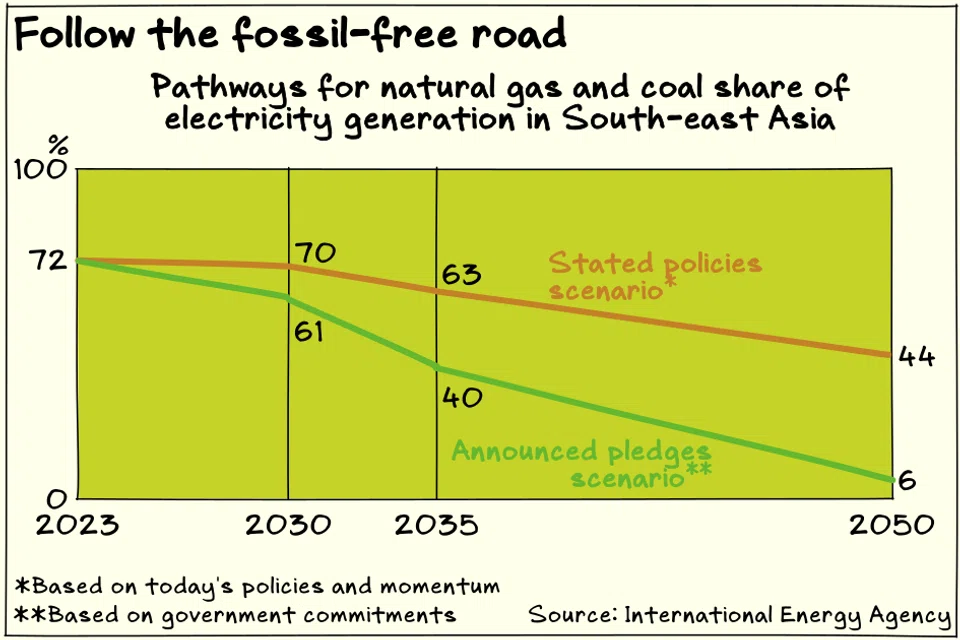
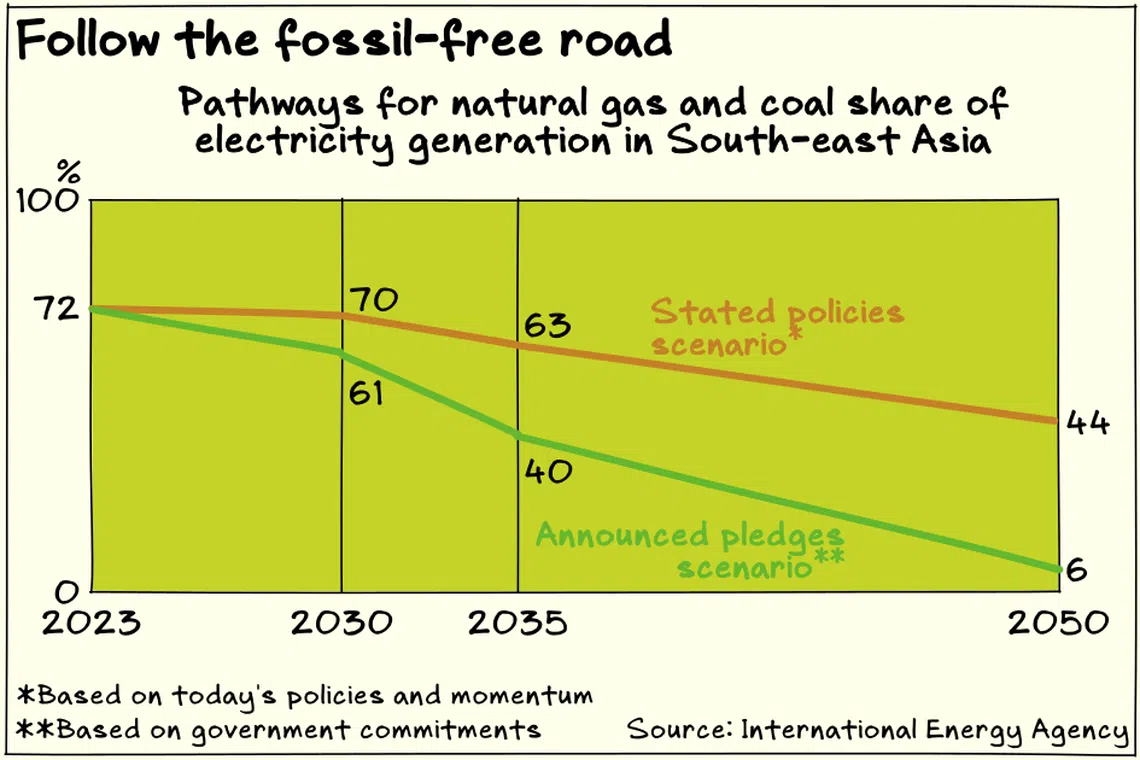
Those pathways exist. The IEA’s scenarios based on stated policies and announced pledges both envision fossil fuels’ share of electricity generation in South-east Asia peaking before 2030. There is a way, if there is the will.
Sustainable finance
Governance matters
Monetary Authority of Singapore chief sustainability officer Gillian Tan may have hit upon an underappreciated hurdle to scaling up blended finance – and a potential strategy to overcome it.
While speaking at the Singapore International Energy Week, Tan mentioned that developing the Asean power grid can unlock more energy transition investments in South-east Asia.
“The market is watching,” she said. “(It’s) watching to see whether (we), governments, get our act together and actually harmonise and make interoperable our standards, our methodologies. And if we can do that, I think commercial investment will come in.”
One of the biggest dangers of investing in emerging markets is often perceived to be political risk. That could come in the form of ineffective or unpredictable policies, government stability and even expropriation in extreme cases. The risk not only reduces the amount of available capital for emerging countries but also raises the cost of capital.
Tan, therefore, rightly points out that demonstrating policy success is important to improve access to capital for the region since investors can be more confident about outcomes.
Tan’s examples – standards and methodologies – are certainly closely watched. For sustainability investors, regional initiatives like the Asean Taxonomy for Sustainable Finance can also reflect the region’s level of commitment and ambition towards sustainability.
Building up credibility for the Association of South-east Asian Nations also benefits regional investment platforms. A regional platform could allow concessional and commercial investors to spread out their exposure to political risk, so that trouble in one single country can be mitigated by other countries in the region.
Other ESG reads
- Singapore will seek financing to develop infrastructure for clean energy imports: EMA chief
- Singapore to import low-carbon electricity from Australia’s SunCable mega solar project
- EMA awards S$7.8 million in research grants to explore battery energy storage solutions
- Enterprise Singapore and EDB to launch sustainability reporting grant in November
- South-east Asia needs to boost investments five-fold by 2035 to meet climate goals: IEA
- Syngenta seeks US$3 billion ESG loan, Asia’s biggest this year
TRENDING NOW
He built the Vingroup empire. Now South-east Asia’s richest man is handing some key roles to his sons
Can CDL become a powerhouse in fund management?
Canada is upping oil flows to Asia, but South-east Asia’s refineries aren’t ready to handle them yet
Data centre energy demand from Asean telcos not a ‘big risk’, says industry group