

Issue 132: Natural disaster losses mount; nature reporting lags; tokenisation keeps trying

This week in ESG: Munich Re finds higher losses from natural catastrophes; Asia-Pacific companies not aligning with nature reporting framework; NUS, Northern Trust, UOB tokenise green bond impact reporting
Climate Adaptation
Insurance numbers don’t lie
If there’s one industry that’s unequivocally concerned about climate risk, it’s insurance.
The sometimes-gradual impact of climate change might be difficult to observe for a casual observer, but the insurance industry has seen the numbers on its bottom line, and it has little doubt about the need for stronger climate action.
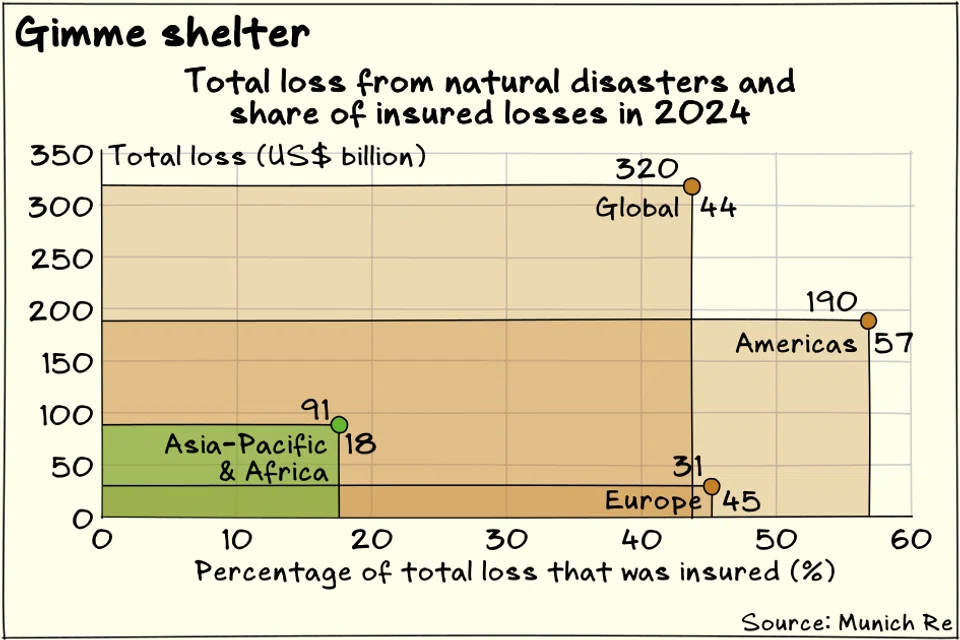
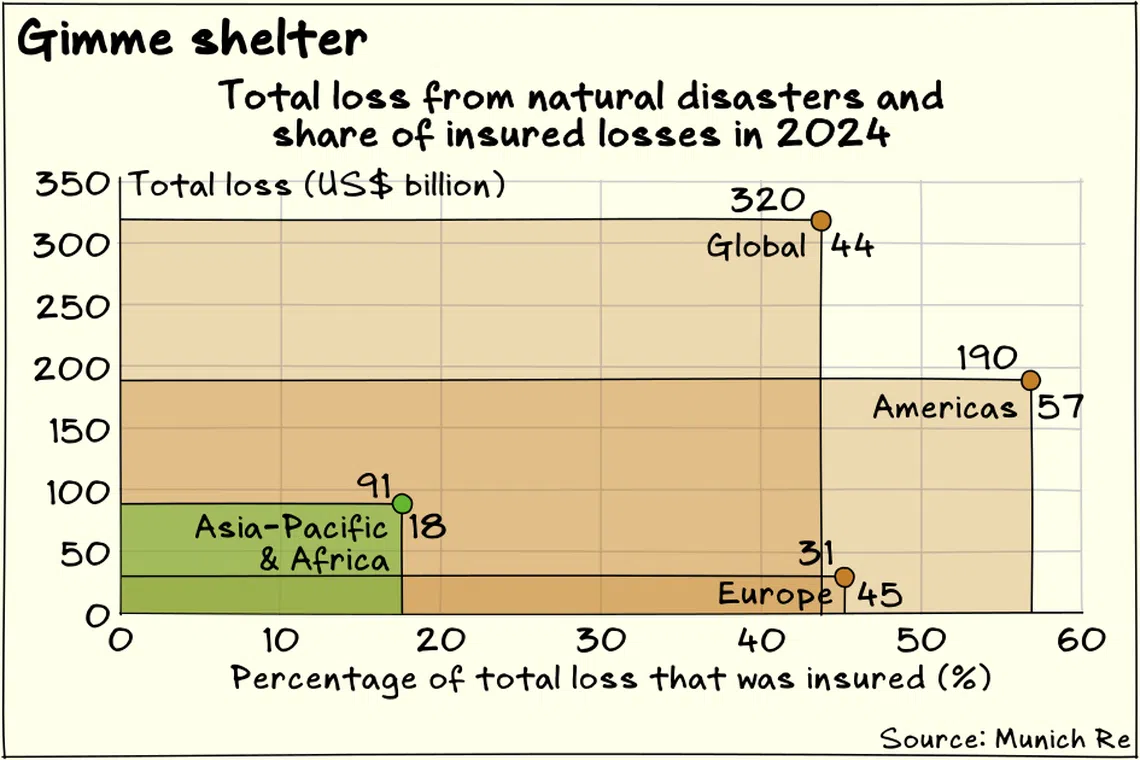
In 2024, natural disasters caused US$320 billion of losses around the world, of which US$140 billion were insured, says an analysis by reinsurer Munich Re. Since 1980, only two years have been more expensive for the industry, Munich Re says.
The link between the increase in natural disaster damage and climate change is clear, Munich Re said.
It starts with higher global temperatures, which hit about 1.5 degrees Celsius above pre-industrial levels in 2024. Warmer air is able to hold larger amounts of moisture, which affects rainfall. The assembly of scientists known as the Intergovernmental Panel on Climate Change has determined that heavy precipitation will become more frequent and more intense as the planet warms. That also means an increase in frequency and magnitude of floods.
Extreme storms will also become more common. Although there is some question about whether the frequency of tropical cyclones will increase due to climate change, there’s higher certainty that cyclones, when they occur, will be more severe and escalate more quickly.
Despite the increase in extreme rainfall, droughts will also become more frequent in some regions as higher evaporation rates lead to insufficient soil moisture and surface runoff.
High alert for Asia
The trends are especially concerning for Asia, which not only has high exposure to natural disasters but is also relatively underinsured.
The Asia-Pacific and Africa regions suffered US$91 billion of losses from natural disasters in 2024, which was significantly higher than the 10-year average of US$66 billion, Munich Re data shows.
Only US$16 billion of those losses were insured. That’s just under 18 per cent of total losses, a lower insured rate than about 44 per cent globally.
The Noto earthquake and tsunami in Japan on New Year’s Day was among the most costly in Asia in 2024, causing US$15 billion of total losses, of which US$2.5 billion was insured. In September, Typhoon Yagi’s path of destruction through the Pacific coast countries including China, Laos, Myanmar, the Philippines, Thailand and Vietnam caused US$14 billion of losses. About US$1.6 billion of that was insured. Heavy rainfall in June and July led to severe flooding in China, with US$12 billion of losses, including US$1.6 billion insured.
A 2024 report by the World Meteorological Organisation found that Asia was the world’s most disaster-hit region in the world in 2023, with 79 hydro-meteorological hazard events in its database. More than 80 per cent of those disasters were related to flood and storm events, with more than 2,000 deaths and nine million people directly affected.
Adaptation investment in the region is more critical than ever, because addressing the damage from those events is likely to become more challenging. The aspirational 1.5-degree warming threshold is almost certainly going to be breached, and the 2-degree goal will probably be missed as well.
Furthermore, the cost of inaction compounds. In America, insurers have begun to cease coverage of areas that are highly prone to natural disasters but lack adequate protection. Some homes in the hurricane-prone state of Florida and in California, where a wildfire is currently raging in the Pacific Palisades, have been declared uninsurable by some insurers.
As the threat of climate-related catastrophic damage increases, insurers will have little choice but to raise premiums to cover the higher risks, and that will flow into higher costs across the board, be it owning a home or running a business. If the risks get high enough, insurance might no longer be an option, and communities will be left under-protected.
Sustainability reporting
Reporting doesn’t come naturally
Almost seven-eighths of large Asia-Pacific companies have not disclosed alignment with the Taskforce on Nature-related Financial Disclosures (TNFD) framework, finds a study by the French luxury group Kering and the National University of Singapore’s Centre for Governance and Sustainability.
Singapore’s adoption rate of 14 per cent was close to the overall average of 13 per cent, the study found. Australia led the pack, with a 42 per cent alignment rate, followed by Japan, at 32 per cent, and Taiwan, at 24 per cent.
The low alignment rate is not surprising, given that the first edition of the TNFD framework was only launched in 2023. Companies also face no pressure to adopt the TNFD framework from regulators, whose focus remains primarily directed at climate-related disclosures.
Many of the large listed companies are also currently in the midst of getting into compliance with the relatively new International Financial Reporting Standards (IFRS) global accounting rules on sustainability and climate disclosures, which were also released in 2023.
Companies can’t simply decide to report on something and immediately do it; there is typically a period during which processes are designed and tested to ensure that whatever is reported is reasonably accurate. It’s understandable that many companies might not feel that they have the bandwidth to handle all of these new reporting requirements at the same time.
But it’s never too late to get started.
The TNFD framework focuses on a broad range of nature-related factors. While some of those factors may not be material to all businesses – a professional services firm may not have much to do with protected or conserved areas, for example – there are enough that can pose risks or that are materially affected by most businesses.
For example, water availability and water condition, and pollution are issues to which most businesses should pay attention. For example, lowering water usage can save on bills for most businesses. Reducing pollution can reduce the risk of penalties and liabilities.
Addressing nature-related issues in a more structured way can bring unexpected benefits. For instance, businesses that own buildings in urban areas might not think their assets affect local ecosystems, but something as simple as rooftop gardens with native plants can be useful to local flora and fauna.
Sustainable finance
Token innovation
The National University of Singapore (NUS), Northern Trust and UOB have teamed up to tokenise green bond credentials.
Under the collaboration, Northern Trust will mint and hold a green bond reporting token. The token will hold environmental impact reporting data from NUS’ green bond due 2033, which was issued in 2023. UOB, the lead arranger of the bond, will provide feedback on how the tokenised data can “enhance investors’ sustainability reporting practices”, states a press release.
In explaining the move, the partners say that “the tokenisation process will focus on ensuring data integrity, providing investors with confidence that the environmental impact reporting data is secure, immutable, and reliable for their own sustainability reporting obligations. Investors of the bond will receive the same complete set of information which will remain unchanged even as the bond changes hands.”
The exercise follows experiments in a number of other jurisdictions to tokenise green bonds. For example, Hong Kong tokenised a series of green bonds in 2023.
Supporters of tokenisation argue that the process of putting the bonds can create certain efficiencies, such as automating payout conditions, reducing settlement times or, in the NUS case, ensuring data integrity.
But the reality is that market players are on the whole still slow to move on from the current system of doing things. Take data integrity, for example. The financial markets aren’t generally struggling with insecure, mutable and unreliable data, for a few reasons.
The first is that assurance, when used, is already a pretty well-established process to ensure that data is reliable. If an auditor is willing to sign off on the report, it’s generally accepted that the report is fairly accurate.
Even if there were issues with data integrity, tokenisation in this instance might not make the data any more reliable because the data is provided and verified by NUS. Sure, the tokenised data might be virtually immutable, but that’s meaningless if the data isn’t accurate to begin with. Bad data that lasts forever is forever useless. Whether the data is to be trusted still boils down to whether credible third-party assurance has been carried out, and that’s not something that requires tokenisation.
Ultimately, relying on accredited verifiers is still the best way to ensure the integrity of data. This need for one or a small pool of authoritative entities to verify truth can make the distributed nature of blockchains – the key technology in tokenisation – inefficient.
When asked about the value of the tokenisation initiative, Alvin Chia, head of digital assets innovation for the Asia-Pacific at Northern Trust, explains the move as a chance to redefine “best practice” for an emerging asset class.
“We saw this as an opportunity to further enhance transparency, data integrity, and investor confidence. For example, would a quarterly update cadence bring more value for the bond investors?” he says.
If quarterly updates are provided, would it be easier to just put those reports up on the website? NUS already provides its annual updates, which are assured by EY, on its website.
The attempt to improve and innovate sustainable finance is laudable and should be encouraged. It’s possible that some forms of efficiency improvement can be extracted by tokenising the reporting, but the tokenisation industry will have to make a more convincing case about the value of the technology.
Other ESG reads
- GuocoLand bags S$1.2 billion in green loans
- Grab partners BYD to expand electric vehicle fleet offering across South-east Asia
- Malaysia’s Yinson secures deal with investors including Abu Dhabi for US$1 billion funding
- Apollo, StanChart sign US$3 billion energy transition partnership
- Airbus partners SP Group to reduce emissions from electricity at Singapore training centre
- Expanding South-east Asia’s grid supply chains can mitigate critical transmission equipment shortages
TRENDING NOW

Once staunchly pro-China, Malaysian Chinese businesses are now distancing themselves from Beijing

Britain’s mansion tax shows the difficulty of targeting wealth

Three hats, one goal: How Ng Kian Swan runs sustainability at NUHS

COE review: The gap between luxury and mass-market cars isn’t the only one worth bridging

