

Issue 43: Consumers bite on banks’ green loans; people matter in Asean Taxonomy

In this issue: Singapore banks probably aren’t offering green consumer loans because environmentally conscious spenders are more creditworthy. On policy, the Asean Taxonomy now requires an assessment of a project’s social impact.
Singapore
Banking on the green life
Singapore banks have been seeing strong demand for their green consumer loan offerings.
OCBC Bank said this week that it has extended S$3.5 billion of “Eco-Care” home, renovation and car loans in the two years since it launched the programme. UOB said its “Go Green” car loans represent 15 per cent of its total car loans. DBS said 90 per cent of its renovation loans are a green loan.
These loans charge a lower interest rate for borrowers who meet certain environmental criteria. When the OCBC loan was announced in 2021, interest on an Eco-Care home loan was about 20 basis points lower than the plain vanilla option. The loans therefore make sense for consumers who can pass the green tests.
But why would the banks offer these loans?
It wouldn’t be surprising if there was some aspect of riding the hot consumer trend to gain market share. Studies have shown that younger consumers are more passionate about sustainability issues and interested in exploring sustainability-related products.
For the banks, which have their own sustainability goals, the environmental criteria also contribute to the greening of their loan portfolios and their financed emissions.
It is unlikely that the preferential interest rates reflect better creditworthiness among green consumers. For a start, there is a dearth of research into the relationship between a consumer’s green credentials and creditworthiness. Do green consumers represent lower credit risk? Are the folks buying electric vehicles wealthy executives with stable jobs, or wealthy start-up employees who are going to be jobless after the next round of layoffs? Does having a green home make you less likely to default or make the home more valuable in a liquidation? There doesn’t seem to be enough certainty on which to act.
More analysis has been done on corporate credit quality and sustainability performance. The general sense appears to be that the larger green companies tend to enjoy a green premium from the market. But these findings don’t necessarily apply to consumers.
In any case, while the green consumer loan segment appears to be growing, it is still a small slice of the overall loans pie. OCBC had S$295 billion of customer loans as at end-2022, making the Eco-Care loans only about 1 per cent of its total customer loans portfolio. Not quite an earth-shattering impact.
Other Singapore reads
- Waste reduction a key hospitality focus as consumption rises with tourism’s return: Ascott MD
- CapitaLand Investment removed from iEdge-OCBC low-carbon index; ComfortDelGro added
South-east Asia
Asean green finance goes woke
A lot of attention has been paid to the Asean Taxonomy Board’s inclusion of a transition financing framework for coal phase-outs. This is the first time a regional taxonomy – which defines what can qualify for sustainable financing – has laid out such a framework for coal phase-outs.
It’s certainly an important step. Coal supplies about a quarter of the Association of Southeast Asian Nations’ energy, which makes accelerating the obsolescence of coal plants a priority. With the Asean Taxonomy’s update, the hope is that banks and investors now have more clarity about how to finance the phasing out of coal.
An underappreciated, and potentially just as important, update to the Asean Taxonomy is that it now includes a test for social factors in its Essential Criteria (EC). The Taxonomy requires that activities are aligned with every EC.
There were already two ECs before the update.
The first was a “do no significant harm” (DNSH) criteria, which is easy to grasp: Don’t create more problems when you try to solve one. But its scope was restricted to the Asean Taxonomy’s four environmental objectives: climate change mitigation, climate change adaptation, protection of healthy ecosystems and biodiversity, and resource resilience and the transition to a circular economy.
The second EC was a test for remedial measures to transition. Solutions should be in place to remove any significant harm within five years from the assessment date.
Both those ECs were focused on environmental factors. The addition of the social aspects EC adds a new dimension to the assessment.
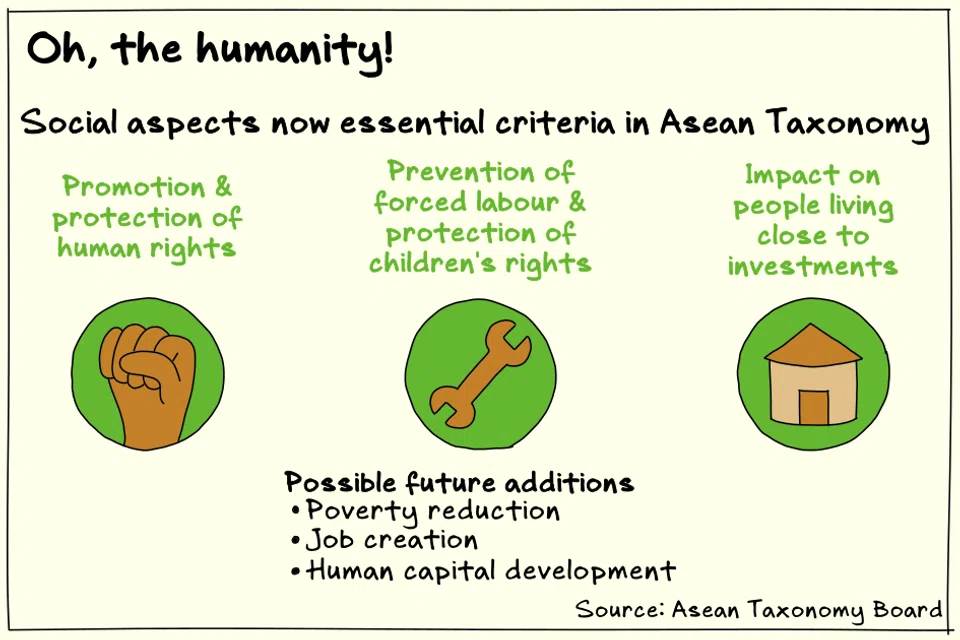
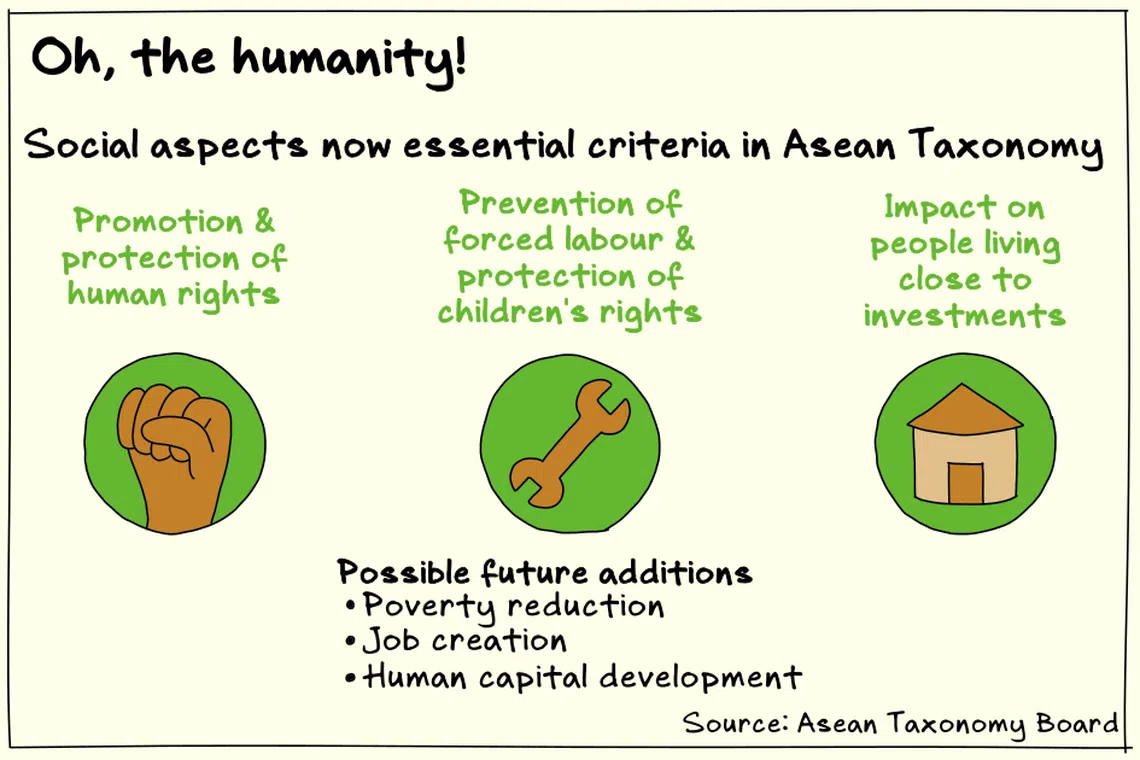
The social aspects EC requires that activities adhere to the promotion and protection of human rights, the prevention of forced labour and the protection of children’s rights, and take into consideration the impact of investments on people living close to them. The definition of those social aspects draw from their respective Asean declarations.
Other social aspects, including poverty reduction, job creation and human capital development, will be considered in future versions of the Asean Taxonomy.
The inclusion of the social aspects EC lays the foundation for country-level taxonomies to address the same issues.
Singapore’s green taxonomy draft, which is being authored by the private sector-dominated Green Finance Industry Taskforce (GFIT), has yet to incorporate specific DNSH criteria. GFIT did recently issue a public consultation on DNSH criteria, but that is confined to environmental factors for now.
While social DNSH considerations would complicate assessments for some projects – a dam project might have to consider its impact on indigenous lands and communities, for instance – it would not be surprising if the Singapore taxonomy eventually includes them. Doing so would improve alignment with the Asean taxonomy, and would also address investor concerns. Negative social impact is not a theoretical risk in South-east Asia, with Malaysian glove maker Top Glove’s troubles with allegations of forced labour being a recent high-profile example.
Other South-east Asia reads
- SVB failure casts a chill across Asean’s climate startups landscape
- Lower fuel costs nudging South-east Asia consumers to switch to EVs: Deloitte






