

Issue 87: Geo Energy deals show coal still hot; Singapore banks growing that green

In this issue: In this issue: Geo Energy gets a key investor and an offtaker, while Singapore’s Big 3 banks see a rise in their sustainable finance portfolios.
South-east Asia
Geo Energy is so not stranded
The sustainability literature has no shortage of warnings about stranded assets, which can doom companies and investors that don’t decarbonise their portfolios and businesses quickly enough.
When it comes to coal, however, some of those risk warnings might seem overblown in the face of recent news. Indonesian coal producer Geo Energy Resources has announced a US$35 million priced-at-premium equity investment and a life-of-mine offtake agreement for its recently acquired thermal coal asset. That’s a pretty solid sign of long-term confidence for a company in an industry that’s commonly relegated to the climate hall of shame.
Geo Energy said that private commodities investor ResInvest will pay US$35 million for at least 5.5 per cent of Geo Energy’s equity. That comprises US$20 million that will be invested in the coming weeks; US$5 million that will be invested by Mar 31, 2026; and US$10 million of treasury shares split into two equal tranches priced at S$0.45 per share and S$0.50 per share in February 2024 and 2025.
The placement prices of the treasury shares are at premiums of 45 per cent and 61 per cent over average share buyback prices of S$0.31 that have been carried out by Geo Energy.
Geo Energy will further issue 41 million warrants to RestInvest that may be exercised at S$0.55 per warrant share and at S$1.00 per warrant share within three years.
Separately, Geo Energy has secured a life-of-mine offtake agreement with the commodities trading arm of European energy company EPH Group for 75 per cent to 85 per cent of the export volume of Geo Energy’s TRA coal mine.
The mine, which Geo Energy acquired in October 2023, has an estimated life of 15 years, based on an independent qualified person report from August 2023.
The takeaway is that coal isn’t going away that easily, especially in Asia. Although the International Energy Agency has predicted global coal consumption to decline by 2026 from a peak in 2023, in India and South-east Asia coal consumption is still forecast to increase in the next three years.
In fast-growing Asia, the increasing demand for energy is more than what lower-carbon alternatives can cheaply provide at this time.
It can be difficult under these circumstances to direct capital away from coal and towards renewables, given the potential for pretty good returns on fossil fuel, and it’s not clear that there are simple solutions. It might be tempting to push for aggressive carbon pricing so that coal won’t enjoy such a favourable cost advantage, but that could impose higher costs of living on poor populations. Directing more concessionary capital to catalyse decarbonisation investments is promising, but the issue there has always been and continues to be one of scale.
Until then, don’t write off coal too quickly.
Other South-east Asia reads
- VinFast recalls nearly 6,000 units in Vietnam to replace switch
- Embracing change: Future-proofing family businesses in S-E Asia
Singapore
Banks riding the green wave
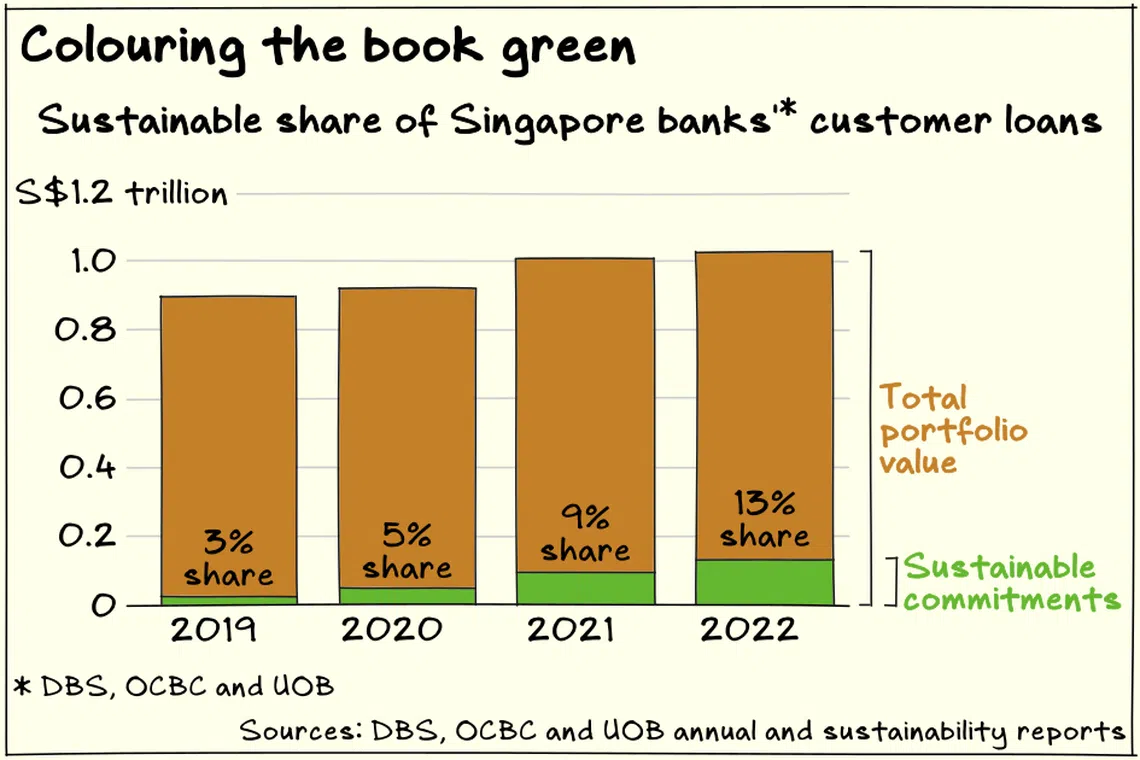
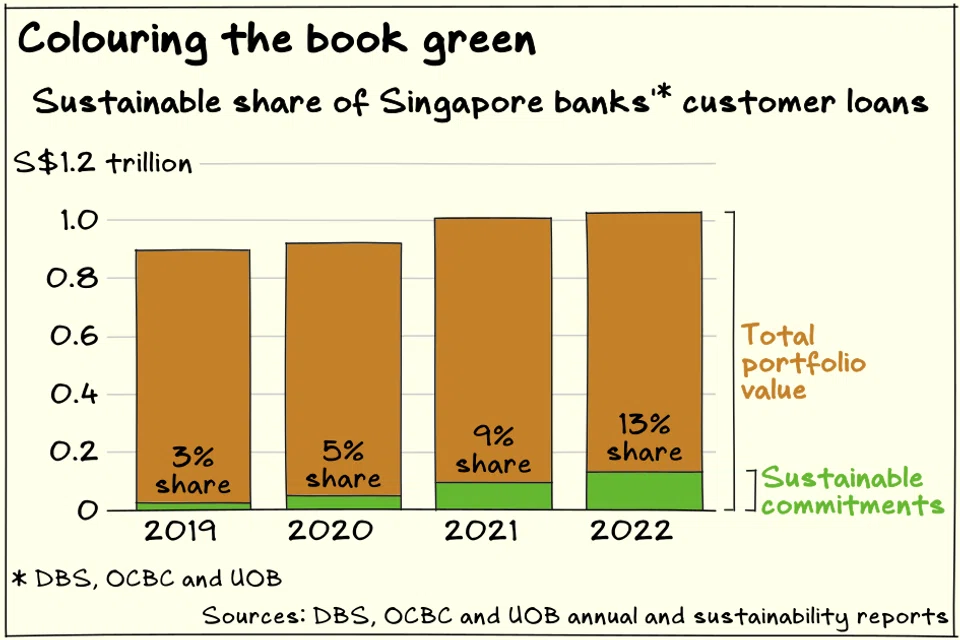
Singapore’s three banks have been aggressively growing their portfolio of sustainable debt, which as a class has been one of the fastest growing segments of the banks’ loan books.
By design, sustainable debt supports some form of sustainable activity. That activity could be a specific project such as a green loan for solar panel installations, or it could be a sustainability-related outcome such as an emissions-reduction performance target in the case of a sustainability-linked structure.
The growth in sustainable debt therefore reflects an increase in sustainability-related activities in Singapore. Whether those activities lead to meaningful impact remains to be seen, but it appears that the banks have been able to ride this green wave.
The latest update by Singapore lender OCBC is that its sustainable finance loans to small and medium-sized enterprises (SMEs) more than doubled in 2023 to S$7 billion from 2022’s S$3.3 billion. More than 80 per cent of the 1,200 SMEs in Singapore and Asia that have taken sustainable financing from OCBC are from the built environment, clean transportation, energy efficiency and renewable energy sectors.
The total sustainable loans offered by DBS, OCBC and UOB reached S$130 billion in 2022, more than five times the S$24 billion committed in 2019. As a share of all customer loans, sustainable debt made up 13 per cent of the three banks’ total commitments in 2022, up from just 3 per cent in 2019.
Some of that growth is probably driven by a genuine rise in sustainability-related economic activity in Singapore and the region. As major multinational corporations, investors and jurisdictions such as the European Union demand better sustainability accounting from their investments and suppliers, companies in Asia have begun to pay more attention to their carbon footprints. Technological advancements and regulatory pressure have also made lower-emissions alternatives like solar panels and electric vehicles more economically attractive for businesses.
There is also real value in virtue signalling. As one sustainable finance expert pointed out to me, companies that are conspicuously green are better able to attract customers and young talent.
From a big-picture perspective, the growth of the banks’ sustainable portfolios shows that they’re performing their function of supporting economic activity. Of course, a bank wouldn’t be a bank if it does things just for the greater good. There must be something in it for the bank as well.
The banks haven’t disclosed how much they make from the sustainable loans they’ve given out, but it’s not a bad business from a purely capital-efficiency perspective. That’s because the interest that banks charge on sustainable loans are often comparable to what they charge for vanilla loans, so it’s not a situation where the banks have to take a lower margin to provide the service.
The banks might give up a few basis points in sustainability-linked loans, which typically step down their interest rates if the borrowers are able to meet sustainability performance targets; but with the typical ratchet size at five basis points or lower, it’s not a huge dent.
A paper by researchers at Penn State University, the University of Washington and the University of Oklahoma looked at the flow of benefits from sustainability-linked loans, and concluded that lenders had the most to gain from these loans. While sustainability-linked loans might not offer meaningfully lower interest costs for borrowers, and might not incentivise borrowers sufficiently to improve their ESG performance, lenders seemed to attract more deposits after the issuance of sustainability-linked loans, the researchers said.
Beyond profits, banks are also better able to achieve their own net-zero targets if a larger slice of their portfolios are sustainable. A bank is a business as well, and virtue signalling is just as meaningful for a bank as it is for the bank’s clients.
Whether all of these sustainable lending will lead to improved sustainability outcomes is up in the air. For example, use-of-proceeds debt is narrowly scoped, so an oil and gas company could take a green loan to provide renewable energy for its equipment but increase production of fossil fuels that would more than offset whatever emission reductions were financed through the loan. The performance targets of sustainability-linked loans could be too easy to achieve, or borrowers could simply miss the targets.
Singapore’s three banks have come up with their net-zero strategies only over the past one to two years, so it might be premature to draw conclusions on their impact. But the next couple of years will be worth watching to see if their growing green portfolio is making a meaningful impact or just meaningful profit.
Other Singapore reads
- Singapore companies may be falling behind on green skills development
- Accountancy body to offer mandatory training programme for new board directors
Other good reads
TRENDING NOW

Knight Frank’s Tan Tee Khoon leaves firm, Nicholas Keong takes over auction business
Keppel Energy, Sembcorp Utilities and Tuas Power to supply biomethane in pilot project
GovTech retrenches another 38 staff in second round of layoffs

Take-up of new private homes dives 45% in Q3 as prices accelerate with 1.4% rise

