
ESG Insights

Issue 96: South-east Asia’s outsized green gap; Singapore banks on sustainability wave in finance

Kenneth Lim
Published Fri, Apr 19, 2024 · 07:00 PM
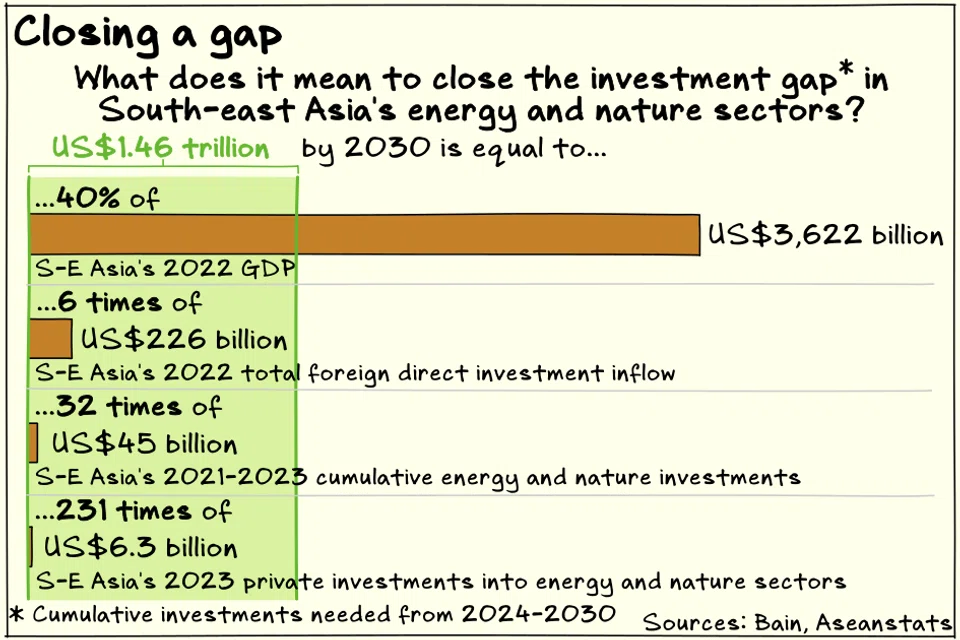
    • South-east Asia’s US$1.5 trillion green investment gap is about 40 per cent of the region’s combined GDP in 2022.
    • South-east Asia’s US$1.5 trillion green investment gap is about 40 per cent of the region’s combined GDP in 2022. ILLUSTRATION: KENNETH LIM

    In this issue: South-east Asia appears highly unlikely to achieve the US$1.5 trillion of green investments needed by 2030 to meet its climate goals, while a skills development roadmap in Singapore shows how integrated sustainability will be in the financial sector.

    South-east Asia

    That’s a really big gap
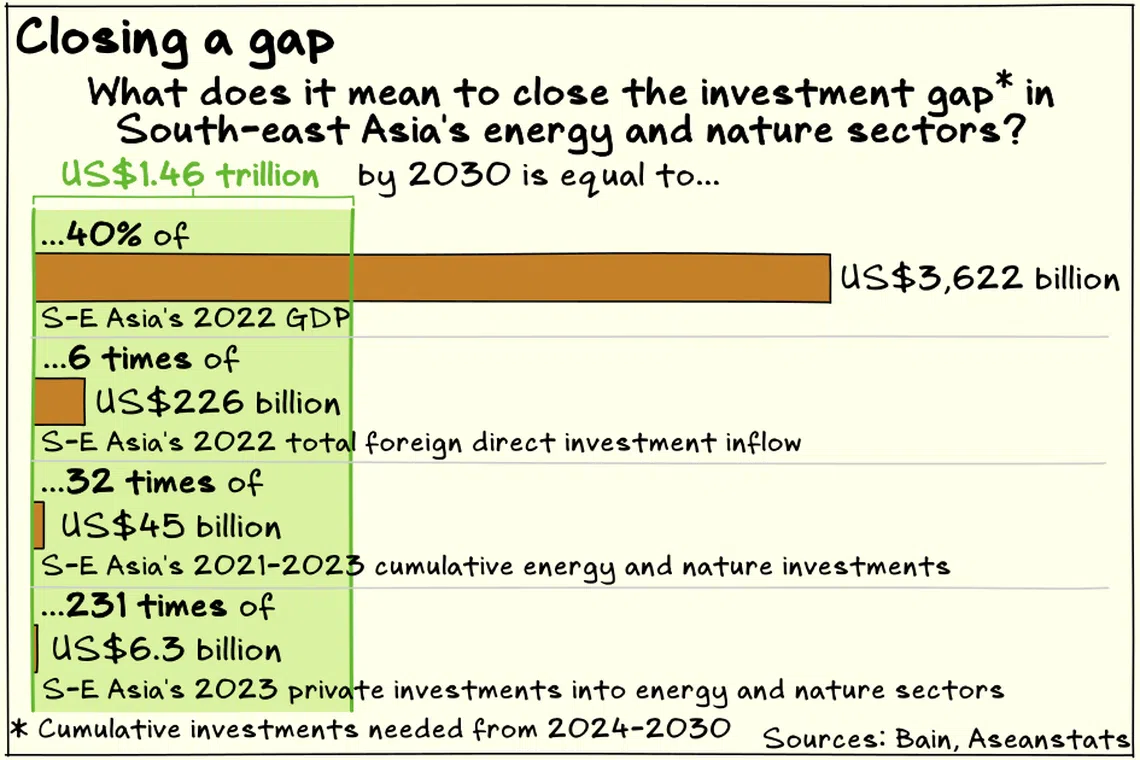
    What would it take to close South-east Asia’s US$1.5 trillion green investment gap?

    The latest edition of the South-east Asia Green Economy report by Bain and Temasek shows that just US$45 billion has been invested into the region’s energy and nature sectors in the three years from 2021 to 2023. At that pace of about US$15 billion per year, it would take almost 100 years to reach the remaining US$1.455 trillion of the US$1.5 trillion that the authors say must be invested by 2030 for the region’s 10 countries to reach their climate targets.

    To close the gap by 2030, the annual investment amount will need to jump immediately to about US$208 billion per year and stay there for the next seven years; or grow at a steady average of almost 70 per cent per year for seven years beginning immediately.

    On paper, it’s possible to accomplish this feat if certain pieces fall into place:

    • Substantial increase in government spending. An annual investment amount of US$208 billion per year represents about 5.7 per cent of South-east Asia’s total GDP of US$3.6 trillion in 2022. The Singapore government has been spending about 15 per cent to 18 per cent of its GDP in its fiscal Budget from fiscal 2018 onwards, so this could mean allocating around a third of the Budget for green purposes.
    • Substantial increase in private investments. Bain and Temasek found that private investments in the region’s energy and nature sectors amounted to just US$6.3 billion in 2023. This figure has the potential to grow if the right mix of government policies is in place. This could include aggressive carbon pricing, sound sustainable financing taxonomies and frameworks, and grants and subsidies such as America’s Inflation Reduction Act.
    • Substantial increase in foreign direct investments (FDI). FDI inflow into South-east Asia was US$225.8 billion in 2022, although only a small slice of that was for green purposes. Policies and programmes that mitigate risk for investors and provide better assurance of impact could grow this amount.
    • The growth happens immediately.

    In practice, however, it seems highly unlikely that all pieces will come together in time for 2030. Furthermore, the nature of a cumulative target means that the longer that change is delayed, the sharper that change will need to be.

    The 2023 edition of the report noted that three of the four countries with the most emissions in South-east Asia are not on track to meet their targets, which, in any case, are not ambitious enough to be aligned with scenarios that limit global warming to 1.5 deg C.

    The 2024 update finds Singapore the only one of the 10 South-east Asian countries assessed as “likely” to be on track to meet its climate goals. Yet, Singapore is one of the smallest emitters in the region – more than only Brunei and Laos – so its performance isn’t going to move the needle much.

    The sobering implication is that South-east Asia has a high chance of missing its climate goals.

    This does not mean that it is pointless to continue investing in mitigating the region’s greenhouse gas emissions. Even though South-east Asia might miss its targets, mitigation work can still help to reduce the overshoot and avoid even worse outcomes from global warming.

    It is nevertheless important that governments and companies pay more attention to adaptation investments, such as agricultural resilience, flood prevention and heat management.

    Adaptation remains severely under-invested in South-east Asia even though the risks are non-trivial, and the lack of attention to the need for adaptation investments is widespread. The Bain and Temasek report contained a deep dive into investable ideas but focused only on decarbonisation solutions.

    There is no doubt that decarbonisation is critically needed; but when the signs are pointing to missed targets, perhaps it’s prudent to also think about the need for and the opportunities in adaptation investments.

    Other South-east Asia reads

    Singapore

    Sustainability leaves its cubicle

    Singapore policymakers have mentioned on more than one occasion that sustainability will be a key driver of growth for the country’s financial services sector.

    Looking at how sustainability affects the people in the sector really drives home the point about how transformative sustainability is poised to become for the financial sector in this decade.

    The Monetary Authority of Singapore (MAS) has set aside S$35 million to support upskilling and reskilling, and to develop sustainable finance specialists over the next three years. This was done as the financial regulator and the Institute of Banking and Finance, supported by Workforce Singapore, launched the Sustainable Finance Jobs Transformation Map.

    The Jobs Transformation Map was informed by a KPMG study, which found that 56 per cent of job roles in the financial services sector will be highly or moderately changed by new sustainable finance-related tasks. That represents a change for about 50,000 professionals in Singapore.

    More than 80 per cent of financial services job roles will involve new sustainable finance-related tasks to some degree within the next three years.

    There will be a further 4,000 to 5,000 new sustainable finance-related jobs created in the next 10 years in Singapore to support the origination of sustainable finance in the banking, asset management and insurance sectors, the report said.

    Those numbers reflect the growing integration of sustainability into finance, such that sustainability is no longer narrowly confined to a single team within an organisation.

    The KPMG study also identified 20 job roles that should be prioritised for upskilling, including seven in sales, distribution and relationship management. Are you suffering from green guilt? We’ve got an investment product just for you!

    Progress!

    Other Singapore reads

    Other good reads



