Maiden UN global stocktake could set off ‘aggressive’ revisions to net-zero pathways
Companies on track for disorderly transition, or a ‘hot house world’ if inaction persists, observers say
IN THREE months, world leaders will descend on the city of Dubai for yet another United Nations (UN) Climate Change Conference (COP28), but this time, parties will head into the summit with the first-ever report book of the progress made since the Paris Agreement.
Expected to be released later this week, the synthesis report of the quinquennial assessment of national climate policies, known as the Global Stocktake, is expected to set the tone for political discussions at COP. Observers, however, see the writing on the wall.
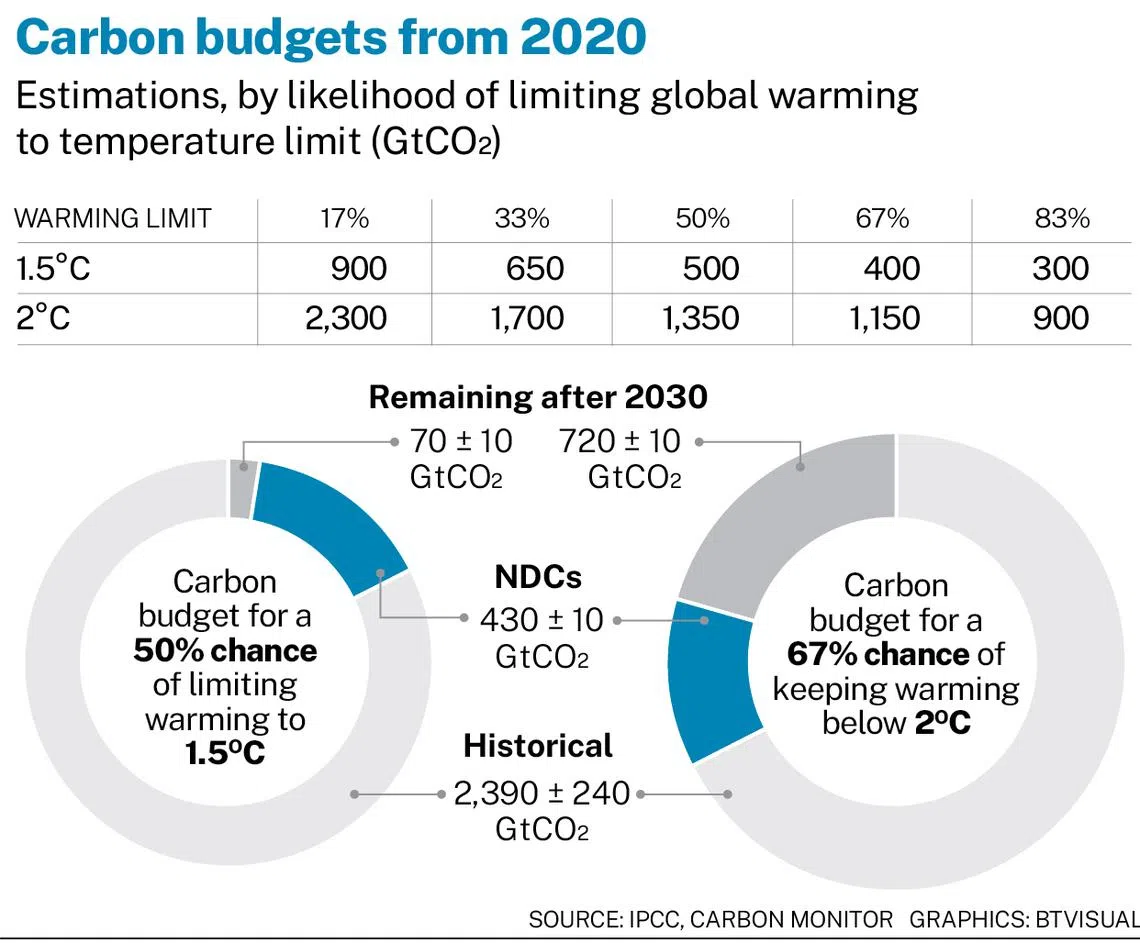
Sharad Somani, head of environmental, social and governance (ESG) at KPMG in Singapore, believes the report will clearly highlight the “impossibility” of limiting global warming to 2 degrees Celsius, much less “well below” 2 deg C as stated under the treaty, unless Nationally Determined Contributions (NDCs) – voluntary commitments by signatory countries – become more ambitious.
Pressure for countries to revise their NDCs to a much higher level of carbon containment may then trickle down to increased proactive policy and financial intervention towards hard-to-abate sectors, like energy and transport, he said. The justification would be that longer-term net-zero targets will become increasingly difficult to achieve if the world was not able to commit to and meet its revised steeper 2030 and 2035 targets, he pointed out.
Temasek’s head of ESG investment management and managing director for sustainability, Kyung-Ah Park, said the UN Environment Programme’s emissions gap report that was published last year “made it clear that we are off-track”.
With global carbon dioxide emissions growing 0.9 per cent to reach a record high of over 36.8 gigatonnes in 2022, the objective of a 45 per cent reduction in global emissions by 2030 is getting out of reach, and the remaining carbon budget to align with a 1.5 deg C outcome is shrinking rapidly, she added.
She then stressed that every year of underachievement means that pathways for decarbonisation will need to be steeper as well as accelerated in order to limit the overshoot and keep the target of being net zero by 2050 within reach.
Darian McBain, the former sustainability head of the Monetary Authority of Singapore, said interim targets will likely need to be reconsidered, even “aggressively” adjusted, leading to the adoption of steeper emission reduction pathways.
This means making harder decisions sooner rather than later, and making significant investments in decarbonisation and technology for cleaner energy systems before 2030 even more important, she noted.
This is where inconsistencies, such as the continued global fossil fuel subsidies – which the International Monetary Fund on Aug 24 estimated at US$7 trillion in 2022, or 40 per cent above 2020 levels – need to be addressed “swiftly and unilaterally”, she stated.
Sustainable finance taxonomies also need work, she said. Interoperable as they stand, they are “not dynamic enough” to drive transition drastically, and “tend to represent a compromise between climate science and what’s politically palatable”, she opined.
Environmental lawyer Joseph Chun from Shook Lin & Bok said the world is headed towards either a disorderly transition, or a “hot house world” scenario, depending on policymakers’ response to the lag already apparent from last year’s UN Emissions Gap Report. The report showed that the world is headed for an increase in mean temperature of 2.4 to 2.6 degrees Celsius, even if all current commitments are fully implemented.
A disorderly transition, he said, comes when policymakers roll out more radical but necessary measures to shift toward a low-carbon future, recognising that a delay in achieving net zero will become more expensive.
Such measures, which could involve carbon tax hikes and financing limits, could bring an “economic shock” to carbon-intensive sectors, sectors relying on them, and financial institutions heavily invested in them, he pointed out.
A hot house world comes if policymakers respond with insufficient action, leading to severe physical risks and irreversible impacts like sea-level rise. Here, sectors vulnerable to climate change – namely agriculture, food and beverage, water, transportation, and insurance – bear the brunt of the lack of action and face long-term distress, Chun said.
This scenario could result from weak political will, underestimations of the risk of tipping points and the cost of catastrophic climate change, preferences to defer the pain of sacrifices as long as politically feasible, and – among developing countries – a lack of finances to invest in the transition, he noted.
PwC Singapore sustainability and climate change leader Fang Eu-Lin raised the likelihood of a disorderly transition as well, believing that a significant lag will move policymakers to launch reforms to accelerate transition within business operations and their supply chains.
KPMG’s Somani said businesses and financial institutions can expect much stronger regulatory compliance requirements and increased scrutiny in four areas. The first is sector-level emission reduction pathways and decarbonisation roadmaps, with stringent monitoring and verifiction. Next is in climate finance, to be channelled towards renewable energy, ending deforestation and improving agriculture sustainability. Third, adaptation finance will be seen as a critical lever to manage and mitigate the risks of climate change. Finally, in technology and finance misalignments, attention will be given to correcting fossil fuel subsidies, while channelling funds to “mainstream” renewable and low-carbon solutions like battery storage, carbon capture and biofuels.
Expect a delay though. Nhan Quang, partner for climate change and sustainability services at Ernst & Young, noted that the stocktake is meant to lay the foundation for countries to update and enhance their NDCs, which are only due next in 2025.
He, meanwhile, said this process will serve more as a wake-up call for countries with notable disparities between their current commitments and the envisioned paths to achieve crucial decarbonisation goals.
Financial institutions are also poised to assume a pivotal role as the transition to net zero requires US$125 trillion by 2050 in climate investment, according to an Intergovernmental Panel on Climate Change report, he added.
Having participated in several of the climate summits now, Danielle Yeow, who leads climate change law and policy at the Centre for International Law in the National University of Singapore, said to expect “incremental” progress from COP28 despite the Global Stocktake.
“Some people don’t like the word incremental. We think we need something dramatic, something that will really move the needle. But the reality is, negotiations at the global level on the climate policy front will likely continue to be incremental,” she said.
“What we will see will be punctuated by unilateral, domestic, regional, plurilateral initiatives that will try to push the agenda a little bit further,” the adjunct senior research fellow at the Centre added.