Money, money, money... and Trump: What’s at stake at COP29
Climate change talks are contentious enough, but Donald Trump’s return as US president is likely to further complicate discussions on finance – and may even hold back global climate action

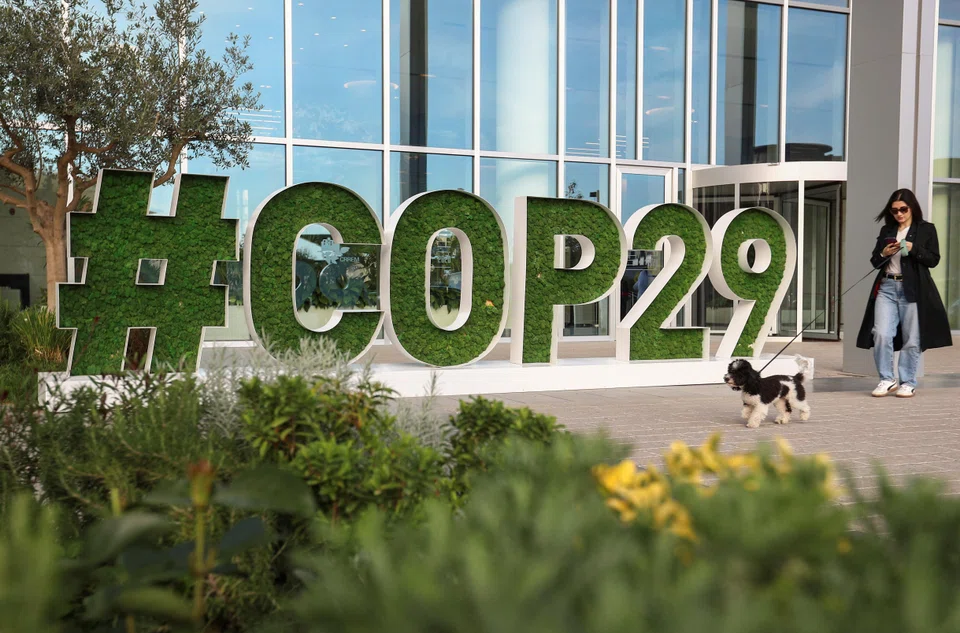
THE annual United Nations (UN) climate change conference kicks off on Monday (Nov 11). Looming large over what will likely be two weeks of heated negotiations is the possibility of the United States pulling out of the Paris Agreement, the international treaty on climate change signed in 2015 to limit global warming to 1.5 deg C.
While climate talks are notoriously contentious every year, the re-election of former US president Donald Trump – who has downplayed and even denied the effects of climate change – just days away from this year’s COP29 summit in Baku, Azerbaijan, could muddle negotiations even more.
Dubbed by its organisers as the “finance COP”, the summit this year places particular importance on the setting of a new climate finance target, with the United States meant to be among the key contributors.
Also on the table are the finalising of rules on the international trading of carbon credits, and the setting of ambitious national climate goals.
The Business Times looks at these issues and what COP29 means for South-east Asia, against the backdrop of the US election result.
A step back for global climate action
Climate advocates reacted swiftly to Trump claiming victory at the polls, with many expecting his re-election to be a setback for global climate action.
Besides promising to withdraw the United States – once again – from the Paris Agreement, Trump also pledged during his campaign to expand oil and gas production, and cut funds allocated to the climate bill known as the Inflation Reduction Act (IRA).
Nonetheless, most climate experts are confident that the overall momentum towards decarbonisation will progress beyond COP29. This is considering the increasingly attractive economics of renewable-energy solutions and the IRA, which provides tax incentives for clean-energy technologies.
Stephanie Choi, sustainable and impact investing strategist at UBS, said that the performance of sustainable investing strategies is more closely tied to investment fundamentals and the macro environment than the governing political party.
“We do not expect a wholesale reversal of the IRA and note that the investment thesis around the climate and energy transition remains robust,” she added.
However, the United States’ role in international climate negotiations is still likely to take a hit, with the country unlikely to deliver on its climate obligations for at least the next four years.
Many pundits expect the European Union (EU) and China – the two other major negotiating blocs at climate talks – to fill the vacuum left by the United States and show climate leadership.
“China will be under the spotlight, like it or not. And I would say the same for the EU,” said Li Shuo, director at the Asia Society Policy Institute.
“I like to think about global climate politics as a tricycle. The three biggest emitters and economies – the EU, China and the United States. You need at least two (major powers) to function at any given time. We just missed one, so the other two – the EU and China – we need to grow and carry us on.”
A new climate finance target
While it is too early to tell how negotiations will play out on several key issues, the US election result has cast a shadow over the top agenda item for COP29: nailing down a new climate finance quantum that developed countries are obligated to provide for developing countries.
Known as the New Collective Quantified Goal on Climate Finance (NCQG), it will supercede the previous target of at least US$100 billion a year, which expires in 2025. Even though the US$100 billion goal was set up in 2009, before the Paris Agreement, developed countries were unable to mobilise that sum until 2022.
With negotiations to reset this goal into its third year, the thorny issues around the headline number to be channelled towards developing countries, and the ones who should foot the bill, are set to take centre stage once again. The difference this time is that the United States – if it pulls out – will no longer be part of the pool of donors.
Alden Meyer, senior associate at climate change think tank E3G, said that the likely absence of the United States will have an impact on the overall size of the deal. However, it may not be that significant in reality, given that the country has not been meeting its climate finance obligations, and other developed countries may be willing to step in to fill that gap.
Even if the NCQG deal value stays flat, Choi believes that the percentage going to green projects and impactful solutions will go up because the taxonomies – classification systems that define what economic activities are eligible for sustainable financing – are more mature today than in 2009, when the framework was first set up.
Securing a sufficient amount of climate finance is especially crucial for South-east Asia. Largely made up of developing economies, it lacks the financial resources to deliver more ambitious climate action.
It is also a region especially vulnerable to the worst of climate change impacts, and requires additional funding to rapidly recover from these disasters, noted Sandeep Chamling Rai, senior adviser for global climate adaptation policy at environmental non-profit, WWF International.
With the United States possibly exiting the donor pool, there may be added pressure to increase funding by expanding the contributor base to include nations classified as developing countries in international negotiations, but are high-emitters or economically advanced. This argument has often been made by developed countries and is one of the most contested aspects in NCQG negotiations.
If the final NCQG text updates its criteria to expand the contributor base, the new contributors would likely include the oil-rich Gulf states, China, South Korea and Singapore, among others. Singapore does not have a mandatory obligation to provide climate finance under the Paris Agreement, said a government spokesperson in response to BT’s queries.
“These obligations are based on the principle that those who contributed most to the climate problem should take responsibility and do more. The principle of common but differentiated responsibilities underscores countries’ different historical responsibilities regarding the climate crisis,” the spokesperson added.
Nonetheless, Singapore is actively doing its part to support international climate action, with the Monetary Authority of Singapore (MAS) committing to contribute concessional capital to a blended finance initiative known as the Financing Asia’s Transition Partnership.
Even as Singapore and other developing countries have made such voluntary contributions to climate action, it “must be in line with the Paris Agreement and not work to dilute the historical responsibilities of developed countries”, said the spokesperson. “Otherwise, the Paris Agreement would fall apart.”
In addition to the deal size, the NCQG will address the finance inhibitors for climate action, such as high costs of capital, debt distress, currency lending and concessionality levels, noted Anjali Viswamohanan, director of policy at the Asia Investor Group on Climate Change.
There have been criticisms that most of the funding under the previous regime was in the form of loans instead of grants, said Nithi Nesadurai, director and regional coordinator at environmental non-profit Climate Action Network Southeast Asia.
However, there is a need for support to come in the form of grants rather than loans.
Eugene Wong, chief executive officer of the Sustainable Finance Institute of Asia, said: “Investors hope to see climate action that does not create unsustainable debt burdens and that the private sector can finance.”
Private finance at a “finance COP”
The role of private financial institutions has featured extensively in NCQG discussions on widening the sources of climate finance. But given that these entities are not parties to the Paris Agreement, the UN Framework Convention on Climate Change is unable to enforce such obligations on them.
Climate experts tell BT that therefore, the smaller turnout of private financiers at this year’s conference – ironic, considering it is the “finance COP” – is not necessarily a sign of waning interest. What’s more important is that they continue working on meeting their net-zero commitments back home.
A check reveals that none of the chief sustainability officers of South-east Asia’s three biggest banks – DBS, OCBC and UOB – will be headed to Baku, even though they did take part in the previous two COPs. Prominent financiers of other multinational banks are also expected to sit out COP29.
Non-C-suite representatives from OCBC and UOB, however, are still attending.
Still, private finance can be mobilised through the NCQG mechanism. Regardless of the figure countries land on after two weeks of parleying, the ultimate aim for these public funds is to encourage the entry of more private capital. This will likely be through blended finance structures.
Blended finance is a capital-raising approach that leans on investors with higher risk appetites – such as development funds and philanthropists – or governments to provide concessional or catalytic capital to pull in more commercial investors.
“When the countries come up with a number and a commitment, first of all, what they’re going to do is probably enact policies to support that number,” said Tiza Mafira, director at Climate Policy Initiative.
“So they’ll have policy signals that the private sector is going to read. Second of all, a lot of that money should be deployed as concessionary capital. That is going to leverage private capital.”
She added: “There is just not enough concessionary capital right now. There needs to be more. So if, as a result of the NCQG, a lot more public finance is committed, and committed as a concessionary or catalytic fund, then I think there will be a domino effect on private finance.”
Climate experts hold the view that public funds raised through the NCQG should be prioritised for adaptation projects in South-east Asia. These projects tend to be underfunded because they do not generate cash flow and are remedial in nature.
Many climate-mitigation projects, on the other hand, are generally able to attract private-sector financing,
“We are in a boat with a big hole, and the water is gushing in. Everyone is rushing to fix the hole – that’s mitigation. But we also need to empty the water in our boat – that’s adaptation,” said Wong of the Sustainable Finance Institute of Asia.
“There are also things which mitigation action (can no longer fix), so we need permanent adaptation.”
A greater cash infusion into the loss and damage fund – which channels financing to developing countries hit the hardest by natural disasters –- is especially crucial for South-east Asia because the region is especially vulnerable to climate impact, said Climate Action Network Southeast Asia’s Nesadurai.
National climate action plans
Clinching a high-enough climate financing target is not sufficient. Investors also want to see credible and detailed decarbonisation plans from governments before they are willing to deploy their capital.
After all, while public finance in the form of concessional or catalytic capital is able to lower investment risks through guarantees or first loss, it cannot derisk poor public policies and insufficient energy transition pathways, said Mafira.
To this end, South-east Asian governments can provide more clarity to stakeholders on how they plan to achieve their Paris-aligned targets when they submit their second set of national climate action plans. Known as nationally determined contributions (NDCs), they are due by February 2025.
Under the Paris Agreement, countries are supposed to submit their NDCs every five years, with each successive NDC reflecting progress and loftier ambitions.
Beyond broad ambitions, NDCs could include plans on whether structural reforms are likely to take place to spur investments, or if catalytic capital would be made available to derisk investments.
Details on what it means to “transition away from fossil fuels” – the landmark agreement reached in COP28 – would also be useful for policy development, said Wong.
NDCs need to be translated into a pipeline of investable projects, said Mafira. For example, the Indonesian investment policy plan that included a list of energy-transition projects which could be funded through the US$20 billion climate deal – the Just Energy Transition Partnership – did not attract investors, as there was no request for proposal or opened tenders for any of them.
While NDCs are not yet due by COP29, the summit is still an opportunity for countries to come forward with their most ambitious plans, said Melissa Low, research fellow at the Centre for Nature-based Climate Solutions at the National University of Singapore.
It is not just NDCs. Countries can also show their climate goal progress when they submit their biennial transparency reports due by the end of this year, she added.
At the end of the day, investors in Asean are looking for concrete, actionable commitments at COP29 that can drive the financing and deployment of decarbonisation activities in the region, said Charlie Knaggs, regional decarbonisation partner at sustainability consultancy ERM.
Carbon markets
Hopes are high that a final deal on Article 6 of the Paris Agreement – which covers both the bilateral and international trading of carbon credits – will come through at COP29.
It will be a massive boost for the voluntary carbon markets, said Daniel Klier, chief executive officer of carbon project developer South Pole. This is partly because a recent series of high-profile scandals sent the market into a nosedive over integrity concerns that carbon credits sold do not represent a real reduction in carbon emissions. The size of the voluntary carbon market is under US$2 billion.
Having the UN as the supranational body to set international standards and develop the trading infrastructure would scale the market. At the moment, only bilateral trading of carbon credits is taking place, but these are too bespoke as carbon project developers have to cater to the varied standards of different governments that are buying these credits.
Even then, there are also leftover details to be ironed out on the bilateral trading front. A major sticking point among negotiators in Dubai last year was whether the carbon credits sold to a buyer country can be revoked by a host country.
Host countries want the option to revoke previous authorisations if they find they are unable to meet their own national climate targets, while buyers of carbon credits feel this would create uncertainty.
Under Article 6, carbon credits come with corresponding adjustments when they are traded. This means that the emissions being offset are counted only once by the country that bought the credits; the country that produced them gives up the right to use the credits to meet its own national climate targets.
This is to avoid the double-counting of underlying emissions reductions or removals when carbon credits are traded.
If host countries are ultimately given the option to revoke previous authorisations, this could lead to carbon nationalism, Low pointed out.
A consensus on Article 6 will help unlock opportunities in South-east Asia’s carbon markets, given the region’s abundance of tropical forests.
As well, South-east Asia’s potential goes beyond conventional reforestation credits. Klier noted that the region can mobilise finance for “high-hanging fruit” – climate action that entails technological transformation or infrastructural development as the region moves from using coal for electricity generation to cleaner sources, such as hydrogen.
The use of transition credits to finance the early closure of coal power plants and their replacement with renewable resources is one example. MAS and its partners are studying the pilot use of these credits in two coal plants in the Philippines.
South-east Asia is also home to some of the world’s largest stocks of “blue carbon” from having 37 per cent of the world’s mangroves and 23 per cent of seagrass meadows. These forests point to the untapped potential in blue carbon credits, which are generated when carbon is sequestrated in these ecosystems.
Singapore substantively concluded a carbon credit transfer agreement with Vietnam in 2023, and has signed Article 6 memorandums of understanding with Cambodia, Laos, and the Philippines.
A government spokesperson said: “Singapore looks forward to working with its partners in Asean to unlock carbon finance that can spur decarbonisation.”
TRENDING NOW
Grab CEO’s wife Chloe Tong on life with Anthony Tan and finding her purpose
HDB reviewing ‘jumbo’ flat scheme after Telok Blangah unit listed for sale at S$2.18m
He built the Vingroup empire. Now South-east Asia’s richest man is handing some key roles to his sons
Singapore judge raises doubts iron ore trader Radiant World is owed US$1 billion