Newer sustainable finance taxonomies converging on common features

REGULATORS in various jurisdictions are increasingly aligned on how they design their sustainable finance taxonomies, according to an analysis of 13 country and regional frameworks.
The “common language” between taxonomies will make it easier to compare and harmonise standards to improve capital flows, according to a policy brief by government-owned enterprise German Agency for International Cooperation (GIZ) and US-based non-profit think-tank Center of Clean Air Policy (CCAP).
“The importance of having a common language and a homogeneous understanding of how to develop sustainable finance taxonomies is becoming more evident as more jurisdictions express interest in using taxonomies as a regulatory policy instrument,” the authors wrote.
“There is an opportunity now to create market clarity, integrity, and transparency when aligning financial flows (public and private) consistent with international sustainability goals.”
Sustainable finance taxonomies are classification frameworks that define which activities qualify for sustainable financing. Without going into whether thresholds and definitions are aligned across different frameworks, the policy brief looked instead at more fundamental aspects that concern the design of those frameworks, akin to asking whether the dictionaries are all in the same language as opposed to whether the definitions are in agreement.
The analysis found that newer taxonomies are displaying more similarities than differences. Beginning with the Association of Southeast Asian Nations (Asean) taxonomy in November 2021, the latest six taxonomies that were published each shared at least nine of 11 traits found across taxonomies launched before them.
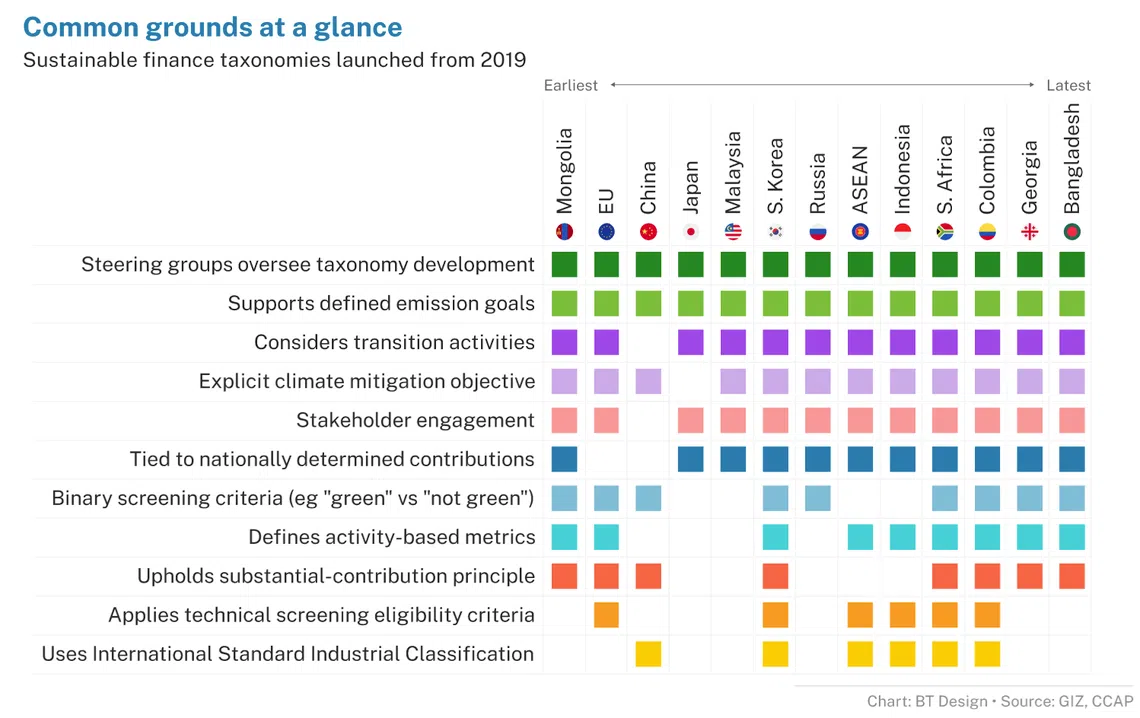
Seven taxonomies launched before them were similar to varying degrees – Japan’s, for instance, shared only five traits, while South Korea checked all 11 boxes, according to the framework that CCAP and GIZ came up with for the analysis. The taxonomies that China and Malaysia launched in April and May 2021 respectively had six of the 11 common features, but the two models are similar in just three ways.
The commonality of a trait is not an indication of how appropriate or ambitious it is. For instance, the Asean taxonomy uses a traffic light system of “green”, “amber” and “red” to indicate an activity’s level of environmental sustainability. Most other taxonomies, however, take a simple binary approach of “green” or “not green”.
The Asean taxonomy also adopts a “do no significant harm” principle whereby an economic activity that substantially contributes to an environmental objective must not do significant harm to any of the other environmental objectives. Most taxonomies, however, stop at a less stringent principle of “substantial contribution”, whereby an economic activity just has to substantially contribute to taxonomy objectives.
The most common features across the taxonomies were the use of steering groups to oversee taxonomy development and the support of Paris-aligned emissions goals. However, the taxonomies were split on the classification systems used to define economic activities and the use of technical screening criteria to determine eligibility.
The report said that the current areas of divergence could make it challenging to harmonise taxonomies on three fronts: determining sectoral priorities, developing locally appropriate screening criteria, and the adoption and use of common metric types.
Now that a common ground language is forming, the brief’s authors said jurisdictions should not view taxonomy development as a “final milestone” but the beginning of a complex process of implementation.
“Implementation will reveal challenges at each step in the taxonomy development framework,” they wrote. “Political and technical challenges require constant collaboration between relevant stakeholders to achieve a taxonomy that is useful for all users.”
“Even in the most complex and advanced taxonomies, the final definitions of environmental objectives, screening criteria, and economic transition activities are still under discussion,” they added.
With taxonomy development being an evolving process, they also said it is important for jurisdictions to set up governance structures that can oversee changes to regulations and screening criteria down the road.
Cherine Fok, environmental, social, governance (ESG) partner with KPMG in Singapore, said the European Union (EU) taxonomy will need to accommodate the specificity of other jurisdictions to effectively support the green transition in other regions, such as South-east Asia.
“As capital flows become increasingly global, the EU taxonomy will continue to be relevant to the South-east Asia region, corresponding to the source of funds,” she said. “It is a taxonomy that is understood and applied by EU investors.”
The challenge currently arises when the taxonomy – developed based on more “green-ready” real economies – are applied to countries that may be at a different stage of maturity, with varying economic and sector profiles, as well as business practices, she said.
Fok also stressed that it is critical to achieve an alignment and common understanding between stakeholders to ensure that sustainable investments remain actionable, while preventing greenwashing.
“Technical screening criteria are important for both investors and investees as these provide a common language, which lends clarity about risk profiles, returns and investment value,” she added.