

Temasek-backed fund under Singapore’s blended finance initiative hits US$800 million in second close
Two other funds under the initiative are progressing towards their first closes later this year


[SINGAPORE] One of the funds under Singapore’s blended finance initiative – known as Financing Asia’s Transition Partnership (Fast-P) – has achieved its second close, securing a total of US$800 million in committed capital.
DBS and Cathay United Bank have joined the fund as new partners, alongside the initial participants, including the Monetary Authority of Singapore (MAS), Temasek, the Allied Climate Partners and the World Bank’s International Finance Corporation.
This comes about eight months after it achieved first close of US$510 million.
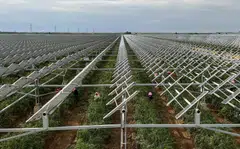
Known as the green investments partnership, the fund – which looks at investing in mature green technologies such as renewable energy – has committed 25 per cent of its first close amount (US$128 million) to four sustainable infrastructure investments in South-east Asia.
Deputy chairman of MAS Chee Hong Tat announced these updates to the Fast-P programme on Wednesday (May 20) at Temasek’s flagship sustainability conference Ecosperity Week.
“Each new partner and every dollar committed sends a powerful signal that the world’s leading institutions are staying the course on climate action, an important reassurance during this period of greater global uncertainty,” said Chee, who is also national development minister.
Fast-P is a blended finance initiative launched by MAS at the United Nations’ 2023 climate change conference in Dubai.
Its target is to mobilise US$5 billion by bringing together public and private-sector partners to de-risk, as well as fund transition and marginally bankable green projects in Asia.
Blended finance is a capital-raising approach that leans on investors with higher risk appetites, such as development funds and philanthropists or governments, to provide concessional or catalytic capital to pull in more commercial investors.
SEE ALSO




The main thrust of blended finance is for concessional or catalytic capital to lower investment risks or the costs of capital through guarantees or first loss, thereby attracting more commercial capital.
The Singapore government will match every dollar, up to US$500 million, of concessional capital committed by other partners joining the initiative.
The aim is for this combined pool of concessional capital of US$1 billion to catalyse US$4 billion of commercial capital, ultimately bringing the total to US$5 billion.
Singapore has contributed US$80 million to the green investments partnership as concessional capital.
It is matched by another US$80 million from development finance institutions including British International Investment (BII) and Export Finance Australia, as well as philanthropies such as the Allied Climate Partners.
Singapore’s ambassador for climate action, Ravi Menon, revealed this as he provided more updates at a side event of the Ecosperity conference.
The base of US$160 million managed to crowd in US$640 million from commercial players, bringing the total to US$800 million.
Pentagreen Capital, a sustainable infrastructure debt financing platform that is serving as the manager for this fund, said in a separate media release that DBS and Cathay United Bank would be entering into senior tranche lending arrangements, while an unnamed new industry partner would join the junior portion.
In a blended finance instrument, there are different layers of investment, where the senior tranches take on lower risk, while the junior portions absorb higher risk.
A number of existing partners have also increased their participation at second close.
The four projects that received financing from this fund include a bioenergy programme deployed across South-east Asia and India; the roll-out of two utility-scale solar energy projects with battery storage in the Philippines; and the construction of small power plants in Indonesia using mini hydro-technology.
Menon said that the funding enabled the projects to be developed, bringing them to a point where they become bankable before construction commenced.
“The significance of Fast-P funding goes beyond the four individual projects. It is a creation of a pipeline of bankrupt projects and the scope of scaling that’s made possible by these initial investments,” he added.
Besides the green investments partnership, Fast-P also has two other funds.
The Private Infrastructure Development Group and DBS were announced as new partners for the displacement sleeve of the second fund, known as the energy transition acceleration finance.
A displacement sleeve refers to a distinct investment allocation focused on replacing carbon-intensive assets or activities with lower-emissions alternatives.
It started with the Asian Development Bank (ADB) and the Global Energy Alliance for People and Planet as the initial partners to finance Asia’s energy transition.
The third fund, which focuses on providing debt financing to companies in hard-to-abate sectors, has also expanded its coalition of initial partners to now include BII and the Japan International Cooperation Agency.
The ADB also plans to participate, subject to internal approvals.
BII said in a separate media release that it has committed US$30 million to the industrial transformation programme, which will be structured as a junior tranche.
These two other funds are progressing towards their first close later this year.
To strengthen Fast-P’s strategic direction and global connectivity, an international advisory board has been formed with Menon serving as its chair.
The board will provide strategic advice and feedback to keep the blended finance initiative aligned with global and regional energy transition trends. It will also guide the scaling and deployment of the three funds, and inform the development of its next phase, said Chee.
Other members of the board include Adair Turner, chair of the Energy Transitions Commission; Shriti Vadera, chair of the World Bank’s private sector investment lab; and Mark Gallogly, co-founder of Three Cairns Group.
As businesses are facing rising costs, supply chain disruptions and technological changes, Chee said that regional transition financing needs will evolve.
To ensure that Singapore’s sustainable financing frameworks remain fit-for-purpose, MAS and the Singapore Sustainable Finance Association (SSFA) have started reviewing the Singapore-Asia Taxonomy for key sectors such as energy, maritime and data centres.
The taxonomy lays out set criteria and thresholds for a range of economic activities that would be considered eligible for sustainable and transition financing.
Chee said that the review will consider the pace of technological developments, updated scientific data and practical implementation challenges.
It will also consider expanding the transition definitions to support financing to enabling activities, such as manufacturing the components needed for green hydrogen.
MAS and SSFA are engaging industry, corporates and international bodies in the review. It is targeted to be completed by the end of this year.
Decoding Asia newsletter: your guide to navigating Asia in a new global order. Sign up here to get Decoding Asia newsletter. Delivered to your inbox. Free.
Copyright SPH Media. All rights reserved.
TRENDING NOW

DBS, OCBC, UOB rout lops billions off STI as inflation, rate concerns spook investors

Grab CEO’s wife Chloe Tong on life with Anthony Tan and finding her purpose

OCBC sheds S$8 billion in value as shares close nearly 6% down; analysts cautious on banks

Deal between tycoon friends sparks scrutiny of Philippine power sector

