As used cooking oil glistens, Singapore’s smaller collection agents struggle

Janice Lim
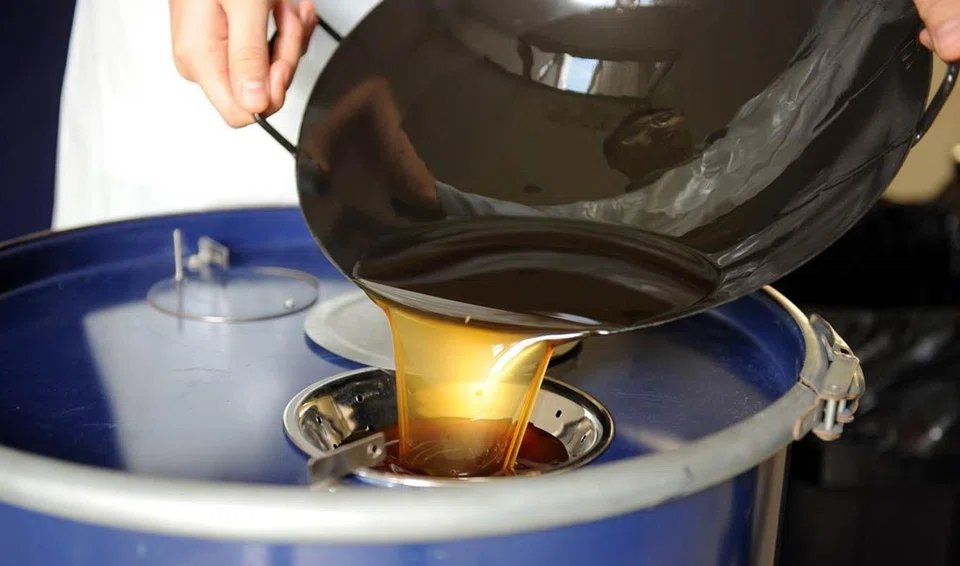
SINGAPORE’S smaller collection agents of used cooking oil (UCO) are struggling to keep up with the global sustainable fuel industry’s ravenous appetite, driving an increasing number of them to consider consolidation.
The global reference price for UCO hovered between US$0.80 and US$1.10 per kilogramme in May. Although it had come down from its peak during the pandemic, it was still higher than pre-pandemic levels.
Demand for UCO used to be led by the production of animal feed, but these days, biofuels are driving growth. UCO is a sustainable feedstock for biofuels, which are increasingly in demand as governments and businesses try to lower their carbon footprints.
More aircraft lessors and banks active in the aviation sector are also looking to integrate sustainable aviation fuel (SAF) supply and usage with their aircraft leasing and financial product offerings, said Teo Hui Ling, partner at law firm Reed Smith.
In Singapore – which houses the world’s largest SAF production facility, run by oil refining company Neste – Chinese exports of UCO jumped to a record 48,832 tonnes in May. This was 18 per cent higher than April’s figure, and almost double the amount a year ago, based on a Bloomberg report citing data from Chinese customs.
In September 2022, The Asahi Shimbun reported that Japan exports the largest amount of its waste oil to Singapore. It cited trade statistics showing how export volumes to the city-state had grown steadily to 42,000 tonnes in 2021, which is 2.3 times the volume in 2018.
Regulations around the world are propping up demand. The US Environmental Protection Agency plans to increase the amount of biofuels that oil refiners must blend into the nation’s fuel mix over the next three years, while the European Union aims to increase the share of renewable energy in its transport sector to at least 14 per cent, including a minimum share of 3.5 per cent of advanced biofuels.
Eddison Lee, principal of the energy and natural resources team at management consultancy Oliver Wyman, said that UCO with clear traceability and reliability of origin, such as UCO from restaurants, tends to command a premium among buyers.
The increased demand for both volumes and traceability favour the larger middlemen. Reed Smith’s Teo said that the larger UCO aggregators have the advantage of more diversified sources, and are better able to weather variations in supply volumes and prices.
With the larger aggregators looking further afield to meet the higher demand, smaller-scale collectors now have to contend with new, better-resourced players on their home turfs.
Several UCO collectors in Singapore told The Business Times (BT) that they are paying more for the waste from restaurants, with some receiving quotes as high as S$2 for 1 kg. Before the pandemic, the collection rates could be as low as S$0.40 per kilogramme.
At current levels, the price of UCO in some collection contracts matches or even exceeds the price of new cooking oil. Based on checks with wholesalers that supply restaurants, new cooking oil prices are generally between S$1.75 and S$2 per kilogramme.
It is almost as if these restaurants have turned their waste into gold, with UCO providing an alternative source of revenue, said Allan Lim, co-founder of Alpha Biofuels, a biodiesel manufacturer that also collects UCO.
The restaurants “are calling from shop to shop, like market ‘lelong’ (sales) or selling durian Mao Shan Wang like that”, Lim told BT, referring to a premium variety of the fruit.
Rebecca Tan, managing director of Go Green Recycle Oil, told BT that she has been losing contracts with hotels and restaurants to competitors that are able to match the higher prices.
“I only offer at the price I can sustain my business. I’m losing my customers… How can waste be more expensive than fresh oil from palm trees?” she said.
She explained that not all of her customers are willing to pay elevated prices for her stock. These customers’ needs are not as stringent, and they are able to turn to other markets in the region that supply cheaper UCO. She has been able to sustain her business thus far by working with multinational food and beverage companies that have a stronger focus on greening their operations.
Vinesh Sinha, chief executive officer of FatHopes, which runs UCO collection points throughout South-east Asia, said that he has not seen such high prices among his suppliers in Singapore.
Nonetheless, he is experiencing rising costs, and amid intensifying competition, he is pricing his UCO collection contracts at between 85 per cent and 90 per cent of the global reference price.
“The margins are extremely slim. And when operating costs go up, they erode the already extremely slim margins,” he said.
Lim said his company has been able to “survive” these higher costs as Alpha Biofuels works on circular economy contracts with companies here, whereby the UCO it collects is converted into biodiesel at its plant in Singapore. The biofuel produced is then sold back to these companies to generate revenue.
These new market dynamics are leading to changes in the industry.
Lim said that risk of fraud is now higher. Industry players told BT that blending various types of oils with UCO or under-declaring the volume of UCO collected are methods some collectors employ to meet their contractual obligations at lower costs.
Bonar Silalahi, head of sector solutions at UOB, noted that UCO’s supply is correlated with the use of cooking oil by the food services and food manufacturing industries.
Countries may restrict UCO exports to secure domestic feedstock, he added. This is because the supply of UCO may not increase quickly enough to meet the rising demand for it, since it is a by-product dependent on other industries.
“These demand-and-supply dynamics will affect the overall pricing of UCO. (Hence), biofuel producers will switch feedstock based on the price movements of different feedstock,” he added.
Given the increased challenges of UCO collection for some players, it may lead to consolidation in the industry.
Reed Smith’s Teo said that she had been involved in transactions where UCO collectors form joint ventures with either their suppliers or their customers – an indication of some degree of vertical integration in the last 12 months.
Such joint ventures often involve preferential terms for the partners which would not be available to other players in the market, she added.
She noted that going forward, there may also be horizontal integration, where UCO players merge or collaborate with one another to increase their effective size and market reach.
Some UCO collectors, such as Tan from Go Green Recycle Oil, are already lamenting the future prospects.
“In another few years, it would not be feasible to do this business,” she said.
“How many multinational corporations can you get that don’t look at dollar signs? It’s very hard for us who are doing business in an honest manner to sustain. We are finding it very hard for us – it’s a toll on us.”
Lim from Alpha Biofuels thinks that the middleman business model typical of UCO collectors is no longer tenable, as the value-add is not high. UCO collection is also a laborious job which Singaporeans are not willing to take up. That is why Alpha Biofuels has a plant that converts UCO into biodiesel.
Lim also believes that government regulations around ensuring transparency and accountability at UCO collection sites, and mandating a certain level of use of renewable fuels in Singapore, will improve commercial viability.
“As long as Singapore (doesn’t) mandate biodiesel use and companies continue to cheat, there is no future for UCO recycling… Today, our own low-carbon feedstock is being sent overseas to help others decarbonise,” he said.