

Women on boards: numbers growing, but Singapore lags developed markets


Women’s share of Singapore’s corporate leadership is expected to grow with supportive policies and changing attitudes, but gender diversity at the highest echelons still lags other developed markets.
According to latest figures compiled by the Council for Board Diversity (CBD) in Singapore, women’s participation on the boards of the 100 largest listed companies here rose to 21.5 per cent at the end of 2022. This is up from 18.9 per cent in end-2021 and 15.2 per cent in end-2018.
It is also a significant increase from 7.5 per cent in 2014 – when CBD’s predecessor group, the Diversity Action Committee, first started.
For the broader pool of all Singapore-listed companies, women’s participation on boards improved to 14.6 per cent in end-2022, from 13.5 per cent a year earlier.
Loh Boon Chye, co-chair of the Council for Board Diversity in Singapore and chief executive officer and board director of the Singapore Exchange (SGX Group), believes the factors that have driven the improvement so far to persist.
“Shifts in business models, changes in consumer behaviour, surge of new technologies, and investor expectations on ESG (environmental, social and governance) matters will continue to emphasise the value of drawing from a wider bench in search of answers in these turbulent and unprecedented times,” he said.
“The regulatory environment in Singapore has also given board diversity a boost,” he added, referring to Singapore Exchange Regulation’s (SGX RegCo) newly introduced rule that limits the tenure of independent directors to nine years. The expectation is that the replacement of long-serving directors will present a chance for women to make inroads onto boards.
“The search for new board members with different experiences and insights is an opportunity for more diversity and women to be included,” Loh said.
Looking at such participation from a global perspective, however, shows that Singapore still has some catching up to do.
In terms of representation at the senior management level in the corporate sector, data compiled by CBD showed that the proportion of women in such roles in Singapore is comparable with that of other developed economies.
But, in terms of board participation, Singapore’s numbers lagged behind that of a number of developed markets.
Women’s share of directorships among the top 100 companies, at 21.5 per cent in Singapore, is lower than the average 28 per cent calculated across a pool of five comparable developed markets, comprising Australia, Hong Kong, London, Tokyo and the US.
“Going forward, we expect companies (in Singapore) to continue to pay attention to board diversity, as companies are required to disclose their board diversity policy, objectives and progress, with gender specified as an aspect of diversity that should be encapsulated in the policy. Companies are also required to explain how the composition of their boards help chart strategy for the companies,” Loh said.
CBD noted that a record 36 per cent of appointments last year were women directors, which may have been influenced by companies responding to SGX RegCo’s requirements – which came into effect in 2022 – for greater disclosure on board diversity policies.
TRENDING NOW

He built the Vingroup empire. Now South-east Asia’s richest man is handing some key roles to his sons

Seatrium allocates S$200 million for new share buyback programme
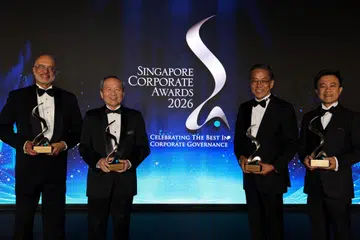
32 companies, 6 individuals bag accolades at Singapore Corporate Awards 2026

Stocks to watch: Mapletree Logistics Trust, Seatrium, Keppel DC Reit, Food Empire

