World Bank-backed global carbon credit registry to go live by Q1 2023
Climate Action Data Trust, which will unify data from leading registries, is headquartered in Singapore
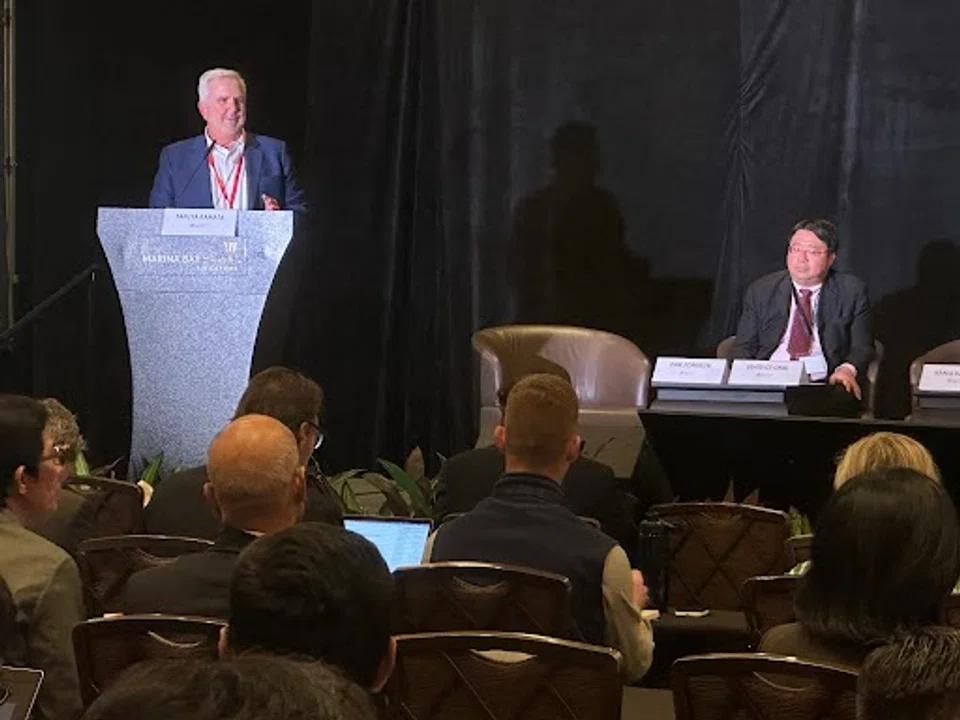

A WORLD Bank-backed carbon credit data sharing platform will go live by March next year in hopes of harmonising data from a highly fragmented market.
Climate Action Data Trust (Cad Trust), which officially launched in Singapore on Wednesday (Dec 7), said plans are underway to integrate the data on all four major registries including Verra and Gold Standard and two smaller registries, by the first quarter of 2023, when the first public data layer will go live.
As many of these registries are already represented via a council that was formed to advise and guide the initiative, data integration is already underway for several of them, it added.
The Cad Trust Council comprises national representatives from Bhutan, Chile, Japan, Senegal, Singapore and the United Kingdom, and registry representatives from Verra, Gold Standard, the American Carbon Registry (ACR) and Global Carbon Council (GCC). Verra and ACR are based in the US, Gold Standard is based in Switzerland, and GCC is based in Qatar. These four registries cover 90 per cent of the activity in the voluntary carbon market.
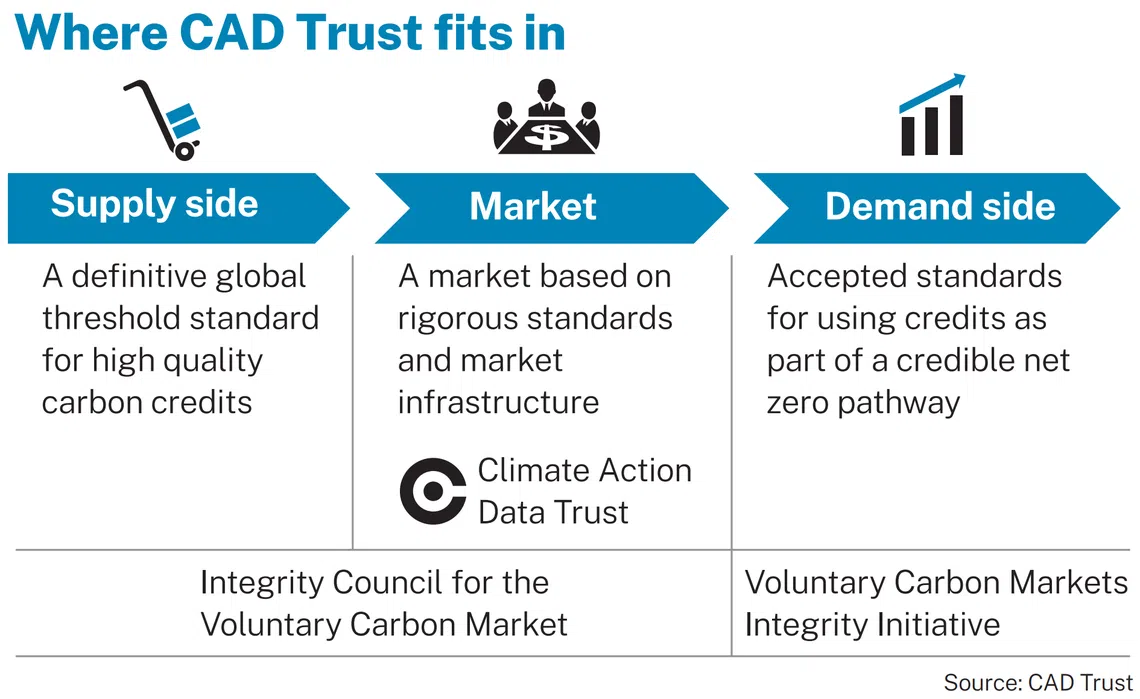
Cad Trust itself is an independent entity headquartered in Singapore that is jointly founded by the International Emissions Trading Association (IETA), the World Bank and the Singapore government. It uses distributed ledger technology to unify the data of different registries and to guard against double counting, which occurs when two different companies or jurisdiction claim the same carbon credit, and raise trust in carbon data.
Clarifying Cad Trust’s role at a briefing, Benedict Chia, director-general for climate change at the National Climate Change Secretariat of Singapore, said the initiative is “not likely to take a directly punitive” stance towards companies or jurisdictions that insist to still go ahead and claim the same carbon credit.
But its underlying blockchain technology will dissuade parties from doing so since all sorts of data, including the flip-flopping of decisions on corresponding adjustments, will be permanently captured on its peer-to-peer network for all to view, he pointed out. “(Such decisions are) going to be trapped in the system, and there will be a reputational effect,” he added.
Hania Dawood, practice manager in the World Bank climate change group’s finance and economics unit, added that the blockchain capability not just aids in the traceability of deals, it allows those interested in analysing market trends, doing due diligence, and auditing transactions to do their work.
Further explaining how the platform works, IT specialist Gemma Torras Vives from the same World Bank unit said once the registries are connected to the platform, they will be subjected to a common data model – a taxonomy with 40 data fields on project-related data. These data fields were validated for the last three years with key stakeholders in the market, she pointed out.
This will grant greater interoperability among registries, Chia highlighted. “We hope that Cad Trust becomes a critically important source of data by connecting registry systems of the voluntary and compliance carbon markets to bolster transparency and accountability in these markets to meet corporate needs and further the implementation of nationally determined contributions,” he added.
Speaking in a pre-recorded speech at the launch event, Second Minister for Trade and Industry Tan See Leng said South-east Asia holds some of the most valuable carbon stock in the world, so the Government is delighted to anchor Cad Trust in Singapore.
“It has the potential to catalyse the development of carbon markets in South-east Asia, and it also strengthens our efforts to build Singapore as a carbon services and trading hub,” Tan said, as he welcomed more countries and partners to join the initiative.
IETA president and chief executive Dirk Forrister said the initiative’s launch marks a significant step in the evolution of carbon markets. Cad Trust’s system will provide the integrity and public trust necessary for scaling up investment in climate action, he added.
“It will lead to the creation of a centralised, accessible and secure digital infrastructure that national governments and private businesses can rely upon as they expand carbon markets to meet their net-zero goals,” he said.
Of the registries to be integrated, Verra is the largest; it has issued more than a billion credits under its Verified Carbon Standard programme so far, of which over 500,000 credits were retired.
The stricter Gold Standard, which takes UN Sustainable Development Goals into consideration when certifying offset projects, issued 191 million credits from projects as at end 2021.