

‘South-east Asia plus one’ becomes new norm as disruption redraws supply chains
Relocation, AI and customs hurdles were discussed at a forum on South-east Asia supply chains

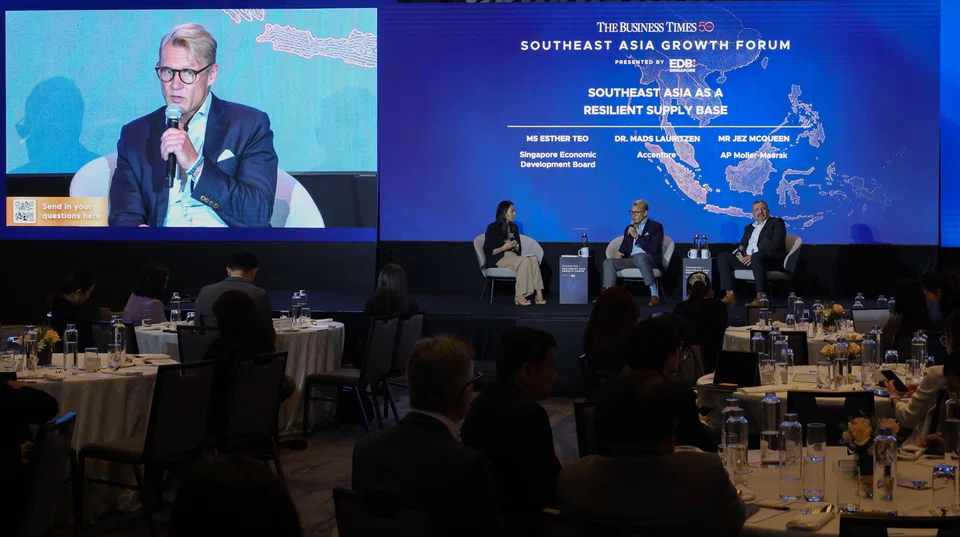
[SINGAPORE] The “China plus one” playbook is giving way to “South-east Asia plus one”, as manufacturers shift production within the region rather than out of it amid supply chain disruption and tariffs, said panellists at a forum on Wednesday (Nov 18).
The South-east Asia Growth Forum, jointly organised by The Business Times and the Singapore Economic Development Board (EDB), closed with a panel discussion on building competitive and resilient supply chains in South-east Asia. The discussion was moderated by Esther Teo, director of the Johor-Singapore Special Economic Zone Programme Office at EDB.
With geopolitical tensions pushing companies to diversify, manufacturers are increasingly moving plants out of China, said Mads Lauritzen, chief strategy officer for South-east Asia and supply chain lead for Asia-Pacific at Accenture.
He noted that China’s share of US imported manufactured goods has fallen from more than 20 per cent to less than 10 per cent over four years, and that three in four US manufacturers are pulling their supply bases out of China into the rest of Asia, with South-east Asia the biggest recipient.
The narrative has shifted from “China plus one” to “South-east Asia plus one”, he said, with the extra site often found within the region. He pointed to electronics clusters in Penang, Hanoi and Ayutthaya, and automotive hubs in Rayong and Jakarta.
Apparel production is moving south from Vietnam to Indonesia, said Jez McQueen, area head of sales for South-east Asia at AP Moller-Maersk, while some solar manufacturers hit by US tariffs have relocated from China to Malaysia and Indonesia, and now the Philippines.

Many rushed shipments to the US ahead of a tariff cut-off, he added, to avoid holding inventory when higher per-watt-hour duties bite.
But many companies have diversified only on paper and still rely on a single source for inputs, Lauritzen added, noting that two-thirds of electronics manufacturers in the region were hit by disruption from single sourcing in the past 18 months.
Such disruptions are costly. Lauritzen puts global revenue lost to supply chain disruption at US$1.9 trillion a year, roughly half the size of the South-east Asian economy, and rising. Supply chains, he said, cannot sustain that level of disruption and must be reinvented for resilience.
Preparing for the next shock
Trade within Asia is less disrupted than transpacific or European routes, said McQueen, noting that 22 per cent of global ocean traffic moves within Asia, and 55 per cent of that is Asia-for-Asia trade.
Even so, companies should assume the next shock is coming.
“There is going to be a disruption tomorrow. I don’t know what it is, but there will be something,” he said, urging parallel sourcing rather than reliance on one manufacturing base.
Yet building resilient supply chains carries a price. McQueen said inventory carrying costs are usually the biggest expense, but that reliable transit times let companies hold less stock, and that customers will pay a premium for speed and dependability.
Still, Lauritzen said companies should treat this as a necessity rather than a cost.
Resilience – meaning the time taken for a company to react and recover from disruption – also depends on speed, which artificial intelligence (AI) can drive, said Lauritzen.
An Accenture study found the average company takes about 35 days to react, while “front-runners”, fewer than 20 per cent of firms, take about five.
What sets them apart, he said, is embedding AI or agentic tools, which can act with some autonomy, in selected use cases, not necessarily at scale.
AI helps most in seeing beyond a company’s direct suppliers, Lauritzen said. Companies have good visibility of their tier-one suppliers, but most disruptions happen at tier two and tier three, where visibility drops sharply.
He cited upstream visibility agents, digital supply chain twins and orchestrators that give early warnings and help firms act.
McQueen noted that older logistics control towers reported what happened last month, whereas AI can start predicting what comes next.
Closing the AI gap
Yet few companies have put these AI tools to work. Lauritzen said only about 25 per cent of companies have begun using AI in supply chains and fewer than 10 per cent are scaling it – a gap he blamed on over-focusing on technology while neglecting processes, talent, and operating models.
He said Singapore is probably the strongest AI-enabling nation globally, citing its AI governance and 60 AI centres.
Small firms can start small, he said, pointing to Singapore’s seven AI funding schemes across six institutions and the Enterprise Innovation Scheme, under which S$100 spent on AI saves S$68 in tax.
Enterprise Singapore is helping more than 300 SMEs build bespoke agents, Lauritzen added, and eight Accenture clients are on the Champions of AI scheme.
Agents are not cheap, he conceded, costing S$50,000 to S$250,000 each but cost-transparency tools can help fund them.
Making the Johor-Singapore link work
Asked about the key gaps in making the Johor-Singapore Special Economic Zone (JS-SEZ) and Batam, Bintan and Karimun work for supply chains, McQueen said the main need is fewer customs touchpoints.
He called for paperless clearance and a “green lane” that would let cargo move from Johor Bahru into Singapore in about two hours, and asked EDB to lobby for it.
Both Johor and Batam must complement Singapore rather than compete with it, McQueen said. Johor offers land, space, water and a different workforce cost base; Batam offers investment and capability, with three quayside cranes in place – though port congestion and holiday slowdowns persist.
Lauritzen agreed the three form a complementary ecosystem, with electronics firms already using such footprints.
Singapore’s edge lies in competency, capability and capacity, McQueen said, adding that it is investing ahead of demand with new runways, terminal capacity and ports. He described Batam and Tanjung Pelepas as compatible with Singapore, not competitors.
His advice to newcomers: measure twice, cut once, and understand why Singapore is the right fit before moving.

Decoding Asia newsletter: your guide to navigating Asia in a new global order. Sign up here to get Decoding Asia newsletter. Delivered to your inbox. Free.
Copyright SPH Media. All rights reserved.
TRENDING NOW

Nvidia reinstates Jensen Huang as CEO; Trump says move poses no national security risk

Beyond the greenback, Vietnam’s big borrowers turn to Asian-currency bonds

Indonesia’s coal tycoon Low Tuck Kwong replaced as Bayan Resources president-director

Six workers file employment claims against Crystal Jade Food Manufacturing

