

A passion to drive digital growth in manufacturing
When an angel investor came knocking, Arcstone founder Willson Deng abandoned his post-doctoral studies to start his own business.
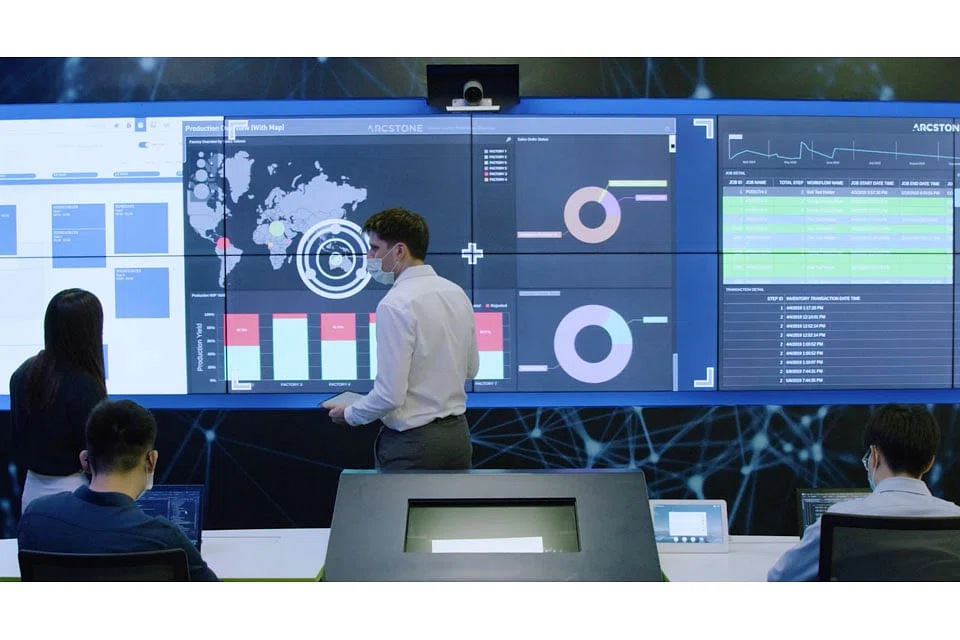

WILLSON Deng discovered his love for the manufacturing sector when he was pursuing a degree in industrial engineering and operations research at the University of California, Berkeley.
Some years later when he began a post-doctoral degree in technology and operations management, he was inspired enough to start his own company, having realised that he wanted to help drive growth in the digital manufacturing sector.
"It really got me interested into thinking: how should we improve this process? How do we control it so that not only is it more efficient, but at the same time, better, more reliable, (and able to produce) more sustainable products?" said Deng.
So when the opportunity presented itself in the form of an angel investor, he dropped out of school to found Arcstone, a company that specialises in helping businesses integrate and digitalise manufacturing operations across the entire supply chain.
Now the company's chief executive officer, he describes the manufacturing industry as a "fascinating field".
Despite having spent more than a decade in the sector, he still finds himself intrigued by the process of how an everyday good, such as a toilet paper or shampoo, is produced.
He noticed how companies would have to go through "an expensive manufacturing process" in order to assemble the raw materials required for manufacturing a product.
To solve the problem, he came up with a unique set of digital solutions aimed at helping businesses achieve greater transparency across its supply chain.
Arc.Lite, one of its products for example, does this by enabling SME manufacturers to go digital with its workflow and processes and granting them access to a real time dashboard.
Having access to such data through digitalisation, Deng believes, helps businesses optimise their operations and improve productivity.
"Data allows for better quality of products so that you don't produce scrap or have issues with quality that ends up being sometimes health conditions or health issues," he said, drawing on examples such as medical products and equipment, which require micro estimates of its raw materials to manufacture.
The company also employs blockchain technology to help its customers link together entire supply chains.
Businesses can also use Arc.Net, a multi-level blockchain tool, to transact data in a safe and protected manner through an encrypted key pair to integrate the entire manufacturing supply chain from the source of raw material to finished goods.
It will also provide enterprises with the option to transact their data with other larger multinational companies for a fee.
Deng said this would help small businesses enhance their attractiveness to large corporations which need direct oversight into their key suppliers, and allow them to position themselves as a more competitive player.
Lifting digitalisation efforts
Deng is a firm believer in the age-old adage, "The rising tide lifts all boats".
He believes the move towards digitalisation would not be possible if companies do not first see digitalising their operations as a benefit to their business.
This justifies part of the reason why the company chooses to establish Arc.Lite as a free-for-all product - to give businesses a sense of how things could be much easier if they went digital.
Thereafter, customers are provided with the option to upgrade, which includes access to more advanced tools to maintain the digital system.
Besides offering a free product, the company also adopts an educational approach in lifting the nation's push for digitalisation - through active partnerships with local educational institutions.
Arcstone signed a Memorandum of Understanding earlier this year with Temasek Polytechnic, in conjunction with the launch of a new S$7 million TP Advanced Manufacturing Centre on its campus.
Hands-on experience
Students at the school are given a chance to learn about tools used in the manufacturing sector as they get hands-on experience with Arcstone's manufacturing solutions being used as the lab's set-up.
"Working with academic institutes allows Arcstone to not only help everyone, but create this positive ecosystem of students learning the tool, deploying it for the customers and deploying for these manufacturers," said Deng.
"Eventually they can be hired as full-time staff, which helps those companies as well as a digital champion to drive that through."
Having turned profitable in the last financial year, the 48-strong team has many up-and-coming plans to ensure a sustained growth for the company.
Although Deng said they were "not quite ready to reveal these plans", he hinted at plans to expand into North Asia and North America by 2022, as well as new products developed from research work at the S$18 million lab jointly set up with the Agency for Science, Technology and Research launched in June this year.
Deng said that Arcstone's sights have always been set on building the business around the global digital manufacturing ecosystem, which is where the company will continue to head towards in the next 5 to 10 years.
"It's really to provide transparency over every single manufacturing shop floor globally, connecting them into this digital manufacturing ecosystem that we are building," said Deng.
Decoding Asia newsletter: your guide to navigating Asia in a new global order. Sign up here to get Decoding Asia newsletter. Delivered to your inbox. Free.
Share with us your feedback on BT's products and services
TRENDING NOW

Once staunchly pro-China, Malaysian Chinese businesses are now distancing themselves from Beijing

Britain’s mansion tax shows the difficulty of targeting wealth
Three hats, one goal: How Ng Kian Swan runs sustainability at NUHS

COE review: The gap between luxury and mass-market cars isn’t the only one worth bridging

