AP Technologies wants to lead the world in medical tubing

Tessa Oh
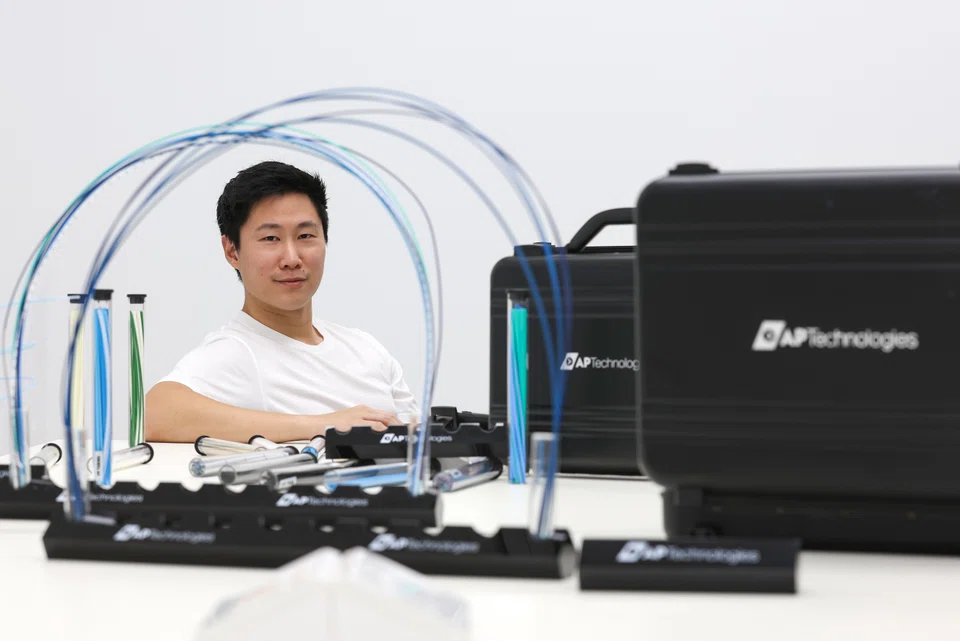
IF YOU are ever in a hospital in China and need to be put on an intravenous (IV) drip, chances are the IV tubing connected to your body was made by AP Technologies.
The manufacturing company specialises in medical tubing and catheters, which are inserted directly into the body. It makes millions of such tubing products each year, which are supplied to major medical device companies for use in life-saving products such as insulin delivery devices.
When people think of medical tubing, they might think of straws – which is not entirely wrong, said chief executive officer Charles Tang. “But the level of quality and the level of precision that’s required when you get into tubing that goes into the human body is at an entirely different level.”
This includes how compatible these parts are with human tissue, the thickness of the tubing walls, and how round and even the tubing is, said Tang. “Controlling these is extremely important, and that’s what we do 24 hours a day, seven days a week.”
The nine-year-old company started with just five employees and one extruder machine in its factory in Xiamen, China, but has since grown to more than 200 employees with more than 10 extruders.
It has also gained capabilities beyond just making tubes, such that clients can now rely on them to build out a full catheter from start to finish.
“Our goal is really to be a one-stop shop for catheters and we are working to become fully integrated,” said Tang.
China-plus-one
Entering Singapore is part of AP Technologies’ strategy to achieve this one-stop shop goal.
While the company was growing steadily in China, some of its customers started to push for it to adopt a China-plus-one strategy – that is, having one location outside China – in the last few years.

“Personally, I felt that it was a good strategic decision to have multiple locations. Especially in the medical field, we don’t want all our eggs in one basket and we don’t want all of our risk in one site,” said Tang.
It shortlisted several potential countries, including Malaysia and Vietnam, but ultimately chose Singapore and opened its second facility here a few months ago.
One big reason that Singapore came out on top was its talented workforce, as “highly talented and specialised engineers” are needed to operate AP Technologies’ equipment and develop new processing techniques, said Tang.
AP Technologies is “not looking to build a commodity product in Singapore”, but rather to make products that are challenging and not easily replicable, with high quality requirements, he added. “We’re really looking to bring some top level state-of-the-art technology into the country.”
The government has also supported the company in opening a facility here. “Medical devices dovetail nicely into the Singapore government’s plan for life sciences and biotech,” added Tang.
Secondly, as a Singaporean company, the goal was always to eventually bring operations back home “one way or another”, said Tang. “What we’re doing is not extremely labour intensive – it’s all very high value-add and high-tech, so it fits nicely into what Singapore has to offer.”
Lastly, the city-state’s strong intellectual property (IP) laws were also a big draw: “Our processes are all proprietary processes and we feel that the IP is more defensible here in Singapore versus other countries in the region.”
Asked if Singapore was picked as a strategic location for eventual expansion to other parts of South-east Asia, Tang replied that while there “could be plans for further expansion in the region”, the company does not intend to move its critical technology out of Singapore.
Aside from the region, it is looking at moving closer to its customers in the United States for some of its research and development work.
“The key when we look at our expansion plans is how it adds value to our customer,” said Tang. “So whether we decide on moving to a low cost manufacturing location to help our customers be more efficient from a cost standpoint, or whether we move closer to a customer geographically to help them be more efficient from a lead time, project development and R&D perspective… we’re taking all that into consideration as we’re picking our locations.”
Big ambitions
Demand increased dramatically during the pandemic, with AP Technologies growing 80 per cent year on year in 2021. This year, it is looking at a growth rate of over 50 per cent.
But Tang believes the manufacturer would have grown even faster without Covid-19. For example, it struggled to source some critical components for its guide catheters due to a supply crunch in the US, which prevented it from scaling up operations as planned.
“This was a big part of our expansion plan in the last two to three years, which unfortunately did not grow as expected. So moving forward, we’re bringing a lot of capabilities in-house,” said Tang.
The pandemic also delayed the expansion into Singapore: “We should have been six months to a year faster, but unfortunately due to supply chain issues, the reality of the situation was that we had to start a little later than we would have liked.”
But as supply chain problems ease, Tang is confident the company will be back on track. AP Technologies plans to go public in the next five years, though the location for listing has yet to be determined.
“There are some good companies out there, but we think we can do that and we can do better. We want to be one of the leading global medical device contract manufacturers for tubing and catheters in the future.”
Decoding Asia newsletter: your guide to navigating Asia in a new global order. Sign up here to get Decoding Asia newsletter. Delivered to your inbox. Free.
Copyright SPH Media. All rights reserved.