Meet the clean-tech innovators helping heavy industry cut emissions, recycle water – without rebuilding from scratch
Hydroleap and Green Environmental Engineering’s patented, chemical-free technologies are designed to work within existing infrastructure – lowering the barrier for heavy industries to hit net zero

WHEN Dr Mohammad Sherafatmand visited water treatment plants in Singapore in 2012, he saw how advanced technologies were being used to treat water for public use. But one question nagged at him: If such technologies existed, why were factories and construction sites still relying on chemical-heavy processes to treat their wastewater?
At the time, he was researching electrochemical technologies for his doctorate studies. The gap between what was possible and what the industry practised became clear.
“At a global level, industries use twice the amount of water that municipalities are using,” he says. “But where do they get the water from? They are using the same sources as municipalities.”
That insight led him to found Hydroleap in 2016, bringing advanced water solutions to industry. The company’s patented electrochemical technologies treat industrial wastewater without harsh chemicals, turning it into water that can be safely reused within the facility.
While Dr Sherafatmand focused on industrial water, chemical engineer Eddy Wee was driven to act by the region’s seasonal haze.
In 2016, Eddy Wee founded Green Environmental Engineering (GEE), which develops solutions to help heavy industries manage emissions more sustainably. GEE’s patented PureFlux system captures carbon dioxide from industrial exhaust and converts it into a stable, safe form, reducing environmental impact without overhauling existing processes.
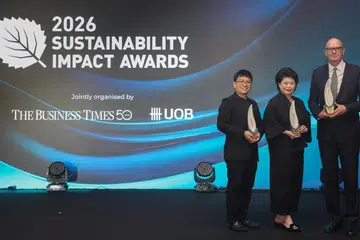
Both Hydroleap and GEE were recognised with the Emerging Enterprise Sustainability Award by OCBC and The Business Times, highlighting their innovation and impact in industrial sustainability.
Hydroleap: Electrifying water cleansing
Hydroleap deploys two key technologies to treat wastewater: Electro-coagulation (HL-EC) and electro-oxidation (HL-EO).
HL-EC uses electrical currents and sensors to remove contaminants, automatically adjusting the treatment in real time based on water quality. Hydroleap claims that it can decrease oil and grease levels by nearly 95 per cent.
HL-EO breaks down pollutants at a chemical level, deactivates microorganisms, and prevents scale build-up in water systems. It can remove up to 99 per cent of effluent colour in wastewater.
While electrochemical treatment is not new, it has traditionally been difficult to deploy in real industrial settings as it consumed too much energy or performed inconsistently. Hydroleap addresses these issues with its systems which are modular, energy-efficient, and designed to run continuously. They can also be added to existing treatment setups, helping companies upgrade their processes without major changes.
Hydroleap’s technologies are currently being used in manufacturing, food and beverage, palm oil, textiles and mining industries. They also play a key role in data centres. The company’s technology has been adopted by Amazon Web Services for the latter’s data centres in Singapore.
Dr Sherafatmand says: “For the data centres, we are saving 70 to 80 per cent of the water that is getting discharged and we are putting it back to the operation.”
The market has responded positively – he says that Hydroleap is now working on projects in Singapore, Indonesia, Malaysia and Australia, and its revenue has grown two to three times year on year over the past three years.
To fuel its growth momentum, Hydroleap secured US$4.75 million (S$6.06 million) in July last year from strategic investors such as EDBI, Antares Ventures and Woh Hup, bringing its total funding to nearly US$12 million to date.
“Winning the OCBC Emerging Enterprise Award is a testament to the impacts that we are making,” says Dr Sherafatmand. “It has given us the visibility that we are delivering real-life, large scale solutions to mission-critical infrastructures such as data centres and semiconductors.”
Building a critical bridge to reduce emissions
Wee, a chemical engineer by training, worked in oil and gas and environmental projects before founding GEE in 2016. The transboundary haze of the early 2010s got him thinking about how to tackle air pollution in heavy industries.
“In the fossil fuel industry – oil and gas, petrochemical, steel, cement plants – they release a lot of carbon dioxide, which is a greenhouse gas that causes global warming,” he says.
However, getting these companies to go green is not something that can be done overnight.
GEE’s flagship product is its proprietary PureFlux Carbon Capture and Storage System. As gases are produced in heavy industrial processes, PureFlux removes dust and harmful pollutants, then traps carbon dioxide and converts it into calcium bicarbonate that can be safely handled and stored.
This means industries can cut emissions at the source without overhauling existing operations. The result is cleaner gas, more efficient systems and a practical path towards net zero for sectors like cement, steel, power generation, and waste incineration.
Wee says: “Fossil fuels are still a very mature technology and we still need to use them. But it doesn’t mean that we have to continue using them in our future. In between, we must find a solution. This is also the reason why I invented this carbon capture and storage system.
“I view the carbon capture and storage system not as a replacement for renewables, but as a critical bridge and also a permanent necessity for the most hard-to-abate sectors.”
Wee says that GEE is currently collaborating with a publicly listed company in Malaysia to establish its first pilot plant and is also exploring deployment opportunities with A*STAR for the Singapore market.
“Winning this Emerging Enterprise Sustainability Award has been a strategic catalyst for my company’s growth, providing the market credibility and institutional recognition to scale this industrial environmental symbiosis model,” he says. “This accolade has granted me access to regional investors and green financing that I’m going to use to fund our capital-intensive turnkey projects.”
Recognising bold ambition
Now in its 19th year, the Emerging Enterprise Awards – a joint initiative by The Business Times and OCBC Bank – continue to champion the innovation, resilience and excellence of businesses under 10 years old. The awards celebrate emerging businesses from across Asia, reflecting a sustained commitment to highlighting entrepreneurial talent far beyond Singapore.
The Emerging Enterprise Sustainability Awards honour enterprises that embrace opportunities in the green economy – whether by embedding sustainable practices in their operations or leveraging technology and innovation to drive the transition to low-carbon economies.
Additionally, the Most Promising Sustainability Startup Awards celebrate businesses with unique, commercially viable ideas and significant long-term potential.
The application for the 2026 Emerging Enterprise Awards is opening soon. Learn more about the submissions here.

Share with us your feedback on BT's products and services