

Mao Sheng Quanji looks beyond pandemic
Faced with manpower squeeze and changing client requirements, the company looks at innovation for the future.
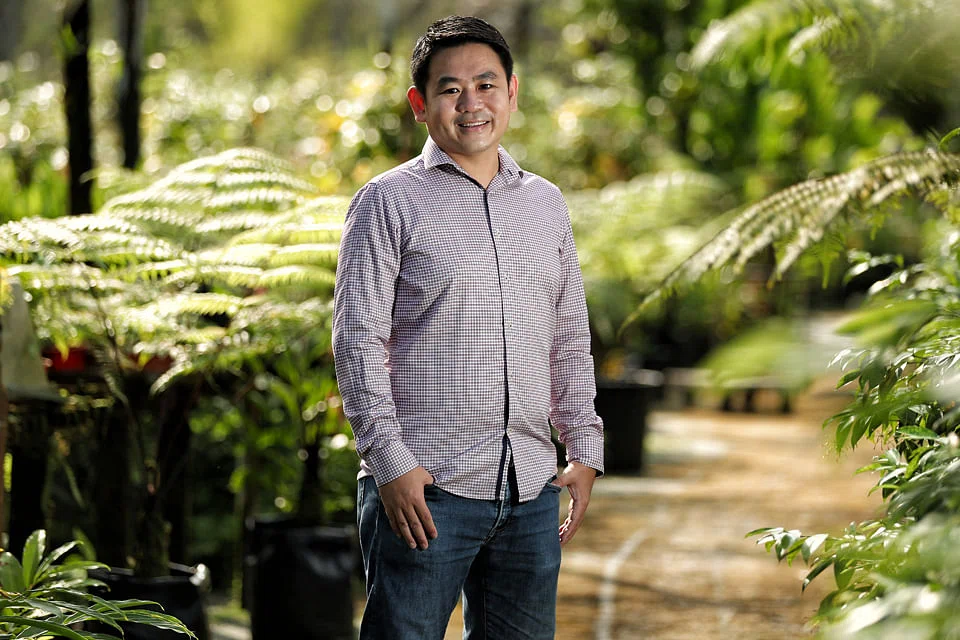
UNDER the scorching sun, neatly ordered rows of leafy potted plants and brightly coloured flowers are intermittently showered by water sprinklers. This irrigation system is one thing that Mao Sheng Quanji Construction Pte Ltd is experimenting with at its plant nursery.
After more than 30 years in the industry, the landscaping company is well aware of the need for innovation to adapt to changing business environments. Choo Jun Wei, executive director and son of Mao Sheng's founder, credits the company's ability to re-invent itself for the Enterprise 50 Five-Year Award winner's continued success.
Mao Sheng designs, builds and maintains landscapes, mainly for large-scale government projects. While its regular work involves the maintenance of grass, shrubs and trees, it has evolved over the years alongside shifting client needs.
"In the past, it was very straightforward. We wanted things green and we would plant grass. Nothing much to it. Now, the sophistication increases," said Mr Choo.
NATURAL PROGRESSION
In the 1980s, it was "a natural progression" to begin incorporating greenery into urban spaces. "We were strong at traditional landscaping, but that specialised knowledge didn't work for trees higher up," he said. "You learn and you improve."
Taking into account variables like gravity, wind load and structural constraints, Mao Sheng adapted practices to create green walls and lush rooftop gardens, like the cactus garden in Changi Airport's Terminal 1. Following requests, it also branched into bringing and maintaining aquatic plants at riverbanks.
Mr Choo believes that the landscaping is moving towards bringing greenery to other sectors, such as healthcare and food. Most recently, Mao Sheng has helped its clients establish therapeutic gardens and edible gardens.
"This creates a narrative where they can talk about climate change, self-sustainability, food security," he said. "Things that are now very critical."
But things are not all rosy for Mao Sheng. Overseas expansion was in the works for the company, which believed it could provide expertise in countries such as the United Arab Emirates and Cambodia, which "aspire to be green". However, with Covid-19 obstructing travel, plans have been halted before it could put down roots.
"You can't do it over Zoom," Mr Choo said. "In our job, you have to be hands-on."
Mao Sheng also imports most of its plants from Malaysia. The country's Movement Control Order has tightened supply, increasing its reliance on stocks and plants that it grows in its nursery, which might not yet be a sustainable long-term model. This problem will be exacerbated as the future of the nursery is now up in the air, with the leased land slated to be returned to the government.
Furthermore, the traditionally labourious sector, with long days toiling under intense heat and literally getting one's hands dirty, relies heavily on foreign workers. Mao Sheng's workforce has been whittled down by over 10 per cent, with some workers stuck overseas.
But the company is not afraid of backbreaking work and trial and error. It has adopted, modified and workshopped technology to reduce reliance on labour and increase selfsufficiency. Mr Choo sees humans and technology working hand in mechanical hand as the future of landscaping. "The maturity of technology is not there yet," he said about the need for a human element.
Some technologies are not particularly new, even if they are not yet commonly used. While not yet ubiquitous, robot lawn mowers can be found weaving around on fields of grass, saving significant man-hours. Mao Sheng's technicians have modified tree pruning equipment acquired from Europe - which originally placed workers in a bucket at a height to trim trees - so that a mechanical saw can be safely operated at the ground level instead, which better suits trees in Singapore's tropical climate.
Other technologies still require some fine-tuning and are currently in experimental stages. Robotic weed trimmers are taught to identify invasive plants before lopping off their tops. Internet of Things devices, light detection and ranging technology, tilt sensors and bug-identifying apps detect problems in tree and plant health.
EXPLORING NEW SOLUTIONS
However, technology is not a panacea. From the information gathered, Mao Sheng has to make judgements and administer treatment, which can be a challenge. Mr Choo calls a spade a spade. The company has experienced many failures, he said. But that has not stopped it from exploring new solutions.
Its nursery irrigation system is one of the technologies that Mao Sheng is still workshopping. Different plants have different needs, which could result in overwatering or underwatering them, Mr Choo explained.
Sensors and better coordination of plant, weather and watering factors would be needed to counter the problem. For now, Mao Sheng continues to refine their solution.
In the near future, at least, the landscaping sector will require people and automation working in tandem.
The E50 Awards provides a third party lens that helps Mao Sheng assess their blind spots, Mr Choo said. It also serves as a reminder that success is not guaranteed.
"That's why we need to keep thinking forward. What happens if Covid-19 continues or workers don't return? To grow, we have to accelerate the use of technology. In the future, I may be selling technology to others in the business. Innovation may become a product in itself."
Decoding Asia newsletter: your guide to navigating Asia in a new global order. Sign up here to get Decoding Asia newsletter. Delivered to your inbox. Free.
Share with us your feedback on BT's products and services
TRENDING NOW
High Court rules against Julius Baer’s Singapore trust arm in US$50 million family trust dispute
MSCI proposes standalone status for Indonesia; Jakarta stocks plunge 8%

Once staunchly pro-China, Malaysian Chinese businesses are now distancing themselves from Beijing
No chicken feed: How Malayan Flour Mills built an empire from flour to fowl

