Bracing for the long term with innovation, staff development
The second runner-up of the Enterprise 50 2022 Awards takes a bottom-up approach to leadership, with over half its middle management starting out as security guards

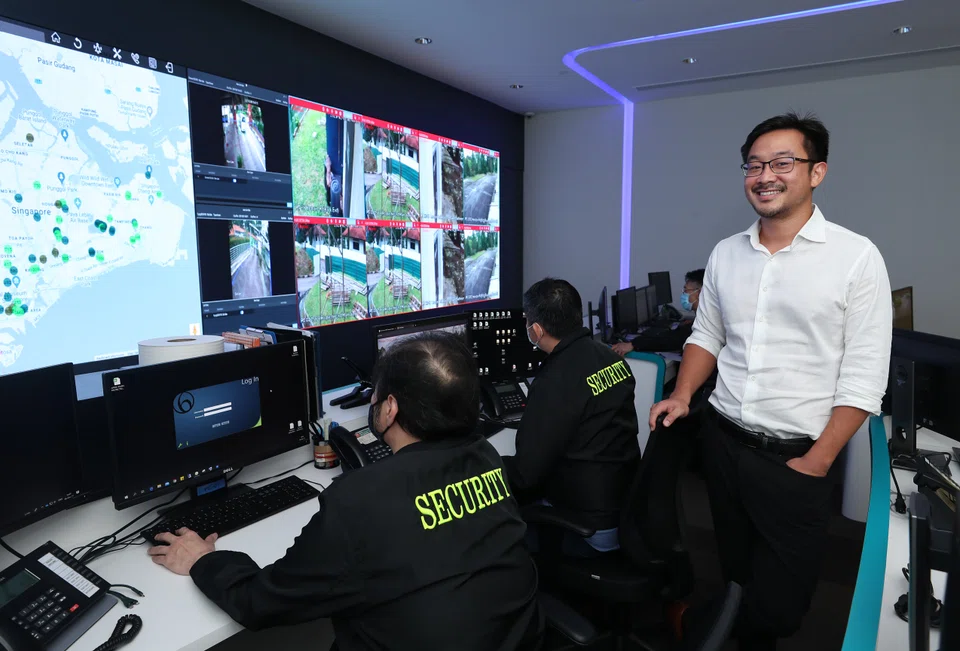
FOR security company Apro Asian Protection, gearing for the long term does not merely mean a structural pivot, but also staff and culture development.
The company conducted a restructuring exercise in November last year in a bid to better tap on the strengths of its business components, but it has also brought about non-tangible benefits to the company in the longer run, said Apro’s deputy managing director Li Xiaowen.
Apro’s business comprises three arms: manpower, technology and training. After the restructuring, the company consolidated its manpower and technology arms – which tend to having more business-to-business customers than its training business – to serve customers in a more integrated manner.
The restructuring also allowed employees to step up in their leadership roles and grow their responsibilities. Li said: “A lot of focus in the last year has been around leadership development.”
This bottom-up approach to leadership, Li said, is part of the company’s long-time culture and organisational value.
More than half of its middle management started in the company as security guards, and most have served in the company for an average of 12 years, Li noted. Apro also has a promotion policy to always consider internal candidates for new roles.
These staff allow the company to strike a balance between different departments which have different interests, namely concerns about profit from its sales department and salary from ground staff.
“The secret sauce – our most important asset in how we’ve been able to be successful over these years – is that dynamic,” Li said.
Apro, which started in 1985 as a partnership between a British and a Swedish company, was wholly acquired in 2008 by Li’s father, who served as the company’s general manager in its early years.
SEE ALSO






While Apro is a family-run business, Li is the sole member of the family in a direct operational role, with most of the family involved either as shareholders or directors.
“I’ve just been a conductor. Everybody else in the company has to be bought in to how we want to develop and evolve as an organisation, rather than just me telling them where to be,” he said.
“Of course, in a way, there has to be a coordinated effort, and I very much see that as my role now,” he added.
Li noted the benefits of developing his staff to take on higher-level responsibilities.
The average tenure of Apro’s security staff is around five years, which Li said is long for the industry. This is in part due to the company’s efforts to pay wages that are above its competitors, and 20 to 30 per cent over minimum prescribed wages.
But paying industry-leading wages is also taking a toll on the company amid rising costs.
Last year, Singapore announced adjustments to its Progressive Wage Model (PWM) for security staff, requiring companies to pay wages that are substantially higher by 2028.
This meant that Apro has had to raise wages, on top of government co-funding, in order to maintain paying above-market rate salaries – an endeavour that has weighed on its margins.
Li also noted that it has been necessary to dig into its margins to retain some contracts because customers are also getting increasingly cost-sensitive.
Hence, the company is looking towards contracts which are less reliant on manpower and can be supported through technology, or what Li calls an “outcome-based model”.
“In my mind, it should not be about cheap sourcing, it should be about adopting more of these kinds of innovative models, which can translate to reduced costs, or increased value,” Li said.
The industry as a whole is also becoming increasingly focused on integrated security operating models, and is pivoting towards the integrated facilities management space, Li said, adding that the Apro is thinking “more deeply” about how it can find relevance for itself in the latter.
For now, it aims to stay competitive by working with partners to identify technological systems that can support its security staff.
Its status as a 24/7 service provider is likely also a selling point. Li noted that Apro may not be able to deliver the full scope of services – such as offering cleaning or landscaping services – due to limited resources. But the company’s round-the-clock security staff can respond to and escalate issues at any point of time, Li said.
And with higher wages, manpower at the company is largely stable and reliable.
Li said: “Because of resourcing and reliability, we feel a lot more confident in our ability to propose a security plan with an optimised deployment of manpower.”
For Li, the Enterprise 50 Awards is a means to “make legitimate” its company’s profile. Having participated in the awards for three years now, Li hopes that Apro’s status as an award winner will allow potential partners to consider the company more favourably than others.
While the plans have not been fully put into motion as Apro’s business is underpinned by the contracts its secures, Li noted opportunities in the pipeline in the next 12 months or so that should allow the company to realise its goals.
“I do believe that kind of heralds the start of a new era in our business and participating in this integrated space,” he said.
Decoding Asia newsletter: your guide to navigating Asia in a new global order. Sign up here to get Decoding Asia newsletter. Delivered to your inbox. Free.
Copyright SPH Media. All rights reserved.