

Choon Huat Engineering prospers by going green and global
Securing the top spot at this year’s E50 Awards, the construction equipment rental firm is embarking on two journeys at once

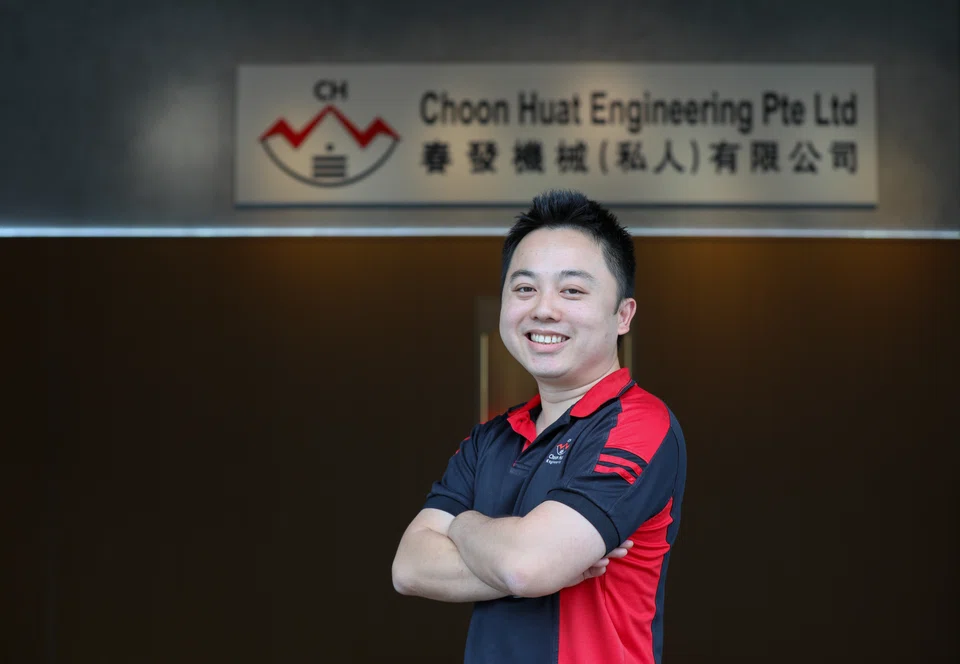
AFTER four decades, construction equipment rental company Choon Huat Engineering broke new ground in two areas this year: going abroad and going green.
Since its founding in 1983, the family business – now run by the third generation – had operated only within Singapore. Sustainability, too, was largely uncharted territory.
But it embarked on two major transformations this year – a new phase that chief executive Oh Chee Yong believes will drive growth for years to come.
“I’m just excited that the company is on a track where we can make a difference and help bring down carbon emissions,” he told The Business Times.
Alongside its first forays abroad and into sustainability, Choon Huat also made its inaugural application to the Enterprise 50 (E50) Awards.
This led to another first: Securing the top spot among 50 winners at the 30th edition of the E50 Awards.
Commercial battery
Choon Huat’s move into both internationalisation and sustainability was powered by a new offering for the business: A battery energy storage system, or Bess, for use on construction sites where electricity is not readily available.
In 2023, the company and a Chinese manufacturer established a joint venture, Infinity Cube, to produce these systems. Choon Huat holds a 60 per cent stake, with the Chinese partner owning the rest.
Through this partnership, Bess units are manufactured to Choon Huat’s specifications in China and then exported to Singapore and other countries.
SEE ALSO



The units are essentially “giant power banks” that can power heavy industrial equipment such as tower cranes, said Oh.
Similar to electric cars, the Bess units run on lithium-ion batteries. They come in two models: A smaller version with the capacity of approximately 2.5 Tesla Model 3 sedans, and a larger model with double that capacity.
“Most construction sites in Singapore do not have access to electricity from the grid,” Oh explained. To power equipment, contractors have traditionally relied on diesel-powered generators.
But these generators are noisy, contribute to carbon emissions and require a constant fuel supply. Bess units are a silent, emission-free alternative.
This is particularly beneficial for sites with noise restrictions, such as those near hospitals or schools, where operations must be quieter during certain hours of the day.
This is on top of the primary use for such units: To power machinery with uneven power demands.
Tower cranes, for instance, operate in a start-stop manner, requiring a surge of power when lifting loads but minimal energy between lifts. Those peak power demands require diesel generators that are rated accordingly – that is, larger and more fuel-intensive ones.
Such generators continue to consume fuel at a significant rate even while equipment is idling, and cannot be turned off as they also power essential systems in the crane operator’s cabin, such as air-conditioning and communications.
In contrast, Bess units can provide low levels of power for essential systems, then ramp up when a boost is needed. By using them to power tower cranes, contractors can reduce their diesel fuel consumption by up to 80 per cent, Oh said.
At those levels, Choon Huat’s clients can achieve overall cost savings of up to 30 per cent, even after factoring in the additional cost of renting the Bess unit.
“It’s win-win,” said Oh. “Costs come down, but emissions also come down.”
Apart from equipment, Bess units can be used for general power requirements. Depending on the model and scale of operations, each unit can power a tower crane for a full day of lifting, or an air-conditioned site office for a few hours.
The units are either transported off-site for grid recharging, or recharged on-site with diesel generators. The second approach still allows companies to cut emissions and costs, as the diesel generators operate at peak efficiency when charging the Bess units.
Going abroad
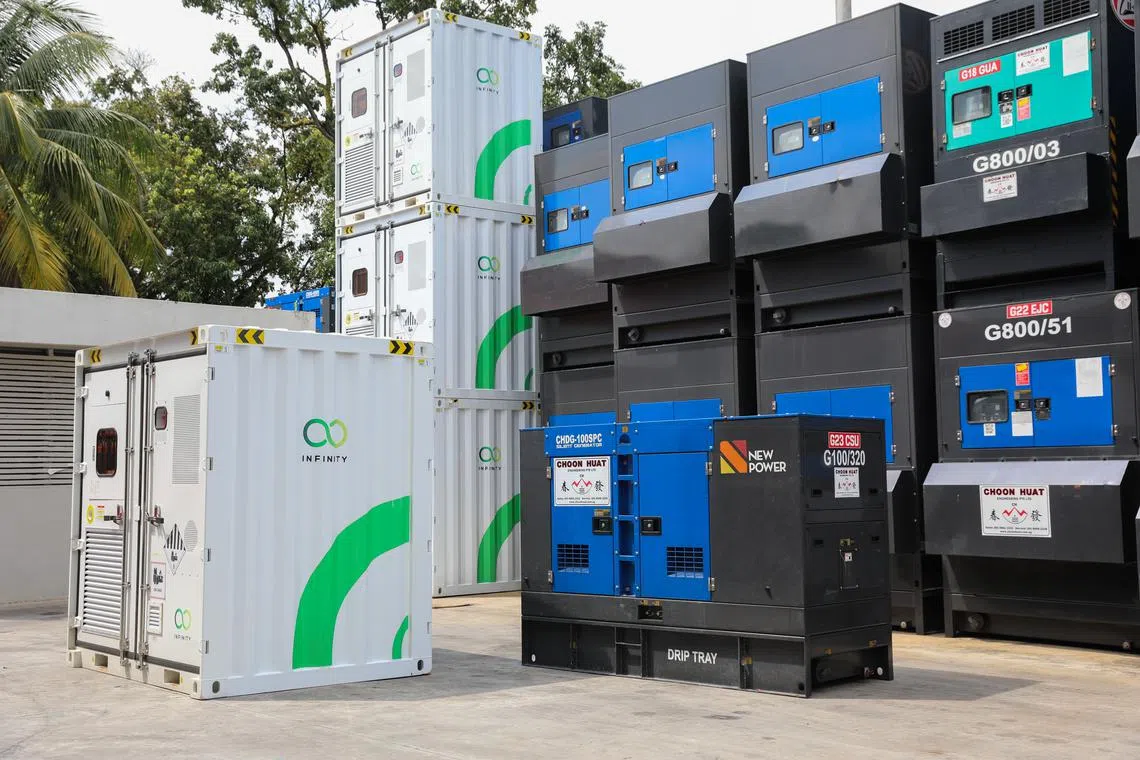
Since 2023, Choon Huat has invested over S$8 million in manufacturing Bess units. More than 50 units have been produced, most of which are in the company’s inventory and rented out to construction clients in Singapore.
It aims to invest another S$8 million by the end of 2025, to manufacture 50 more units to meet local rental demand.
Bess units have also been Choon Huat’s ticket to new markets. Four units have been shipped to Australia as samples for potential customers, following the company’s debut at a Brisbane trade show in June – its first overseas foray.
Oh anticipates selling around 20 units in Australia next year, with sales there expected to grow to 50 units annually within the next three to five years.
Choon Huat views Australia as a favourable market due to its strong push for green construction practices. It is eyeing other markets with similar initiatives, such as Japan and Hong Kong.
For overseas markets, the business model will focus on direct sales and maintenance services, rather than the rental model used in Singapore.
This is because an overseas rental network, while potentially more lucrative in the long term, is difficult to establish without existing business contacts, Oh said.
“Singapore is limited in terms of earning potential,” he added. “Right now, Choon Huat is bringing in 30-plus million dollars per year (in revenue) – but if you want to grow to 50, 70 or 100-plus million dollars, you definitely need an international presence.”
Within the next three to five years, revenue from overseas operations is expected to account for up to 20 per cent of total sales.
With this, Choon Huat’s annual revenue growth rate is expected to double to around 20 per cent, from 10 per cent now.
In 2023, the company reported revenue of S$33.2 million, up from S$30.2 million in 2022. This is expected to grow at least 10 per cent to exceed S$36 million in 2024, Oh said.
The company had a net profit of S$12.4 million for 2023, and expects to stay in the black.
Family business
Before going into Bess units, Oh had brought Choon Huat into another new area of business: customised diesel generators.
This was shortly after he joined the family business in 2013 as a fresh-faced IT consultant who had earned his degree in computer engineering just two years before.
He had never intended to join the family business, nor did his father encourage him to previously. But this time, his father wanted his help with an IT issue.
“That was the first time my dad asked me to join the business,” Oh recalled. “I felt there were some obligations, some responsibility to do so; I just went in.”
He was tasked with implementing enterprise resource planning software – a project that had dragged on longer than planned due to issues with a third-party vendor.
After completing the project in seven months, Oh shifted his attention to improving the company’s business model.
At the time, in 2014, Choon Huat primarily served subcontractors and smaller construction firms. To continue growing, the company needed to attract larger clients.
Oh identified a gap in the market: renting out diesel power generation units. Back then, costly Japanese models dominated the market and ownership, rather than rental, was the industry norm.
He reasoned that if a more affordable alternative could be sourced, perhaps from suppliers in China, Choon Huat could fill a niche.
However, Chinese units had a drawback: They tended to break down more frequently than their Japanese counterparts, making them less attractive to own.
Yet, this made them ideal for rental, with Choon Huat managing maintenance and charging clients a flat monthly rate.
Having decided on this model, Oh partnered a Chinese manufacturer to customise diesel generators for Choon Huat.
Japanese models typically could not be modified without voiding the warranty. In contrast, Chinese manufacturers were “extremely flexible” and could tailor their products to meet Choon Huat’s needs – at half the price of Japanese products.
For instance, generators may require costly repairs if they keep operating after fuel runs out. One custom tweak was to add a sensor that shuts down the generator before fuel runs out.
From 2014 to 2018, using a combination of internal resources and bank loans, Choon Huat invested more than S$10 million annually to purchase these generators for rental operations in Singapore.
The company now has more than 2,000 of these diesel generators, comprising about half of its 4,000 pieces of equipment available for rent. The remaining inventory includes air compressors, welding machines and forklifts.
Topping the list
After various managerial stints at Choon Huat, Oh took over as CEO from his father in 2017. But in 2022, he hit what he described as a mental and career gridlock. “I didn’t know what I could do for the company,” he said.
To find direction, he enrolled in the one-year Enterprise Leadership for Transformation programme, run by Enterprise Singapore and his alma mater, the National University of Singapore.
“Through the programme, I met mentors and peers, and learnt how small businesses can grow.”
One key takeaway was the importance of marketing – specifically, the need to “put yourself out there” to drive growth, recalled Oh. This led Choon Huat to apply for the E50 Awards this year, for the first time.
Using exams as an analogy, Oh said that Choon Huat does not need to be the top performer in order to make a name for itself.
“I don’t have to be No 1, but if I can get to No 10, then we can still try to stand out,” he explained.
But as it turned out, Choon Huat did become No 1.
Decoding Asia newsletter: your guide to navigating Asia in a new global order. Sign up here to get Decoding Asia newsletter. Delivered to your inbox. Free.
Copyright SPH Media. All rights reserved.
TRENDING NOW

Britain’s mansion tax shows the difficulty of targeting wealth

Once staunchly pro-China, Malaysian Chinese businesses are now distancing themselves from Beijing

The only common thing in S-E Asia is that we all eat rice: Cisco’s Asean president
Singapore data centre operator DayOne opts for US IPO at likely US$20 billion valuation

