

Taking small steps towards sustainability – and helping others make the journey
Beyond internal improvements, HR firm Elitez helps other companies meet ESG goals

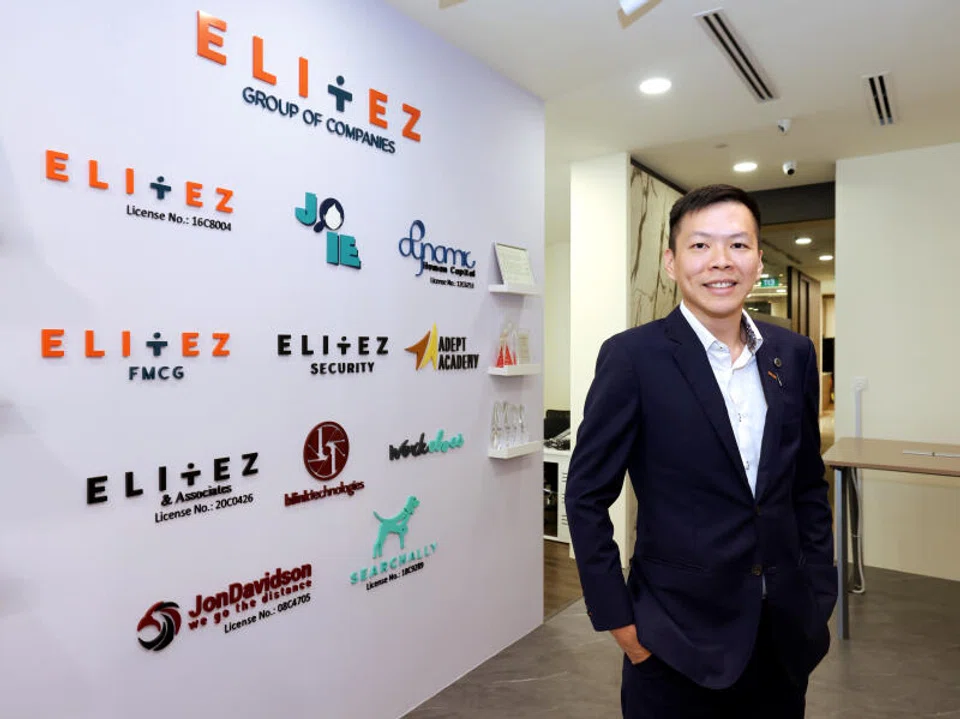
UNLIKE energy-intensive manufacturing or construction, human resources (HR) might not be the most obvious industry for pursuing sustainability. But Elitez Group’s varied efforts – from accreditations to electric-vehicle (EV) loans – won over the Enterprise 50 Awards judges, who named it this year’s Sustainability Innovation Award winner.
As Singapore emerged from the Covid-19 pandemic, Elitez’s management assessed the company’s future – and decided to make environmental, social and governance (ESG) an important management philosophy.
Robust ESG frameworks could enhance the company’s credibility and help to attract or keep clients, who may have ESG criteria for vendors, said co-founder and CEO Derrick Teo.
This has proven to be the case. Last December, Elitez won a two-year contract worth more than S$4 million from the Ministry of Social and Family Development, thanks to its abundance of ESG practices – not least in the “social” pillar.
ESG practices also appeal to Gen Z workers who feel a “deeper sense of responsibility” in such issues, and to financiers – banks, investors or capital markets – which want to align themselves with socially or environmentally responsible companies, said Teo.
Furthermore, as ESG reporting is required for public listings, an early start could ease the way for Elitez’s plans to list in 2027.
'%3e%3cpath%20d='M12.1475%2025.5262C13.7713%2025.4295%2014.94%2023.913%2014.94%2021.8832C14.94%2019.5359%2013.474%2018.093%2011.5917%2018.093C11.3745%2018.093%2010.9582%2018.093%2010.8393%2018.1413V25.2086L11.8891%2025.5745C11.8891%2025.5745%2012.207%2025.5262%2012.1475%2025.5262ZM11.4934%2017.6281C13.2567%2017.6281%2014.3843%2016.4292%2014.3843%2014.4501C14.3843%2012.372%2013.275%2011.2973%2011.4339%2011.2973H10.8393V17.6305H11.4934V17.6281ZM6.66078%2025.6482L7.39265%2025.5492C8.02617%2025.4502%208.26403%2025.3053%208.26403%2025.1097V11.6149C8.26403%2011.4193%208.1451%2011.3709%207.23484%2011.249L6.68137%2011.173L6.6219%2010.7588H11.9508C15.7153%2010.7588%2017.0624%2012.0797%2017.0624%2014.1578C17.0624%2015.9666%2015.7748%2017.1909%2013.4969%2017.6305V17.7041C16.111%2017.948%2017.6571%2019.5382%2017.6571%2021.7636C17.6571%2024.3318%2015.8937%2026.0417%2012.1109%2026.0417H6.60132L6.66078%2025.6482Z'%20fill='%232B2B2B'/%3e%3cpath%20d='M20.6287%2025.6505L21.5596%2025.5515C22.1725%2025.4779%2022.4104%2025.3076%2022.4104%2025.112V11.249H21.9346C20.073%2011.3479%2018.982%2013.0095%2018.408%2014.6227L18.1907%2015.5018H17.6555L18.1701%2010.7588H29.3837L29.6421%2015.4787H29.1664L28.9491%2014.6227C28.3728%2012.8645%2027.3047%2011.2743%2025.5002%2011.249H24.9856V25.1856C24.9856%2025.3812%2025.1251%2025.4548%2025.9965%2025.5515L26.7695%2025.6505L26.829%2026.0417H20.5693L20.6287%2025.6505Z'%20fill='%232B2B2B'/%3e%3c/g%3e%3cdefs%3e%3cclipPath%20id='clip0_5242_21648'%3e%3crect%20width='24'%20height='16.8'%20fill='white'%20transform='translate(6%2010)'/%3e%3c/clipPath%3e%3c/defs%3e%3c/svg%3e)
Piecing together a strategy
In late 2020, Elitez set up an ESG committee to recommend and implement policies, seek certifications and make commitments.
Big carbon emitters such as manufacturers can slash emissions by swopping out a single machine. Elitez, which provides recruitment, staffing, outsourcing and training services, does not have this “luxury”, said Teo.
Instead, it tries “all the micro strategies” it can.
SEE ALSO


On the environmental front, it has trimmed emissions from its workplace with energy-saving lights, air-conditioning and taps. It also takes a primarily work-from-home approach, reducing emissions from employees’ commutes.
Elitez’s office also boasts an urban farm, managed by a subcontractor. Inspired by Singapore’s “30 by 30” goal of locally producing 30 per cent of nutritional needs by 2030, the company considered providing courses for urban farming.
In 2021, to get familiar with the subject, Elitez set up a 1,000-square-foot aquaponics farm on its office’s balcony. The company ultimately decided not to launch such courses. But the farm remains as a legacy of that exploration, with its vegetable crop going to employees every month.
In theory, the garden could offset some of Elitez’s carbon emissions, Teo said, though the HR firm has not engaged a consultant to measure this.
But for the office as a whole, Elitez has done carbon footprint analyses.
On the social front, Elitez has adopted tripartite standards for fair employment, as well as gender-balanced hiring; developed schemes to make jobs LGBT-friendly; and set up a nursing room at the office.
It also funds “at least 80 hours” of training per employee per year, even where such training is not directly relevant to their job scopes.
As for governance, Elitez has a code of business conduct to set an “ethical baseline”. This includes whistleblowing and inquiry processes.
Besides these concrete moves, Elitez has commitments and accreditations. It conducts ESG reporting based on international standards and has joined alliances such as the Carbon Pricing Leadership Coalition Singapore.
It has also committed to the 10 Principles of the UN Global Compact, for responsible business practices relating to human rights, labour, the environment and corruption.
Elitez also purchases renewable energy certificates, showing how much of its energy comes from green sources, and has achieved various sustainability certifications, including the LowCarbonSG Mark and ISO 14001 Certification.
Beyond the workplace, Elitez hopes its employees can lead sustainable lifestyles. Leading by example, the management team switched to EVs in 2021. This year, it introduced interest-free loans for staff to switch to EV vehicles.
Five or six employees have expressed interest, though none have made the decision yet, Teo said.
For the past two years, Elitez has also enforced a no-dustbin policy at the workplace – except in the female toilets – to encourage mindful consumption. Anecdotally, more employees now use reusable lunch boxes instead of getting takeaway meals in disposable packaging.
Going beyond itself
Over the past four years, Elitez has invested more than half a million dollars in its ESG journey, Teo said. But it also aims to earn “ESG revenue” from HR services that help clients improve social equity, environmental sustainability or responsible governance.
In its latest financial year, Elitez’s revenue neared S$70 million. Of this, S$4.7 million was ESG revenue, mainly from five major clients.
Elitez has also launched ESG-related training courses, with the first being a SkillsFuture-funded introduction to EVs in 2021. Within half a year, this brought in close to S$100,000 in revenue.
In the last year, Elitez’s training academy has put up a string of ESG-related courses for businesses. These are approved and funded by SkillsFuture Singapore, and are being evaluated for double accreditation by the Institute for HR Professionals.
These include courses on environmental sustainability management; diversity and inclusion management; and Personal Data Protection Act training.
“In whatever small ways we can… we try to impact people,” Teo said. “So if I’m an organisation that doesn’t really emit a lot, how can I try to, via some thought leadership, encourage other companies to (cut emissions)?”
Ironically, the company’s growth does make it hard to meet sustainability targets such as deadlines to implement energy efficient measures, said Teo.
“It’s two divergent needs. Proclaiming and putting actions in to reduce carbon footprint is something we’re passionate about. At the same time, we have to grapple with the fact that by the sheer volume of growing our businesses, inadvertently, we will have more carbon footprint.”
The company is therefore revising its metrics to consider carbon emissions per million dollar in revenue, instead of absolute emissions – in anticipation of future revenue growth.
Decoding Asia newsletter: your guide to navigating Asia in a new global order. Sign up here to get Decoding Asia newsletter. Delivered to your inbox. Free.
Copyright SPH Media. All rights reserved.
TRENDING NOW

Once staunchly pro-China, Malaysian Chinese businesses are now distancing themselves from Beijing

Looking beyond looming CEO succession, should UOB potentially pursue a transformative merger?

Could stablecoins be the future of money?

Grab CEO’s wife Chloe Tong on life with Anthony Tan and finding her purpose

