

Health and beauty group A Wellness wants to build local strength into global ambitions
The company wants to bring homegrown brands to China’s beauty market through product-driven growth

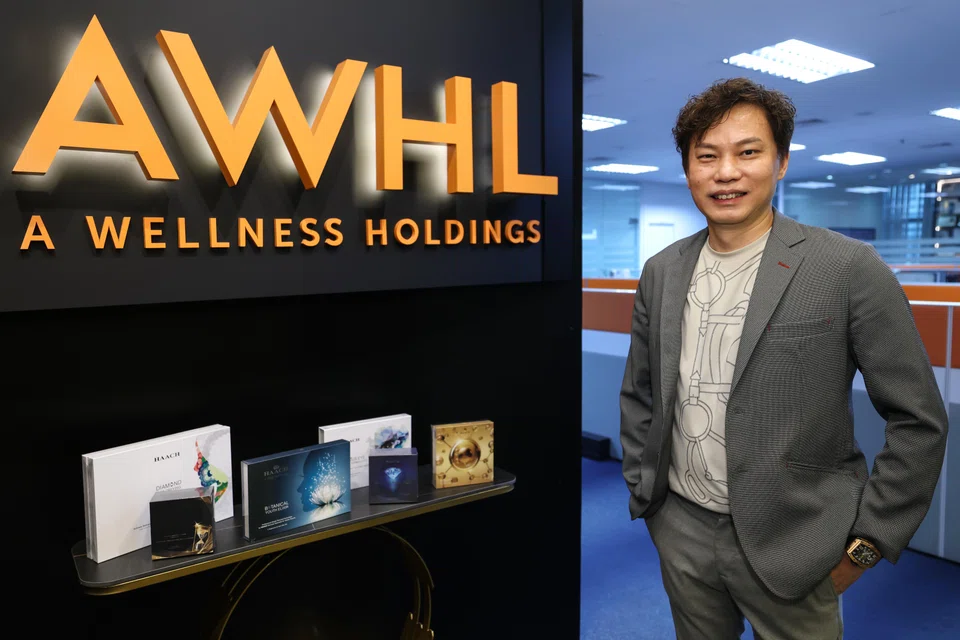
FOR 14 years, health, beauty and wellness group A Wellness Holdings (AWHL) has been a stalwart of the local beauty and wellness industry.
Over the years, it has evolved from a single chiropractic clinic into a group whose operations span beauty, medical aesthetics and even traditional Chinese medicine (TCM).
Its portfolio includes chiropractic and wellness brand Natrahea, beauty services provider Haach and its medical aesthetics wing Dr Haach, as well as TCM provider Guo Tai.
Chief executive officer and founder Arich Tan told The Business Times that the company is looking to take its homegrown success overseas as it launches a new product-driven strategy, banking on the reputation of its established health and wellness service brands.
The company is also celebrating its latest achievement – the five-year prize in the Enterprise 50 awards, jointly organised by The Business Times and KPMG in Singapore. The accolade is given to companies that have been named among the top 50 winning enterprises for five cumulative years.
AWHL got its start with its first chiropractic clinic in Parkway Parade in 2012.

The company’s growth potential was clear from the get-go. Within three months, it opened its second outlet, then a third within nine months.
Its first year also saw AWHL make its first acquisition of a competitor, another clinic also located in Parkway Parade.
Curious about how AWHL had expanded so rapidly, the clinic’s owner approached Tan.


Tan discovered that the competitor had accumulated substantial debts, and the two worked out an arrangement that would allow the business to settle its liabilities.
This was the first of several “white knight” acquisitions that Tan would undertake over the years, taking over established spas and aesthetic clinics whose owners were struggling financially or looking to exit.
One of AWHL’s most significant acquisitions was Haach, a Singapore beauty brand that had already been operating for around 19 years when its founders decided to sell the business.
It was not an easy decision to make nor an easy deal to execute, taking almost a year to close. But Tan saw value in the move, which enabled the group to acquire an established local brand with a loyal following.
“It was a bold decision back then, because we didn’t really have that kind of cash,” he said, “But we decided to take on the challenge.”
After taking over the brand in 2014, the company expanded its services to include Dr Haach, a medical aesthetics wing providing treatments such as Botox and laser procedures to cater to its ageing customer base.
This was not the last of their acquisitions. In the wake of the Covid-19 pandemic, several competitors struggled with sustaining their operations, opening up opportunities for AWHL to acquire them.
Today, AWHL operates seven Natrahea outlets, four Haach beauty outlets and three Dr Haach aesthetic clinics, and two Guo Tai TCM clinics.
These cater to different aspects of wellness, from chiropractic and muscle therapy to skincare and aesthetic treatments.
Looking further
Having made the group a diversified player within the local beauty and wellness industry, the prospect of taking its business global has intrigued Tan, particularly in China.
“It is never easy,” he admitted. “I have seen people venture into China, but they pack up and come back by the third year. You need a good local partner to know what the market needs, and then there is no guarantee you will succeed.”
But he believes the group can build on its established services brands through a pivot towards products in 2027, allowing the group to reach a wider consumer base while building the foundation for international expansion.
The group plans to expand its line of skincare products under Haach, and supplements under Natrahea, including collagen, vitamins, probiotics and magnesium products.
Tan believes products offer greater opportunities for international expansion because they can be distributed through overseas partners without the manpower and operating costs associated with establishing clinics and salons.
Haach, in particular, holds strong potential to reach global consumers, he said. The group is currently exploring licensing and distribution partnerships in China and other markets.
“This is a Singaporean brand with a track record of almost 30 years,” he said. “We want to build a legacy for Haach as a household brand made in Singapore, and then branch it out to the world.”
He noted that the group’s physical outlets will continue to play an important role, both as businesses in their own right and as channels through which customers can discover its products.
Staying competitive
The challenges of staying competitive in the challenging health and wellness industry never go away, Tan said.
He believes the group’s ability to maintain its competitive edge over the years comes down to its focus on quality and willingness to adapt to the needs of consumers.
It is not easy for small businesses in the industry to survive, where new entrants can quickly face difficulties and cease operations.
Manpower costs to provide wellness services can quickly add up, and expanding a network of outlets requires even more investment in staff training and operations.
Meanwhile, a fast-moving and highly competitive market can threaten customer retention – new operators quickly enter the market, he explained, often through aggressive discounts to attract customers.
“We choose to stay out of these price wars,” Tan said. Instead, AWHL has sought to maintain quality services that can increase customer willingness to pay more.
Another factor determining the success of an industry player is whether they can adapt to changing consumer preferences.
Noticing that younger consumers increasingly shun the aggressive sales tactics common in the industry, AWHL has been developing a mobile app intended to change customer experiences.
The app, known as Magic Mirror, uses artificial intelligence to analyse facial characteristics using a smartphone camera, identifying problem areas such as pigmentation and eye bags and recommending suitable treatments.
This allows consumers to understand their needs and view available services on their own, before they even step into a store, he explained.
“Now, younger consumers want to buy something that is transparent in the market, have the service done, and walk out,” he said. “They don’t want a therapist or consultant talking to them.”
Tan said the group allocates around 20 per cent of its profits towards new development initiatives, including such technology.
He understands that finding the funds for these investments can be challenging for other small and medium enterprises – AWHL itself spent about two years and S$1.5 million on AI app development.
But in the long run, this willingness to adapt can pay dividends as demand for wellness grows in an ageing society.
“People are now more aware of health and beauty, because people want to look good (as they age),” he said. “This is not a sunset industry.”
Decoding Asia newsletter: your guide to navigating Asia in a new global order. Sign up here to get Decoding Asia newsletter. Delivered to your inbox. Free.
Copyright SPH Media. All rights reserved.
TRENDING NOW

Grab eyes financial services arm as next growth engine, targets US$500 million in segment Ebitda by 2028

As Indonesia picks new vice-president to succeed Gibran, investors see risks and opportunities

Singapore telco recovery at least 2 years away despite StarHub-M1 merger, say analysts

Prive liquidators meet with creditors a year after restaurant group’s shutdown

