

Pollisum sets sights on 2027 milestones while building for the next decade
Second-generation CEO Chris Ang is pairing analytical discipline and new leadership systems with a people-first philosophy as the crane leasing group prepares for overseas expansion
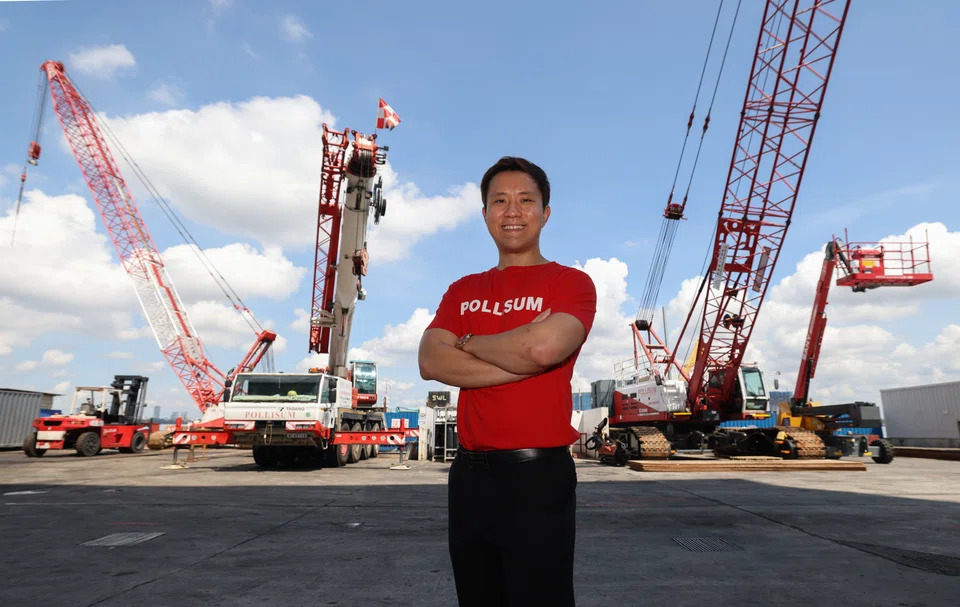
POLLISUM Group has two major targets for 2027. It plans to expand overseas and reach S$100 million in annual revenue.
But second-generation chief executive Chris Ang is looking further ahead. Over the next five to 10 years, he wants to turn the family business into an international brand, capable of taking on increasingly complex projects and thriving long after he has stepped aside.
Getting there will take more than a bigger fleet and new markets. It will also require stronger management, better systems and careful investment decisions.
Pollisum, which placed third in this year’s Enterprise 50 Awards, expects revenue to reach S$92 million in FY2026, up from S$75.2 million in FY2025. It is targeting S$100 million in FY2027.
For Ang, who succeeded his father as CEO in January 2025, the challenge is to pursue growth without overstretching the business.
“I tend to pursue growth more aggressively, but I want that growth to be supported by sound numbers and calculated risks,” he said.

Putting overseas plans into action
Pollisum has begun committing capital to its international ambitions.
The group established an overseas subsidiary this year and has spent S$5 million on its expansion plans, with a capital expenditure target of S$10 million. One crane is scheduled for delivery in the first quarter of 2027, with another nine planned for the year, bringing the total target to 10 units.
It is also expanding its existing operations in Malaysia. Its Malaysian subsidiary, established in 2016, currently operates 17 prime movers and heavy transport vehicles. Pollisum plans to increase the fleet to between 22 and 25 units in 2027.

“We plan to begin our overseas expansion next year, building on the foundation we have established in Singapore. To sustain this growth, we will need to develop our capabilities, strengthen our systems and build a leadership team that can manage the business across markets,” Ang said.
Back in Singapore, he has been making changes to how Pollisum is run. The group has appointed a chief financial officer and a general manager, strengthening the management team as the business grows more complex.
It is also rolling out an operations management system to improve coordination and oversight. The company has traditionally relied on an Excel-based job board and an enterprise resource planning system.
For Ang, these changes are part of preparing Pollisum to operate on a larger scale, rather than simply adding equipment and taking on more work.
Knowing when to pull back
Ang joined Pollisum in 2016 after working at PwC. His first assignment was to help turn around his father’s struggling transport business in Malaysia, which he brought back to break even.
His approach differs from that of his father, Ang Ka San, who started Pollisum with his wife in 1984 as a small crane repair business.
“My father draws heavily on his instincts and years of industry experience when making decisions,” Ang said. “I take a more analytical approach, examining profitability, costs and potential risks before committing.”
That thinking has sometimes led Ang to make difficult decisions.
One was to close Pollisum Logistics, even though the business was profitable. He felt the returns did not justify the resources and management attention it required. Rather than continue running it, he transferred its fleet to Pollisum Engineering, making better use of existing equipment while deferring further capital expenditure.
More than an IPO
Ang is open to further acquisitions and strategic investors if they can help Pollisum develop new capabilities or enter new markets. The group acquired Gim Sen in 2025, and he has not ruled out more deals. Nor has he ruled out an eventual stockmarket listing. But he is clear that an IPO should serve the business, rather than become a goal in itself.
“An IPO is something we could consider in the longer term, but we don’t see listing as an end in itself,” he said.
What matters more is building a company with the management and operational strength to keep growing, regardless of whether it eventually goes public.
That’s also shaping how Ang approaches his role as a second-generation leader. Taking over from his father did not automatically win him the confidence of employees who had spent years working with the founder.
“Being part of the family gave me the opportunity to lead, but their trust was something I had to earn,” he said, adding that he spent evenings and weekends working alongside employees to understand the business and build those relationships.
Looking beyond the numbers
For all the attention on next year’s milestones, Ang’s longer-term ambitions are not measured solely in revenue or the number of markets Pollisum enters.
He wants the company to become an international brand known for reliable equipment, capable employees and good service. He also wants its expansion to open up opportunities for employees to gain experience, develop new skills and advance their careers.
For Ang, international expansion is also an opportunity to develop Pollisum’s next generation of leaders. As the group enters new markets, he wants employees to take on greater responsibilities and gain the experience needed to manage a business operating across borders. Building that leadership pipeline is central to his ambition of creating a company that can thrive beyond his own tenure.
“Growth is meaningful when it helps our people progress in their careers and improve their families’ livelihoods,” he said.
It’s a responsibility he learnt from his father.
Ang recalls a time when his father told him that Pollisum had more than 800 people to look after. He was puzzled. The company had only 400 employees at the time.
His father explained that he was counting their spouses and children too. Every employee had their families depending on the business for their livelihood.
Today, Pollisum employs 415 people. As Ang prepares to take the business into new markets, he wants to preserve that sense of responsibility.
“As a second-generation leader, I see my role as building on what my parents started and preparing the company to thrive beyond my own leadership,” he said.
The S$100 million revenue target and overseas expansion may mark an important year for Pollisum. But Ang has a longer measure of success in mind.
“If Pollisum continues to thrive and look after its people long after I have stepped aside, I would consider that a success.”
Decoding Asia newsletter: your guide to navigating Asia in a new global order. Sign up here to get Decoding Asia newsletter. Delivered to your inbox. Free.
Share with us your feedback on BT's products and services
TRENDING NOW

Grab eyes financial services arm as next growth engine, targets US$500 million in segment Ebitda by 2028

As Indonesia picks new vice-president to succeed Gibran, investors see risks and opportunities

Singapore telco recovery at least 2 years away despite StarHub-M1 merger, say analysts

Prive liquidators meet with creditors a year after restaurant group’s shutdown

