

Riding the wind without building the turbines: How Cyan Renewables built a US$400m offshore giant in four years
By focusing on specialised marine logistics and strategic acquisitions rather than turbine manufacturing, the Singapore-based company has become Asia-Pacific’s largest offshore wind support provider.
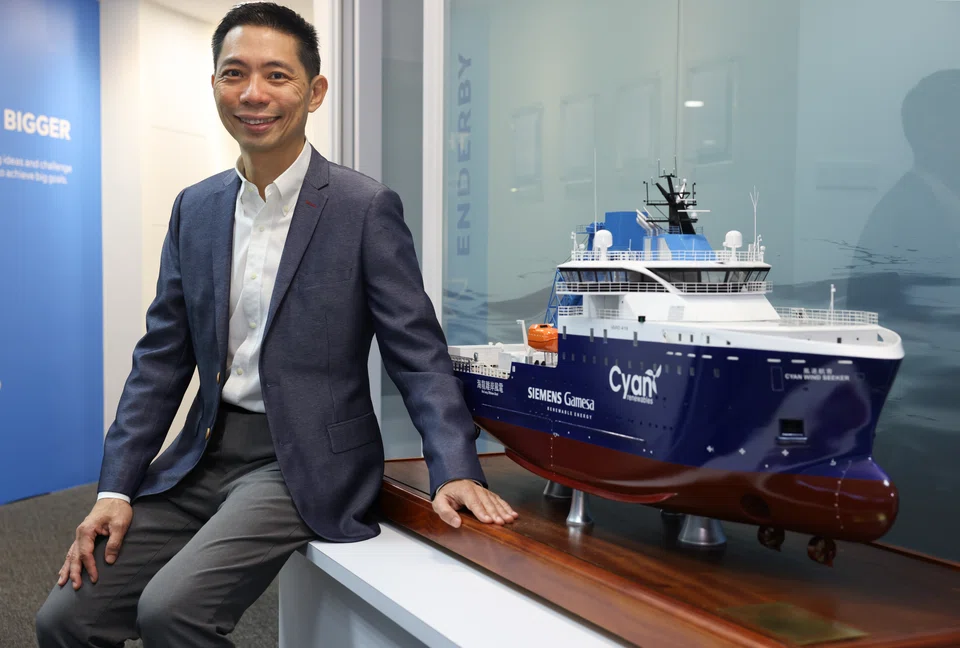
AS SINGAPORE is an island shifting more to green energy sources, you would expect to see wind turbines in its surrounding sea. There are none in sight.
If there were any, you couldn’t have missed them. Much larger than the land models, offshore turbines are towering structures, each fitted with blades longer than 100 metres and standing three times as tall – 1.5 times as high as Marina Bay Sands.
Maybe wind farming at sea is still in its infancy in Asia and will soon catch on here. But Lee Keng Lin, a leading veteran in the maritime and offshore industry and CEO of Cyan Renewables, doesn’t see it happening. There is simply no room in Singapore’s busy waters for offshore wind farms, which house as many as 300 wind turbines each.
In the wider world, however, a big future awaits the business. The green movement is picking up speed and wind can be a major clean source of energy.
Already a tenth of global power consumption comes from offshore wind. The number is tipped to jump to up to a quarter in 2050. By the end of this decade, the business will be worth about US$126 billion. Key growth markets include the US, Europe, South Korea, Vietnam and Australia.
A single offshore wind turbine has a capacity of up to 16 megawatts of renewable power – enough to meet the annual electricity needs of more than 13,000 households in Singapore.

Certainly, there’s lucrative business to be done in offshore wind farming. And thanks to the country’s long experience in building ships and oil rigs, Singapore companies are capable of winning a chunk of it.
Building and installing giant turbines in rough terrains like the ocean is, however, too risky and expensive a venture for Lee’s Singapore-based company to have gone into. It had instead made a beeline for the vast logistics involved in the business.
It’s safer to play the backup serviceman than to be the main player in offshore wind farming, according to Lee, who had spent 10 years tracking the industry before starting Cyan Renewables.
“You don’t take as much risk. If you provide the support (services), you are on day rate.”
And there’s plenty his company could do as a service provider, because the logistic support needed in offshore wind farming is vast and service providers are scarce, he added.
Cyan Renewables surveys seabeds and helps to identify ideal spots for wind turbines. It helps to get the turbines up and maintain them to ensure they run smoothly.
Among other things, this means providing the vessels to house technicians during the installation, laying cables and making sure they remain stable underwater.
Cracking Europe to win Asia
Cyan Renewables was officially registered in 2022, just after Covid. The timing was great. Offshore wind farming was then taking off in a bigger way in Europe and picking up in Asia.
The sunny outlook and shortage of service providers in the industry made it relatively easy for the new startup to secure the financial backing of private equity firms like Seraya Partners, and to persuade the main players to accept it.
Still, Lee had to slog to get the business going in the early years. Together with another colleague – they were the only staff in the startup then – he was on the road often, travelling extensively in Europe and Asia to sell its services.
“It wasn’t uncommon for us to fly to 13 cities in 12 days in those days,” he recalled.
Things really got moving after Cyan Renewables opened an office in the UK, giving it a presence in Europe.
This was where offshore wind farming started and Europe was also home to its key decision-makers, developers and manufacturers.
They would get to know Cyan Renewables, which would be helpful when the European main players expand into Asia.
“Our name would then ring a bell when we bid for jobs with them,” Lee reasoned.
Cyan Renewables won its first major job in 2024 – a 15-year contract to build Siemens Gamesa’s first service operations in Asia, helping to support offshore wind turbines in Taiwan. Others soon followed.
Four years after it started, Cyan Renewables has carved a niche as the biggest provider of support services to offshore wind farming in the Asia-Pacific region.
The company, which placed fourth in this year’s Enterprise 50 Awards and also bagged the Internationalisation Award, has a workforce of 1,800 and a sizable fleet of multipurpose and specialised vessels fully deployed in jobs in Europe and the Asia-Pacific region. Every year they bring in revenues close to a total of US$400 million.
“We’re now in a strong position,” Lee noted. “In the industry, we’re a known name.”
Recalling Cyan Renewables’ journey, he said: “Once we got the (business) concept, the vessels and a track record, the next thing was to scale up – and the fastest way was by acquisitions.”
Cyan Renewables targeted companies “with a certain unique selling proposition, companies with a certain kind of moat that’s hard to replicate”.
In early 2024, it snapped up Sentinel Marine, a leading maritime environmental response vessel operator in the UK. The acquisition gave it a quick entry into the world’s second-biggest offshore wind market and a new expertise in marine life and biodiversity protection.
Six months later, Cyan Renewables paid US$702 million for MMA Offshore, an Australian offshore marine services provider.
It was the region’s biggest take-private deal in offshore wind energy services.
Lee said the purchase “solidifies our leadership in the offshore wind industry and energy transition”. It also broadened the company’s maritime know-how and markets in the region.
Beyond offshore wind
The company’s clients are not confined to offshore wind farming. Its versatility has led Cyan Renewables to cross-deploy its backup services in, as its website lists, “transitional energy support”, “government and defence” and “coasts, ports and reefs”.
In the UK and Australia, the company works with the governments on coastal surveillance and sub-sea projects.
It also supports the liquefied natural gas sector in Australia. Elsewhere, it helps to clean up the ocean after the decommissioning of offshore energy projects.
“We don’t see Cyan Renewables as a company supporting (only) offshore wind farming, or the LNG industry, or governments,” Lee stressed, “We see ourselves as a maritime infrastructure platform which is able, in each of the industries we work in, to deepen relationships and cross-deploy our assets. No other company does this in the world today.”
Decoding Asia newsletter: your guide to navigating Asia in a new global order. Sign up here to get Decoding Asia newsletter. Delivered to your inbox. Free.
Share with us your feedback on BT's products and services
TRENDING NOW

Grab eyes financial services arm as next growth engine, targets US$500 million in segment Ebitda by 2028

As Indonesia picks new vice-president to succeed Gibran, investors see risks and opportunities

Singapore telco recovery at least 2 years away despite StarHub-M1 merger, say analysts

Prive liquidators meet with creditors a year after restaurant group’s shutdown

