

Future-proofing the business by going green

WHO says change doesn’t come from the top? At Maha Chemicals (Asia), it does. Its executive chairperson, Tan Seow Hoon, leads the way by driving an electric car and teeing off with second-hand golf balls.
At work, she made the change a decade ago, when she put the chemical-distribution business on the path towards more environment-friendly products. But she believes that “what one person can do is not as powerful as what a business can do”.
“Our core mission is to enrich lives with chemistry... and in recent years, it has become more imperative that we make this chemistry sustainable,” she told The Business Times (BT).
Maha Chem, which is working to grow the share of green and sustainable products in its sales, is one of the two winners of the inaugural Enterprise 50 Sustainability Innovation Award.
Buildo Engineering, a supplier of building solutions such as wall panels, flooring, insulation and waterproofing, shares the prize in this year’s awards, which celebrate local, privately-held firms that put in special efforts towards sustainability.
Its managing director, Mike Wong, who previously worked in information technology, said he tries to “bring new style, new value, and especially, sustainability” to construction.
'%3e%3cpath%20d='M12.1475%2025.5262C13.7713%2025.4295%2014.94%2023.913%2014.94%2021.8832C14.94%2019.5359%2013.474%2018.093%2011.5917%2018.093C11.3745%2018.093%2010.9582%2018.093%2010.8393%2018.1413V25.2086L11.8891%2025.5745C11.8891%2025.5745%2012.207%2025.5262%2012.1475%2025.5262ZM11.4934%2017.6281C13.2567%2017.6281%2014.3843%2016.4292%2014.3843%2014.4501C14.3843%2012.372%2013.275%2011.2973%2011.4339%2011.2973H10.8393V17.6305H11.4934V17.6281ZM6.66078%2025.6482L7.39265%2025.5492C8.02617%2025.4502%208.26403%2025.3053%208.26403%2025.1097V11.6149C8.26403%2011.4193%208.1451%2011.3709%207.23484%2011.249L6.68137%2011.173L6.6219%2010.7588H11.9508C15.7153%2010.7588%2017.0624%2012.0797%2017.0624%2014.1578C17.0624%2015.9666%2015.7748%2017.1909%2013.4969%2017.6305V17.7041C16.111%2017.948%2017.6571%2019.5382%2017.6571%2021.7636C17.6571%2024.3318%2015.8937%2026.0417%2012.1109%2026.0417H6.60132L6.66078%2025.6482Z'%20fill='%232B2B2B'/%3e%3cpath%20d='M20.6287%2025.6505L21.5596%2025.5515C22.1725%2025.4779%2022.4104%2025.3076%2022.4104%2025.112V11.249H21.9346C20.073%2011.3479%2018.982%2013.0095%2018.408%2014.6227L18.1907%2015.5018H17.6555L18.1701%2010.7588H29.3837L29.6421%2015.4787H29.1664L28.9491%2014.6227C28.3728%2012.8645%2027.3047%2011.2743%2025.5002%2011.249H24.9856V25.1856C24.9856%2025.3812%2025.1251%2025.4548%2025.9965%2025.5515L26.7695%2025.6505L26.829%2026.0417H20.5693L20.6287%2025.6505Z'%20fill='%232B2B2B'/%3e%3c/g%3e%3cdefs%3e%3cclipPath%20id='clip0_5242_21648'%3e%3crect%20width='24'%20height='16.8'%20fill='white'%20transform='translate(6%2010)'/%3e%3c/clipPath%3e%3c/defs%3e%3c/svg%3e)
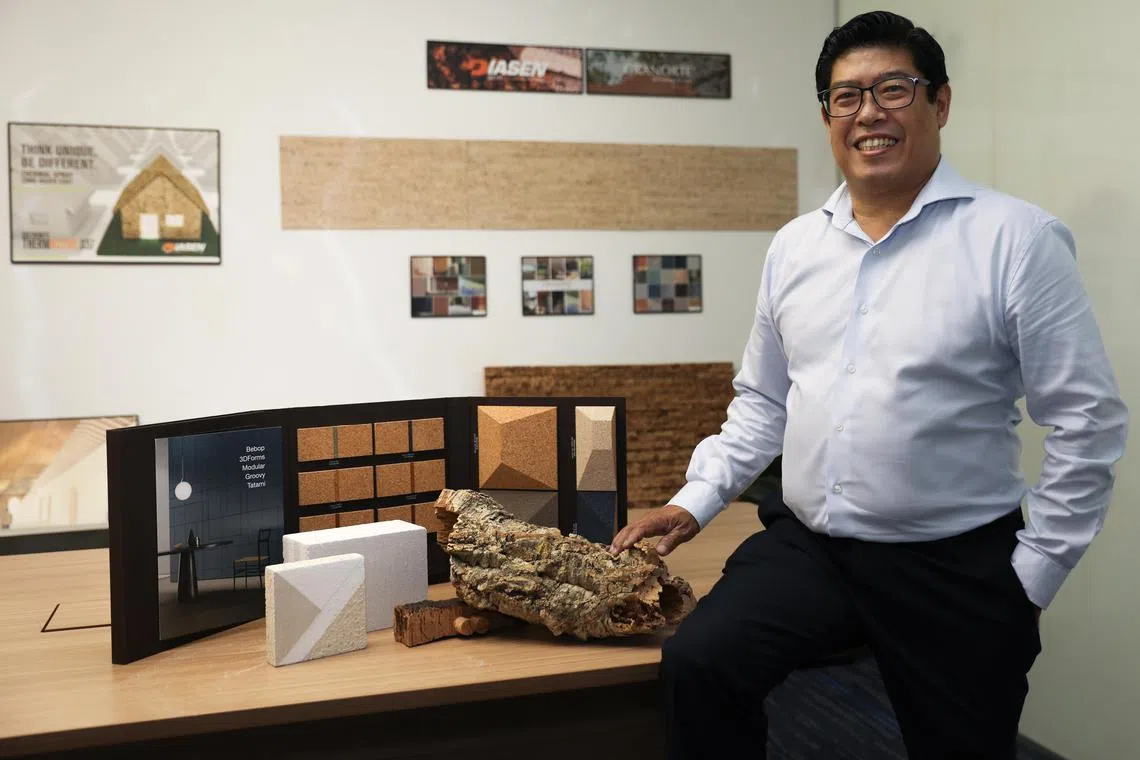
As a newcomer to the industry, he knew that his company would have to find a niche, which is why “we want to bring in new stuff that can support sustainability”.
He added that sustainability is not about short-term profits but long-term business, which could take as long as 10 years to bear fruit.
Still, Maha Chem and Buildo have noticed a growing market for greener products in their respective industries, which are known to be resource-intensive and pollutive.



In 2021, Maha Chem began categorising its chemicals as “conventional”, “less toxic”, or “made from bio-based or recycled materials”. It aims for green and sustainable products to contribute to 80 per cent of revenue by 2025, up from 55 per cent last year.
Its managing director, Chew Chin Seong, said the expected change in revenue share since 2021, when greener products made up 51 per cent of revenue, is not because sales of conventional products have dipped, but because growth in the green and sustainable products segment has been “a lot faster” than overall sales growth.
“In the last three years, our business-to-business customers have been asking for these products. The growth is definitely driven by consumer demand, so that’s why we can see the percentage in our green and sustainable product line increasing,” he said.
Separately, Buildo started off a decade ago by offering aerated, lightweight concrete as an alternative to conventional wall panels, which have hollow cores. Its alternative concrete system has a lower density and a lower carbon footprint.
Just before the Covid-19 pandemic, the company turned to cork-based products for thermal and acoustic insulation; it is also eyeing cork-based home furnishings, such as wall and floor tiles. Cork products now make up about 5 per cent of its sales, and Wong targets growth to between 10 per cent and 15 per cent in the next two years.
Cost considerations
Yet, like many small and medium-sized enterprises (SMEs), Maha Chem and Buildo must consider the question of how to price their greener products in a cost-sensitive market.
Maha Chem’s Chew pointed out that SMEs typically face resource constraints, and the exercise of going green does not bring results overnight. “It can be five, 10 years; so you need to be very patient,” he said.
But the company has noticed the price difference between conventional and greener products narrowing. The latter used to cost 20 per cent to 30 per cent more, but now, the gap is between 15 per cent and 20 per cent.
For Maha Chem, the challenge is compounded by its operational focus on the Asean market, where customers from Indonesia and Vietnam account for more than half its sales.
Regional currency weakness have led to foreign exchange transaction losses that have been eating into the company’s earnings. Full-year net profit fell to roughly US$841,000 in 2022, down from US$3.21 million the year before; revenue dipped by 2.2 per cent year on year to about US$55 million.
Buildo’s Wong said that when the company started out with its lightweight concrete product, it did a lot of research to understand the material and to come up with ways to sell it, with its price pegged 30 per cent higher. The newer range of cork products also comes with a heftier price tag.
The company’s full-year net profit more than doubled to S$1.95 million in 2022, from about S$729,400 in the year prior; its revenue rose to about S$15 million, up from some S$9.1 million previously.
Wong put this growth down to a post-pandemic rebound in the construction sector, as well as to sales of older products. He noted, that the cork segment is not yet profitable, but hopes that its margins will be higher, thanks to the novelty value of the products.
The company is now eyeing expansion into Malaysia. Despite the more cost-sensitive market there, Wong thinks “the return on investment is much, much bigger than in Singapore”, as higher sales volumes can cover the difference in profit margins. Wong said: “Our challenge is always cash flow, because we want to grow, and there are so many things we want to do – and we’re not relying on investors yet – so we can do it only one step at a time.”
Indeed, Maha Chem and Buildo, though engaged in the business of distribution, also work on studying new formulas and use cases.
Regarding the value-added services that Maha Chem offers to customers, Tan said: “We start with recommending formulations, provide the ingredients, and do application laboratory tests.
“We are not just solving pain points. We also want to share what we know where we can, and source ingredients that are better for (business clients) and for the end-customers.”
Maha Chem traces its history back to 1975, when it started out as part of a family-owned paint business. The company’s surface-technology business unit, which handles paints and coats, still contributes to half its sales.
Chew named the shift from solvent-based paints to more environmentally friendly ones as a successful substitution facilitated by Maha Chem – a process that entailed conducting customer tests over six to nine months.
He said: “For many years, there was no ‘green’ product that was a substitute for solvent-based performance, but the technology has evolved.”
Moving upstream
While always on the lookout for new suppliers of sustainable products, Maha Chem is also hoping to move upstream and develop its own product lines soon.
This is an ambition that Buildo shares. It has been carrying out trials on cork as a flooring material for outdoor playgrounds in Singapore, to replace conventional rubber-based products – and has even roped in polytechnic interns to conduct these tests.
“We want to offer (this product) to one of the community centres… We have a lot more work to do. But we keep trying to explore new things, to use this green sustainable material,” said Wong. “A lot of people have loved the idea so far.”
Both companies tell BT that outreach to customers and partners is key to sustainability.
“To be frank, everybody... is now more open to using (materials) more sustainably, but the ones who need to lead the change are the developers and architects,” said Wong. He added that suppliers must also be ready to bring in the materials needed.
The executives stressed that the shift to sustainability in business is a long-term process – both for their own enterprises and the industry at large.
Maha Chem’s Tan said that other Asean countries are not as developed as Singapore, and the regional market is not moving “at the speed that we want”, on the back of both the cost factor and a lack of regulatory pressure to drive industry change.
Still, she told The Business Times: “On the practical side, sustainable chemistry is aimed at future-proofing the careers of everybody at Maha... If we still sell what we used to sell, we are not making sure that we have a credible, solid future business, and career growth for our people.”
Decoding Asia newsletter: your guide to navigating Asia in a new global order. Sign up here to get Decoding Asia newsletter. Delivered to your inbox. Free.
Share with us your feedback on BT's products and services
TRENDING NOW
Prima to move out of historic Keppel Road flour mill building in 2028
Temasek-related Azalea, SeaTown, Seviora Capital to merge in 2027

Family offices see more tailored products, leverage ‘collective firepower’ for direct deal access

Singapore room rates soar, but hotels seeing mixed demand from F1 race and events

