

Food Empire perks up for instant (coffee) success
Tan Wang Cheow, founder of the instant food and beverage manufacturer, spills the tea on emerging stronger from crises.

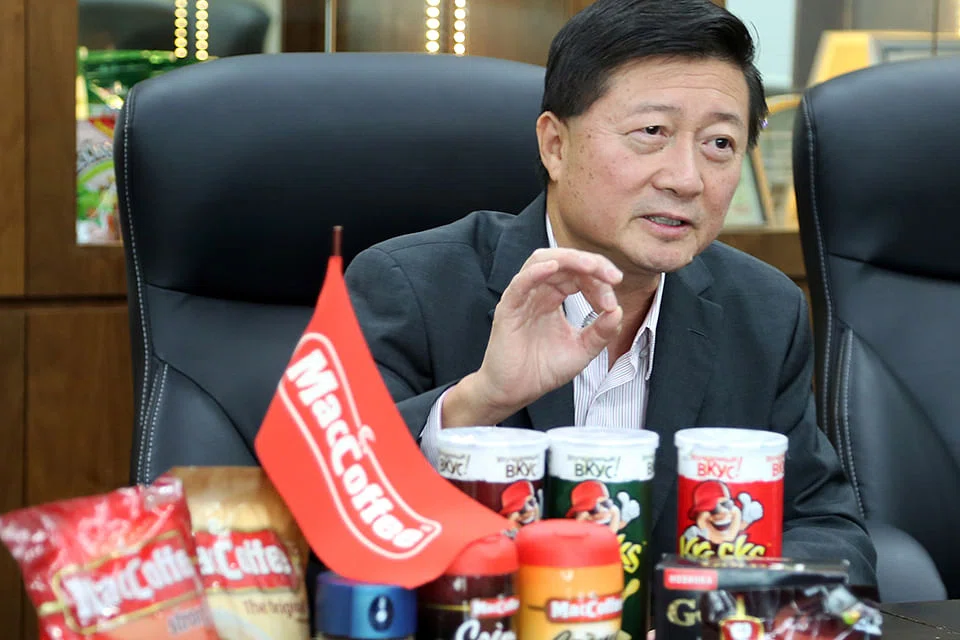
FOOD Empire's proprietary 3-in-1 instant coffee brand, MacCoffee, could possibly be the most famous Singapore brand that Singaporeans have never heard of.
But, as the group's founder and executive chairman Tan Wang Cheow describes it, MacCoffee is a household name in Russia, where it is regarded "in the same league as Coca-Cola". "If you ask any Russian students who come to Singapore, I can bet you that 90 per cent of them will tell you they know the brand," Tan says. "We are considered a famous brand in the country."
Food Empire scoops The Enterprise Award this year for its pioneering spirit in establishing itself in emerging markets and successfully building its MacCoffee 3-in-1 instant mix brand into a household name in Eastern European markets like Russia, Ukraine, Commonwealth Independent States and Central Asian countries like Kazakhstan. At the same time, it has built on this success to diversify into new markets such as Vietnam.
The MacCoffee name harks back to the 1980s, when Tan was trading and distributing personal computers and IT peripherals, including Apple's Macintosh, into eastern Europe and the Soviet Union.
On his travels, Tan brought along a few sachets of instant coffee to share with his business partners. The instant hot beverage turned out to be a hit with these associates, who live in cold climates for most part of the year. Tan's friends requested that he brought more of these on his next trip. Sachets turned into carton boxes, and eventually, into shipping containers.
Before long, Tan figured out that trading in instant food and beverage (F&B) was more profitable than selling computer parts - and Food Empire was born. "After a while, we realised that there was some acceptance (of instant coffee), though the acceptance level was still low because Russia at the time was more of a tea drinking country and coffee was something of a luxury," Tan says.
In 1994, Tan started MacCoffee, his own brand of 3-in-1 coffee. Soon, he expanded the range to include other instant beverages such as chocolate and tea.
Today, helmed by Tan and group CEO and executive director Sudeep Nair, Food Empire operates out of 23 offices worldwide and 8 manufacturing plants. The group now manufactures and markets over 200 instant beverage and food products, including flavoured fruit teas, instant cereal mix, frozen convenience foods and snack products such as potato crisps. These products are sold in more than 50 countries, including Russia, Vietnam, Ukraine and central Asia.
"It took us a long time to build up the numbers to where we are today. And thankfully, most of the people who have been working alongside us have been quite passionate and perseverant," Tan says. "There were many problems on the ground, but we overcame them one by one."
The Covid-19 pandemic was a particularly challenging period for Food Empire, as it grappled with different coronavirus-related restrictions across the countries it operated in.
In its largest market Russia, for example, a mandatory stay-at-home order meant residents were largely forbidden to leave their homes, with exceptions made for buying groceries and medicines and disposing of litter. Residents were also allowed to walk their pets only within 100 metres from home.
"They only allowed some grocery stores to open. (Other) supermarkets were closed, and we couldn't even deliver to them as they couldn't sell at all," Tan says.
The measures varied from country to country, and also across different regions.
"But we had almost 2 months of closing in many markets all around the world during the period," he recounts.
Severe disruption from the lockdowns saw the group's sales shrink in the Russia, Ukraine and South Asia markets, as revenue slipped 5.4 per cent year on year to US$273 million for the fiscal year 2020 ended December 2020.
A devaluation of the Russian rouble, Ukrainian hryvnia and Kazakhstani tenge against the US dollar, as well as the closure of the group's Myanmar operations at the end of 2019, also contributed to the lower revenue.
Despite the challenges, Food Empire's cost-cutting measures during the period paid off, and lifted the group to a record net profit of US$26.8 million for the full year, up 2.6 per cent from the year-ago period.
Selling and marketing expenses decreased by US$5.5 million to US$36.0 million, while general and administrative expenses were reduced by US$5.1 million to US$34.8 million. The lower expenses were mainly attributed to lower advertising and promotion expenses, manpower costs, and travelling and office related expenses.
"We could not do a lot of offline activities, so a lot of expenses were also cut off," Tan says. "Usually, our guys would be travelling left and right, up and down, everywhere. But because we couldn't travel, a lot of these expenses and other related expenses were totally cut down."
In a way, this has forced the group to expedite the digital transformation of its businesses.
In FY2020, it increased collaboration with stakeholders virtually across different electronic platforms. The group also shifted more marketing engagements and promotions online through the use of social media advertising and live-streaming, and also sought to increase its e-commerce presence.
However, Food Empire is not yet out of the woods.
As economies start to reopen, Tan says pent-up demand and restocking activities have led to an increase in the cost of raw materials. In addition, shipping costs have also soared.
For the first half of FY2021, the group has seen sales improve across all its core markets. Revenue jumped 12.5 per cent to US$149.6 million for the six months ended June 2021, compared with the corresponding period a year ago.
Higher commodity prices, record high ocean freight rates, and supply chain delays as a result of a shortage in shipping container slots, however, have eaten into the group's profit margins.
Yet, the group remains "cautiously optimistic" that the business will continue to be resilient in FY2021, and says it will work towards balancing revenue growth and profitability in view of the cost pressures and protracted recovery from the Covid-19 situation.
FIGHT FOR SUCCESS
While Tan describes the Covid pandemic as a Black Swan event that has wreaked havoc on global markets, he is confident that his team will overcome the challenges.
In fact, Tan says, this pandemic is not even the greatest test that the firm has faced to date. "We have overcome many major crises," he says. "We are operating in emerging markets, and are always subject to a lot of geopolitical (risks, such as) sanctions and currency situations."
Tan recounts that one of the worst episodes in the group's history was when the rouble collapsed during the Russian financial crisis of 1998.
"It was quite a big thing, especially for the consumers, as any imported goods at that time would be considered 5 times more expensive. So for 3 months, we had to freeze all deliveries," Tan says.
Just 10 years later, Food Empire would again face a huge challenge when global financial services firm Lehman Brothers collapsed in 2008 in what was the climax of the subprime mortgage crisis.
"One foreign bank just pulled out and said 'I want to take back my loan'. US$10 million, they want to take within 2 weeks," Tan recalls. "You're having a crisis, and somebody just pulled the rug from under your feet."
With hundreds of shipping containers of raw materials en route, the group was left stranded. It eventually managed to survive, but after the tumultuous period, Tan decided that things had to change to avoid a repeat of the situation.
"After the crisis, I decided that we would do a backward integration to produce our own ingredients," he says. "We don't want to be at the mercy of these guys whenever there's a crisis. They start jacking up the price and cutting down on deliveries, that will cause us a lot of problems and we cannot adjust according to the market situation."
In addition to consumer retail products, the group now also manufactures raw ingredients like instant coffee and non-dairy creamer.
In 2013, Food Empire expanded into the ingredient manufacturing space with its first non-dairy creamer plant in Malaysia. A year later, it commissioned its first spray dry instant coffee plant in India, followed by a freeze dry instant coffee plant in 2021.
The group is also in the process of building a second non-dairy creamer plant, which is expected to be completed by 2023.
To help reduce its geographical concentration risks, Food Empire also decided post-crisis to push its diversification into other regions such as South-east Asia and the Middle East.
Driven by the popular Cafe Pho brand, Vietnam is now the group's second-largest market behind Russia, and accounts for nearly 20 per cent of total group revenue. Food Empire is also one of the top three players in Vietnam's instant coffee mix industry, with 80 per cent market share in the instant iced coffee segment.
"I think the greatest success is that we've been able to, over the years, groom many people to be quite independent, matured and quite resilient in the marketplace to be able to operate by themselves independently," Tan says.
This strength, he adds, is particularly evident in this period, as businesses are disrupted by the pandemic. "Despite the fact that there is a pandemic and people cannot travel ... the factories are producing, the markets are operating, sales are still going on," Tan says. "Everything is still in order."
Decoding Asia newsletter: your guide to navigating Asia in a new global order. Sign up here to get Decoding Asia newsletter. Delivered to your inbox. Free.
Copyright SPH Media. All rights reserved.
TRENDING NOW

LTA proposes combining car COE categories, adding rebate-surcharge system
StarHub to acquire MyRepublic’s mobile business amid ongoing telco consolidation

DBS, OCBC, UOB rout lops billions off STI as inflation, rate concerns spook investors

Grab CEO’s wife Chloe Tong on life with Anthony Tan and finding her purpose

