

Eric Leong’s steel ambitions take Mlion beyond Singapore
From BMX parts to steel piles, he built a regional business by going where others would not

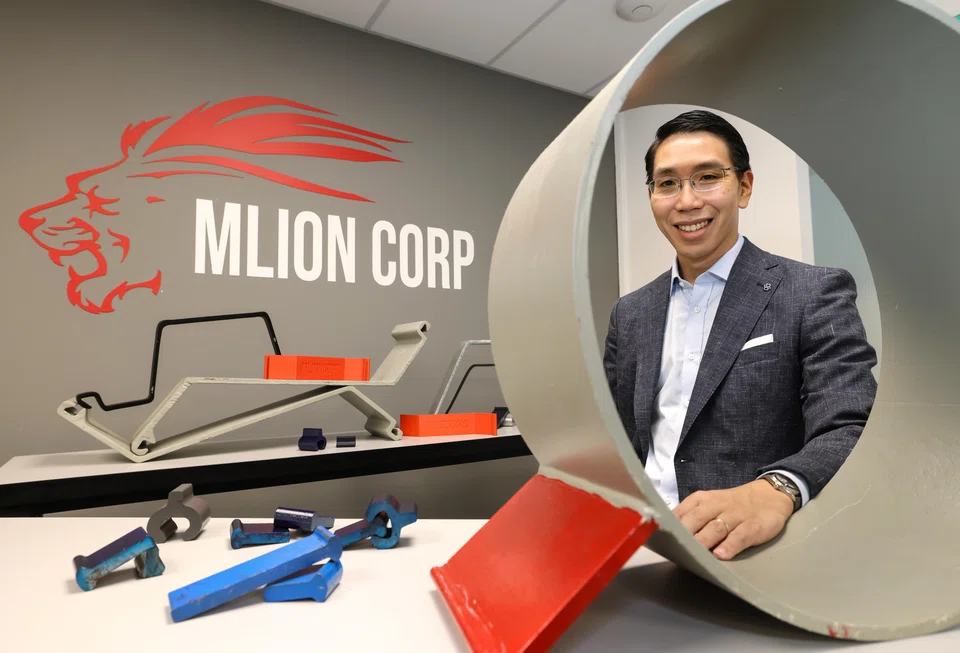
[SINGAPORE] Eric Leong’s first foray into business was during his first year in university, when he asked his father for S$20,000 to start a business importing BMX bicycles and parts. The latter, wary of entrepreneurship after seeing his own dad go bankrupt, agreed – but only after asking him to write a business plan.
There was another condition. “My father said he calculated that my allowance from year one to year four in university would amount to close to S$20,000,” Leong recalled.
“So he told me he’ll give me that cash upfront, but don’t ever go back to him for my allowance anymore. If my business fails, it’ll be my problem and I would have to go and work to feed myself.”
The venture became a crash course in entrepreneurship. Leong’s first shipment filled his family home from floor to ceiling, forcing him to think quickly about warehousing, inventory and cash flow.
Manufacturers were already asking for deposits for the next season before he had sold enough of the first.
“I had to quickly sell (and) move the cash,” he said. “That business of BMX taught me a lot about cash flow, how fast I had to move my inventory, how to manage.”
More than two decades later, that early instinct remains visible in the way Leong runs Mlion, the Singapore-headquartered foundation steel solutions company he co-founded in 2011.
At 41, the chairman and CEO has been named Young Business Leader of the Year at the Singapore Business Awards, in recognition for turning what many saw as a player in an unglamorous, mature sector into a regional business with global ambitions.
Built from scratch
Mlion focuses on foundation steel for waterfront and underground construction: ports, bridges, tunnels, reclamation works, excavation support and major infrastructure projects.

It is not the kind of industry that attracts young founders, and Leong is also used to the assumption that he inherited the company. “A lot of people thought it was a family business, because not many expected a 26-year-old would want to go into something like steel... it’s not the most sexy of businesses.”
But he saw something different. After two years of working in sales at a steel company, the mechanical engineering graduate felt the industry was too transactional.
Many players behaved like stockists – holding thousands of line items and competing largely on price.
Leong wanted Mlion to be more focused, technical and consultative. “We came from a very different approach by being customised to what the customer wants. We didn’t want to come from a commodity angle and just fight on price alone. We wanted to come as a solution.”
That decision shaped the company as Mlion found its niche in waterfront and underground projects, instead of simply chasing every construction segment. It built engineering capabilities, worked with factories to develop differentiated products, and advised contractors even years before some projects began.
The approach helped Mlion win credibility on complex infrastructure work, including around Marina Bay and on Singapore’s rail projects.
Leong pointed to projects such as Jubilee Bridge, the upcoming NS Square and tunnelling work for MRT lines as examples of where Mlion has had to provide more than just supply.
“When people came to us, they didn’t come to us with the easy projects,” he said. “They came to us when there were difficult projects that they could not solve.”
Beyond Singapore and supplying steel
From the start, Leong knew Singapore alone would not be enough. Mlion moved early into the Philippines, where infrastructure demand was rising and competition was less entrenched.
Today, he said only about 20 per cent of the group’s revenue comes from Singapore, with the rest generated internationally.
The company has expanded across the region and, more recently, into the Middle East and Africa.
The global push accelerated after Nippon Steel Trading took a strategic minority stake in Mlion in 2024.
Leong said the value of the partnership was never just capital, because what he wanted was an investor that could open doors and create industry synergies.
Mlion’s newer initiatives also reflect Leong’s desire to change the mechanics of a traditional industry.
GoListid, its marketplace for used steel, was created after the company observed how reusable steel was often scrapped simply because contractors could not find the next buyer.
GoTagID, which uses radio frequency identification (RFID) tags to identify and trace steel materials long after the point of sale, was born from a simple question Leong asked after seeing RFID used in retail: if Decathlon and Uniqlo could tag consumer goods, why not steel?
The idea was not immediately embraced. Steel is muddy, heavy and rough. QR codes would not survive well on site; RFID on steel was considered problematic. Even people in the industry told him not to waste time.
“When people say no, it cannot be done, that is something I will always challenge,” he said. “When my team told me, RFID doesn’t work on steel, I said, no, we have to make it work on steel.”
The system took about two years of iteration before its launch in 2023, but Leong believes it put Mlion several years ahead of the market.
As the construction sector pushes towards greener steel and lower carbon emissions, reuse and traceability are no longer peripheral ideas.
That willingness to move first is balanced by a deep conservatism around trust.
Leong speaks often about reputation and the cost of keeping promises.
One formative episode involved a Hong Kong MTR project where Mlion proposed a technical solution that worked on paper but failed during installation. The company scrapped and remade the pipes, losing about S$250,000.
“We could have walked away,” he said. “But internally, we knew that if we did that, there would be reputational implications in the long run.”
The decision paid off later, when similar tunnelling work came up in Singapore. Asked why the contractor should trust Mlion, Leong had an immediate answer: “Because we have already paid the school fees to learn.”
Another early setback came in the Philippines, where Mlion was scammed on a plastic-pellet supply deal outside its core business.
Containers arrived filled with rocks, but Leong accepted responsibility to his partner because sourcing had been his role and made good on the loss. That partner later became central to Mlion’s growth in the Philippines.
Evolving leadership style
For Leong, these incidents taught him more about leadership than any management theory.
In Mlion’s early days, he even designed the catalogues, worked on the website, handled sales and learnt logistics from the ground up.
“I’m never afraid of getting my hands dirty,” he said. “People don’t realise what it takes to get a successful business off the ground.”
His leadership style has evolved. In the early years, he was more collaborative and uncertain.
With scale, he has become firmer about direction, while still trying to remain open enough to admit mistakes.
“I think being humble to admit to your mistakes is important. There are times that I make mistakes, and I had to go back to the rest of my team and apologise.”
The personal cost has been time. Leong travels heavily, often to the Philippines, Malaysia, the Middle East and Africa. He tries to be home for dinner with his wife and two children before catching red-eye flights.
He calls it not work-life balance, but work-life integration. “I never really have a real holiday. As a CEO, situations change and you have to be ready to make certain calls.”
Still, the excitement has not left him. Fifteen years after starting Mlion, he is often the first in the office, arriving after dropping his children at school.
The same restlessness that made him import BMX parts during his university days still pushes him towards difficult markets, difficult products and difficult problems.
“I always look at things and ask, what can I do better?”
Decoding Asia newsletter: your guide to navigating Asia in a new global order. Sign up here to get Decoding Asia newsletter. Delivered to your inbox. Free.
Copyright SPH Media. All rights reserved.
TRENDING NOW

LTA proposes combining car COE categories, adding rebate-surcharge system

StarHub to acquire MyRepublic’s mobile business amid ongoing telco consolidation

DBS, OCBC, UOB rout lops billions off STI as inflation, rate concerns spook investors

Grab CEO’s wife Chloe Tong on life with Anthony Tan and finding her purpose

